Systematic Intelligence Cloning
An isolated success is merely wasted potential for a corporation; true power lies in the ability to simultaneously clone a single victory into thousands.
In the modern business world, one of the greatest enemies of corporations is making the same mistake repeatedly across different departments and trying to rediscover the exact same solution in complete ignorance of one another. A brilliant innovation might be found, or a chronic quality problem might be eradicated at its root in one corner of a factory. However, if that knowledge remains trapped within that specific department, it generates zero value for the rest of the company. At this very point, a structural knowledge transfer system is required—one that can transform a localized success into a global standard in a matter of seconds.
Corporate Learning and Horizontal Cloning
The true wealth of organizations is not the money in their bank accounts, but the collective mind they manage to integrate into their systems. If a piece of knowledge does not distribute itself to every single cell of the company, that company, as a whole, is not learning.
Universalizing Local Successes
When an engineer on an automotive assembly line discovers a new mechanical angle that speeds up the production process by ten seconds, this should never remain solely that line's success. This new angle must immediately be adopted as the new normal (standard) on all lines producing the same part in all of the company's factories worldwide. The rapid universalization of a local success to the furthest edges of the system is the cornerstone of corporate learning. Through this mechanism, the company multiplies the profit gained from a single improvement hundreds of times over, depending on the scale of its operations.
Shattering Information Silos
In many organizations, departments operate as isolated silos surrounded by invisible, impenetrable walls. The quality department solves an issue but fails to inform the production department; the European branch achieves a massive process saving, yet the Asian branch continues to utilize the old, costly method. In order for the corporate structure to remain competitive, these walls must be shattered with a sledgehammer, allowing knowledge to flow freely in all directions. For effective knowledge dissemination, organizations must dismantle the following barriers:
- Inter-departmental Ego: Eradicating the "we know better than them" attitude completely.
- Bureaucratic Delays: Preventing knowledge from losing its current value while awaiting hierarchical approvals.
- The Urge to Hide Data: Overcoming the desire to keep successes or failures confined solely within one's own team.
The Replicability of Standardization
For knowledge to be successfully transferred from one place to another, it must first be packagable. A discovered solution or an executed improvement must be formulated into a simple, visual, and clear standard operating procedure (SOP) that an engineer in another factory can easily understand and apply to their own machinery. A solution documented with complex mathematical formulas or department-specific jargon can never be horizontally cloned. Proper standardization transforms raw knowledge into a universally deployable "copy-paste" module.
Yokoten Dynamics and Natural Synergy
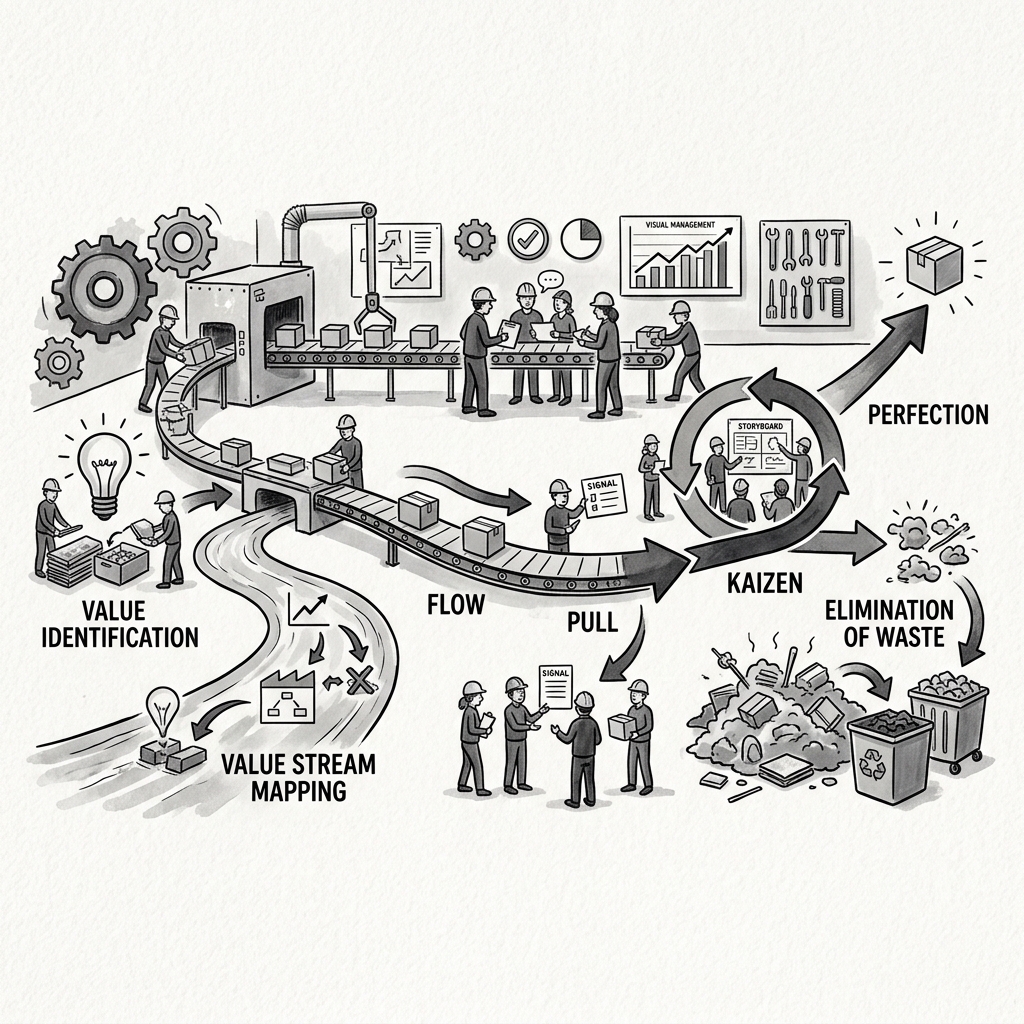
In the Lean Production philosophy, this process of horizontal knowledge cloning and dissemination is known as Yokoten. Yokoten is the lateral transfer of best practices, achieved successes, and even critical lessons learned from past mistakes across all levels of the organization, without waiting for centralized commands.
The Communication Network Through the Forest Metaphor
We can equate the operating logic of Yokoten to the secret communication network established by the roots of trees in a massive forest. When a harmful insect or disease attacks a tree in a forest, that tree does not merely defend itself. Through its roots and the underground fungal networks (mycelium), it releases a chemical signal. This distress signal rapidly propagates to all other trees in the forest. Receiving the news, the other trees raise their shields and begin producing defensive chemicals in their leaves to repel that specific insect long before they are even attacked. The trees (departments) in the forest instantly broadcast the danger experienced and the solution formulated to the entire system in order to survive and grow stronger.
Frictionless Implementation Transfer
Much like this rapid signal propagation in the forest, a Yokoten process implemented within a company must be entirely frictionless. When a solution is formulated, the information must be made directly available to other units without getting bogged down in managerial approval processes that take days. Organizational resistances such as "our processes are different, this solution won't work for us" must be systematically broken down, mandating every unit to deeply consider how they can adapt this newly offered improvement to their own internal dynamics. Success lies not just in sending the knowledge, but in its successful integration into the system by the receiver.
The Architectural Power of Horizontal Communication
Yokoten dismantles the hierarchical chain of command (top-down instructions), establishing a horizontal architecture that allows peer teams to learn directly from one another. In this architecture, the primary duty of leaders is not to forge the solution, but to construct and maintain this underground neural network through which knowledge can seamlessly flow. When every node of the organization is instantly nourished by the experiences of all other nodes, the company achieves unparalleled resilience against any economic or operational shocks from the outside. Just like a massive forest connected by its roots, no single storm can ever topple the system as a whole.