Corporate Athleticism and the Anatomy of Waste
Perfection is a state of silent and frictionless operation, achieved not when there is nothing left to add, but when there is nothing left to remove.
The Lean philosophy is the art of transforming a complex, sluggish organization—whether a factory or a service network—into an agile and razor-sharp entity. At its core lies a single, uncompromising goal: The elimination of every step that does not add value for the customer. This process is identical to a professional athlete preparing for a championship race. The athlete must burn off unnecessary body fat, stabilize erratic running tempos, and avoid overloading muscles to the point of injury. For businesses, these three major threats are defined by the Japanese words Muda, Mura, and Muri. These concepts (the 3Ms) form an analytical framework that allows us to diagnose "corporate enemies" within the system.
Muda: The Fat that Produces No Value (Waste)
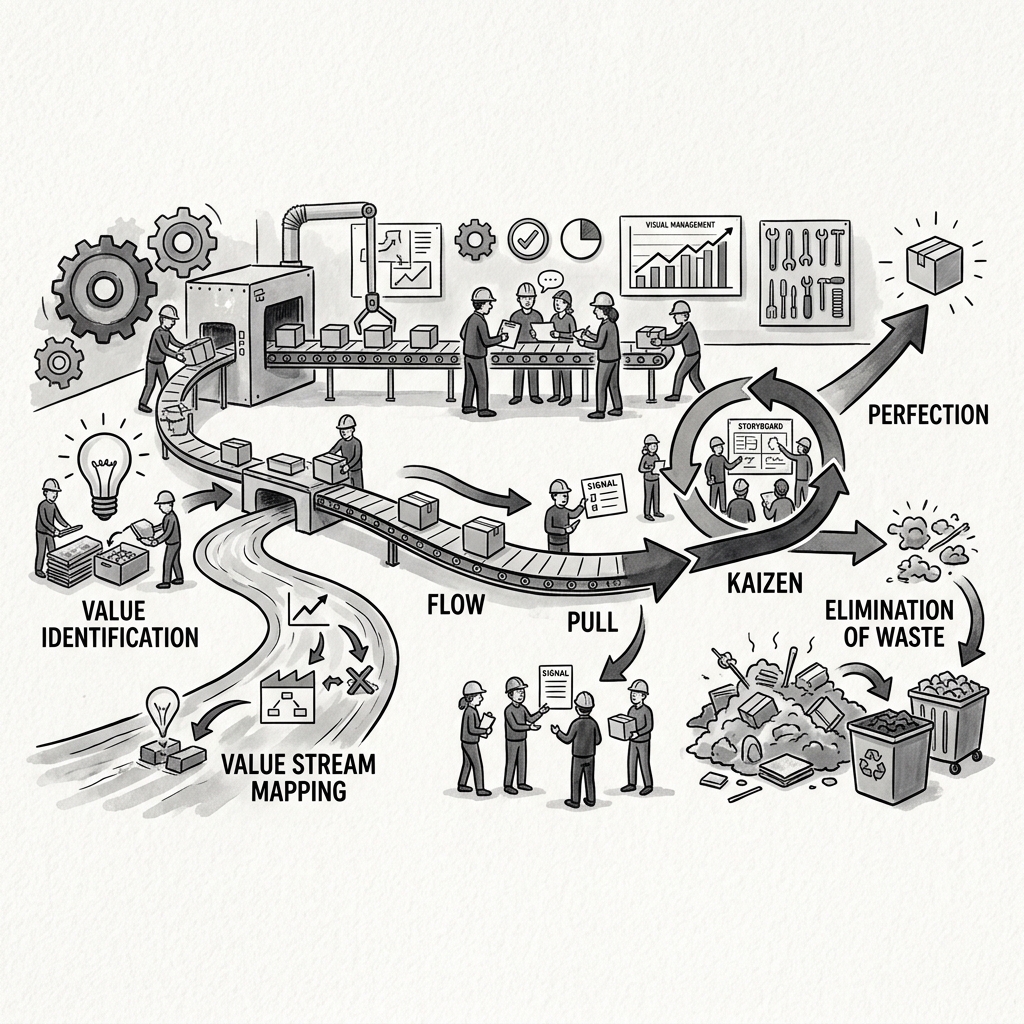
Muda is any activity during an operation that consumes resources (time, money, effort) but for which the customer will not pay. Like the unnecessary fat carried by our athlete, it slows the company down and creates massive costs. Lean philosophy treats Muda as a disease and categorizes it into seven distinct sub-types:- Waiting: Personnel sitting idle because a machine broke down or a managerial approval is delayed. Every second an employee spends without producing is cash leaking from the company's vault.
- Transport: Moving products or documents from one end of the factory to another without a valid reason. Moving an item does not increase its value; it merely increases the risk of damage and transportation costs.
- Inventory: Goods produced in excess of demand and sitting in a warehouse. Inventory is where the company's cash is tied up, buried in concrete, and left to slowly melt away.
- Motion: An employee bending, turning, or walking unnecessarily to find tools in a poorly designed workstation. It is the pure squandering of human energy.
- Overproduction: Producing more than is required or producing it too early. It is the mother of all waste because it inherently creates extra inventory, transport, and waiting.
- Overprocessing: Complicating a process unnecessarily by adding quality standards or features that the customer neither requested nor will notice.
- Defects: Having to fix a poorly manufactured good or throwing it in the trash. It means both raw materials and valuable time have been entirely wasted.
Mura: The Erratic Heartbeat (Unevenness)
Mura refers to inequality and fluctuation within processes. It is a production line operating far below its capacity one day and vastly exceeding it the next. In our athlete metaphor, Mura is the runner suddenly sprinting, then running out of breath and walking, before abruptly accelerating again. Such an erratic tempo creates devastating shockwaves throughout the system.If one department processes a document in five minutes while another takes three days, that is an example of Mura. This inconsistency in processes destroys quality standards and reduces predictability to zero. Lean systems eliminate Mura by standardizing workflows and creating a steady, smooth operational rhythm (takt time), much like a reliable metronome.
Muri: Breaking the System's Bones (Overburden)
Muri is forcing people or machines to work far beyond their physical and mental capacities. If a machine is run at one hundred and fifty percent (150%) of its designed speed, it will soon catch fire. If an employee is burdened with the workload of ten people, they will make critical errors or burn out completely. It is like an athlete lifting weights heavy enough to tear their muscles; it might bring momentary success, but it results in permanent injury (system failure).Muri is often the natural consequence of Mura (unevenness). On volatile days when orders pile up, managers overload the system to get the work done. Lean thinking strictly prevents Muri to ensure the system operates at a healthy, smooth, and sustainable pace indefinitely.