The Heartbeat of Production and Flow Balance
A perfect system is neither too fast nor too slow; it is an unwavering metronome perfectly synchronized with the rhythm of customer demand.
In production processes, efficiency is often measured by how fast the machines operate. However, in modern manufacturing management, maximum speed does not always equate to the best outcome. The real element that drags a system into disaster is uncontrolled speed or unpredictable slowdowns. Two revolutionary concepts within the Toyota Production System (TPS), Heijunka (Production Leveling) and Takt Time (Customer Demand Pacing), transform industrial operations from a random sprint into a flawless symphony. These two mechanisms minimize inventory costs while maximizing customer satisfaction.
Takt Time: The Precise Rhythm of Customer Demand
Takt Time is the precise mathematical duration that dictates how fast a factory's production line must move. Deriving from the German word for "rhythm," it signifies the factory aligning its output to the exact speed at which customers purchase the products.
The formula for Takt Time is elegantly simple: Net Available Work Time / Customer Demand. For instance, if a factory has 480 minutes of net available work time in a day and customers have ordered 480 products for that day, the Takt Time is exactly 1 minute. This means that every 60 seconds, no more and no less, a flawless product must roll off the end of the line.
- Producing faster than customer demand (e.g., 2 products per minute) only saddles the company with massive excess inventory costs (Muda - Waste). Warehouses fill up, and the risk of product obsolescence increases.
- Producing slower than customer demand (e.g., 1 product every two minutes) leads to delivery delays, angry clients, and canceled orders.
The goal of the system is not to run the machines at their absolute maximum speed, but to maintain a controlled production rhythm that precisely matches what the market can absorb.
The Orchestra's Metronome: Think of Takt Time as a metronome (heartbeat) placed in front of a massive symphony orchestra. The violinists (workers) must not play faster than the metronome (which ruins the song and creates chaos), nor should they play slower (which delays the performance). Everyone must adhere to that single, flawless metronome beat down to the millisecond.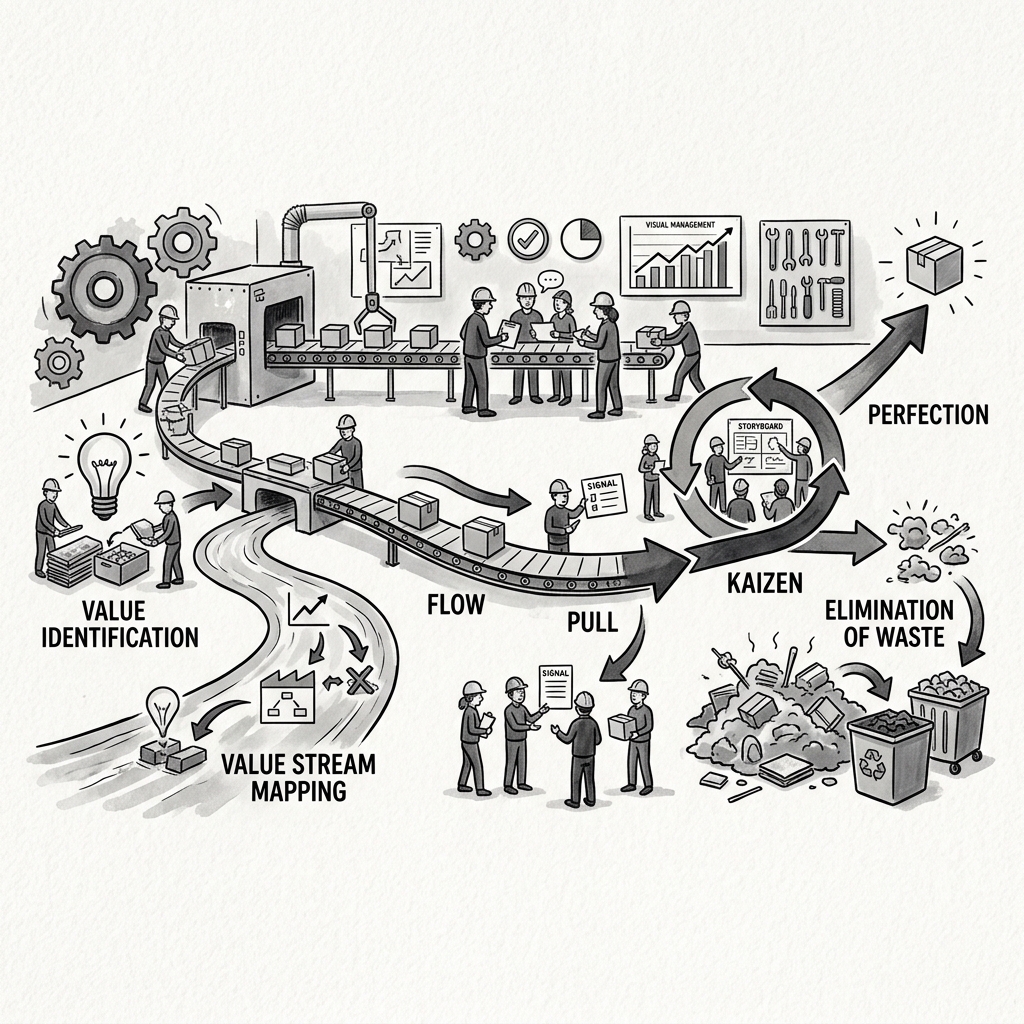
Heijunka: The Mixed Production Architecture Absorbing Fluctuations
Heijunka is the art of leveling the volume and variety of production over time. Customer demands are inherently volatile; the market might request 100 "Model A" units one day and 10 "Model B" units the next. If a company operates with traditional batch manufacturing logic and focuses solely on the largest immediate order, massive shocks and bottlenecks (Mura - Unevenness) occur within the system.
Heijunka breaks these massive demand waves down into small, manageable, and continuously repeating sequences. Instead of spending an entire week producing only "Model A" before switching to "Model B" the following week, the company establishes a much smoother, balanced production sequence like A, B, A, C on an hourly or daily basis.
- The Heijunka Box: The brain of this system is often a physical planning box. Work orders are dispatched to the production line not in massive batches, but in small increments via kanban cards, sequenced in a mathematical order.
- Gaining Flexibility: Through this method, if the market suddenly changes its mind, the factory is not caught off guard. Because there is a continuous flow of every product type on the line, shifts in customer demand can be accommodated within hours.
Eliminating Mura (Unevenness) and Achieving Operational Calm
The greatest benefit of Takt Time and Heijunka working in tandem is the absolute elimination of "Mura," or uncontrolled fluctuations, within the system. When the production line progresses at the exact same pace and with the identical product mix every day, the physiological and psychological overburden (Muri) on the workers is completely eradicated.
Material supply becomes seamless because suppliers know exactly how many screws or raw materials they need to deliver tomorrow. Quality defects plummet because workers operate in an established rhythm rather than in a state of panic. The factory transitions from a loud, crisis-filled chaotic environment to flowing smoothly like a predictable, powerful, and calm river. Optimizing the process in this manner forms the bedrock of massive financial profits.