The Mathematics of Inventory and Perfect Equilibrium
Excess inventory is a silent swamp that swallows corporate cash flow, while stockouts are a leaking bucket that gifts potential customers to competitors; operational mastery is finding that thin, invisible line between these two disasters.
One of the greatest battles companies face is the speed and volume at which they convert their cash reserves into physical goods. When a company produces or buys too many items, those goods sit in warehouses until they are sold. Every waiting item is essentially the company's cash embedded in concrete, unable to be used elsewhere. Conversely, if a company holds too few items, a customer who cannot find what they want will instantly walk over to a competitor and never return. This is precisely why companies must not operate on random guesses, but rather on strict, precise mathematical formulas.
The Mathematical Point of Equilibrium
The process of managing stock is not simply about counting boxes entering and leaving a building. It is the art of figuring out how to trade time and money against each other. Every day, companies face a brutal decision: Should they order goods continuously in tiny batches, or buy a massive truckload all at once? Both choices carry their own heavy and unforgiving penalties.
The Grocery Shopping Metaphor
Think of this complex corporate problem as your daily grocery shopping at home. You need one loaf of bread every day. If you drive to the supermarket every single day just to buy one loaf, you will spend far more money on gas and time than on the bread itself. Starting the car, fighting traffic, and finding parking every day creates an incredible Ordering Cost.
So, what happens if you do the exact opposite? To avoid paying for gas every day, you buy one hundred loaves of bread at once and bring them home. You eliminate the travel expenses. But this time, within three days, the bread molds, goes stale in your kitchen, and ends up in the trash. Furthermore, you have no room left to step inside your kitchen. This creates a massive Holding Cost. To protect your household budget, you must find that magic number—perhaps going every three days to buy three loaves—that keeps both your travel costs and the risk of mold at the absolute lowest level.
Ordering Cost and Invisible Burdens
When companies purchase a product, they do not just pay the factory exit price. Every step that product takes until it reaches the company's warehouse is an independent expense gate. These invisible expenses are generally called ordering costs, and they occur as a fixed penalty with every single order action, regardless of the quantity of products.
Logistics and Administrative Friction
- Freight and Shipping Fees: Whether a transport truck carries a single small box or is packed to the brim, the diesel it burns and the driver's salary remain largely the same. Therefore, companies despise sending half-empty trucks on the road.
- Customs and Documentation: When placing an international order, the border customs officer does not care how many items are inside the container; they care about processing the transaction. Every order means hundreds of pages of paperwork to fill out and fixed tariffs to pay.
- Quality Control and Receiving: Every time new goods arrive at the dock, workers must unload them, count them, inspect their quality, and log them into the system. Each of these actions drains labor costs and wastes time.
Holding Cost and the Price of Time
Trying to escape ordering costs by buying massive quantities and piling them into a warehouse might seem logical at first glance, but it is a company's deadliest trap. Every product sitting in a warehouse silently damages the company from the inside as time passes.
Imprisoned Capital and Decay
- Tied-up Cash (Opportunity Cost): When a company takes hundreds of thousands of dollars, buys a million plastic cups, and puts them in a warehouse, that money is effectively gone. If that cash had remained in the bank, it could have generated interest, or it could have been used to buy a new machine. As the product lies dormant in the warehouse, the money lies paralyzed with it.
- Physical Space and Energy Bills: Housing that gigantic mountain of products requires gigantic warehouses. The rent, security, lighting, and—if the products are food or medicine—the electricity bills for massive refrigeration units reach staggering heights.
- Obsolescence and Damage Risks: Especially in sectors like technology or fashion, if a product sits in a warehouse for six months, its value can suddenly plummet to zero. A new model comes out, and nobody wants to buy the old ones gathering dust. Additionally, sitting inventory can be chewed by rodents, flooded, or destroyed in a fire.
Economic Order Quantity (EOQ) Formula
Right at the exact point where these two completely opposing forces collide, the company's savior steps in: the Economic Order Quantity (EOQ) formula. This formula eliminates emotions and guesswork, relying entirely on cold, precise mathematics.
The Intersection of Opposites
The EOQ formula asks the company this: "Tell me your total required demand for the entire year. Then tell me the exact fixed cost you pay for shipping/paperwork every time you place an order. Finally, tell me how much it costs you to store one single unit in your warehouse for a full year."
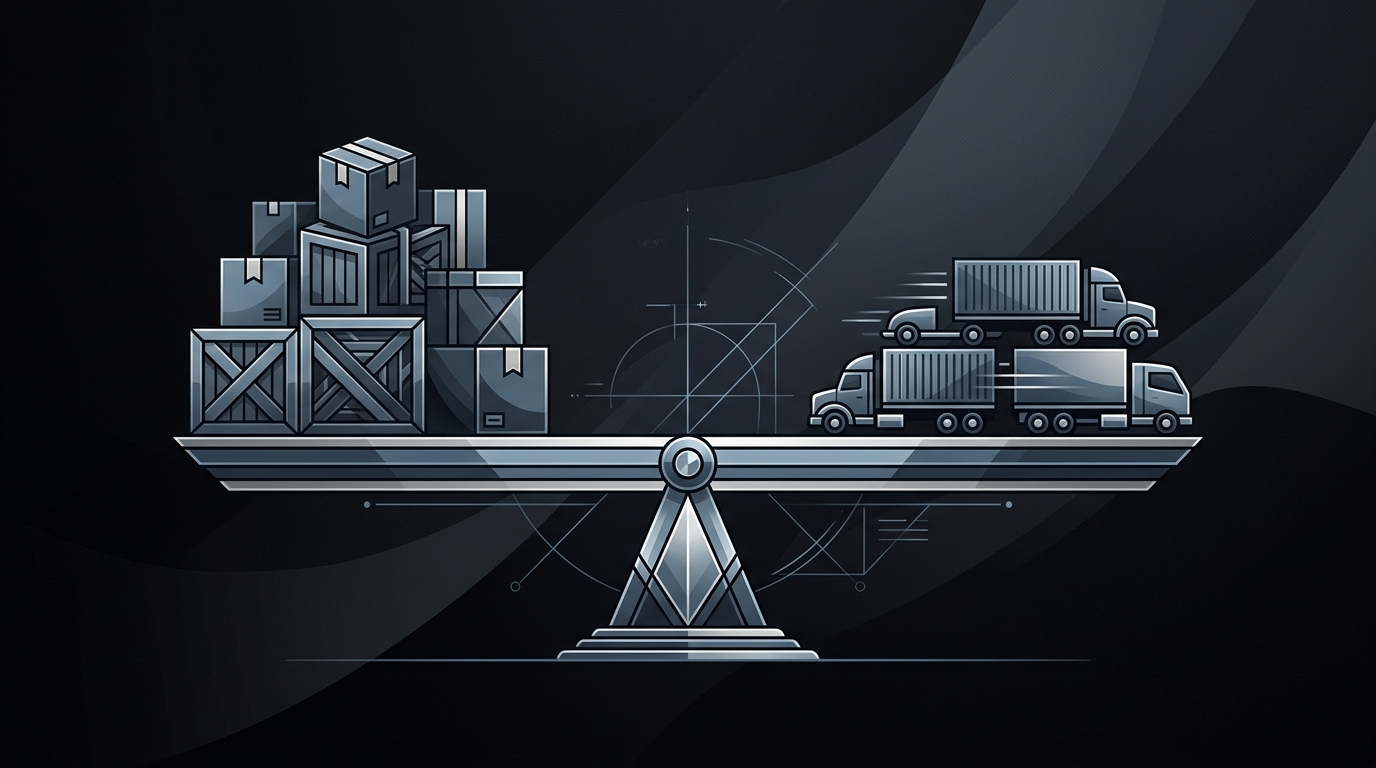
The formula takes these numbers, calculates the square root, and spits out a single magic number. If that number is 450, the system tells the company: "Do not order in batches of 100, and do not order in batches of 1000. Your perfect sweet spot is 450. If you order exactly 450 units at a time, your total annual shipping costs will perfectly equal your total annual holding/decay costs, and your total overall bill will hit the lowest point in history." EOQ is the flawless engineering scale that perfectly balances both sides, completely eliminating waste.