The Strategic Arsenal and Offensive Architecture
Observation alone holds no power; only systems that forge detected weaknesses into action and opportunities into ruthless advantage will seize market dominion.
SWOT Analysis: Strategic Inventory and Reconnaissance
The SWOT analysis is a high-resolution photograph taken to understand a company's current situation. It clearly reveals the conditions inside the company's internal walls and the reality of the world outside those walls. You can think of this as an army's inventory count and terrain reconnaissance before engaging in a war: "How many rifles do we have? Where is the enemy?" In the business world, this discovery phase lists what is going right and what is threatening the company with mathematical clarity. However, mere reconnaissance is never enough to win a war.
Strengths: Heavy Artillery in the Arsenal
Strengths are the internal assets a company possesses that provide an undeniable advantage over its competitors. These are your army's best-equipped soldiers, unshakeable armor, or high-tech artillery batteries. In the corporate world, this could be your strong brand recognition, massive cash reserves, a rare patent, a highly skilled engineering team, or the ability to manufacture at a fraction of the usual cost. These factors are entirely under your control and serve as the foundational load-bearing pillars that ensure the company's survival.
Weaknesses: Cracks in the Walls
Weaknesses are internal deficiencies that slow down the company's growth and operationally leave it behind. It is akin to your army moving sluggishly, your ammunition being outdated, or your soldiers lacking proper training. In business, these manifest as obsolete software infrastructures, slow decision-making processes (clunky bureaucracy), high staff turnover rates, or an inadequate marketing budget. If the company does not repair these internal cracks, its walls are doomed to collapse under the slightest external pressure.
Opportunities: Hills Waiting to be Seized
Opportunities are external factors that develop beyond the company's control but can yield massive profits with the correct tactical moves. These are like a high hill left unguarded by the enemy or a fertile valley no one has yet crossed. Economically, a new law bringing corporate tax cuts, a rival company going bankrupt, the birth of a brand-new consumer habit, or a new technological breakthrough (like artificial intelligence) can be a massive opportunity for you. However, it must be remembered that opportunities only mean something to armies that have the weapons to exploit them.
Threats: Storms on the Horizon and Ambushing Enemies
Threats are external dangers that are completely out of the company's control and can halt its operations or even destroy the company entirely. These are the probability of an approaching hurricane, a new enemy army lying in ambush, or the sudden severing of supply routes. In business life, a new competitor entering the market with extremely cheap production, global economic crises, severe currency fluctuations, harsh financial penalties coming with changing laws, or consumer trends shifting in a completely different direction are the most prominent threat elements.
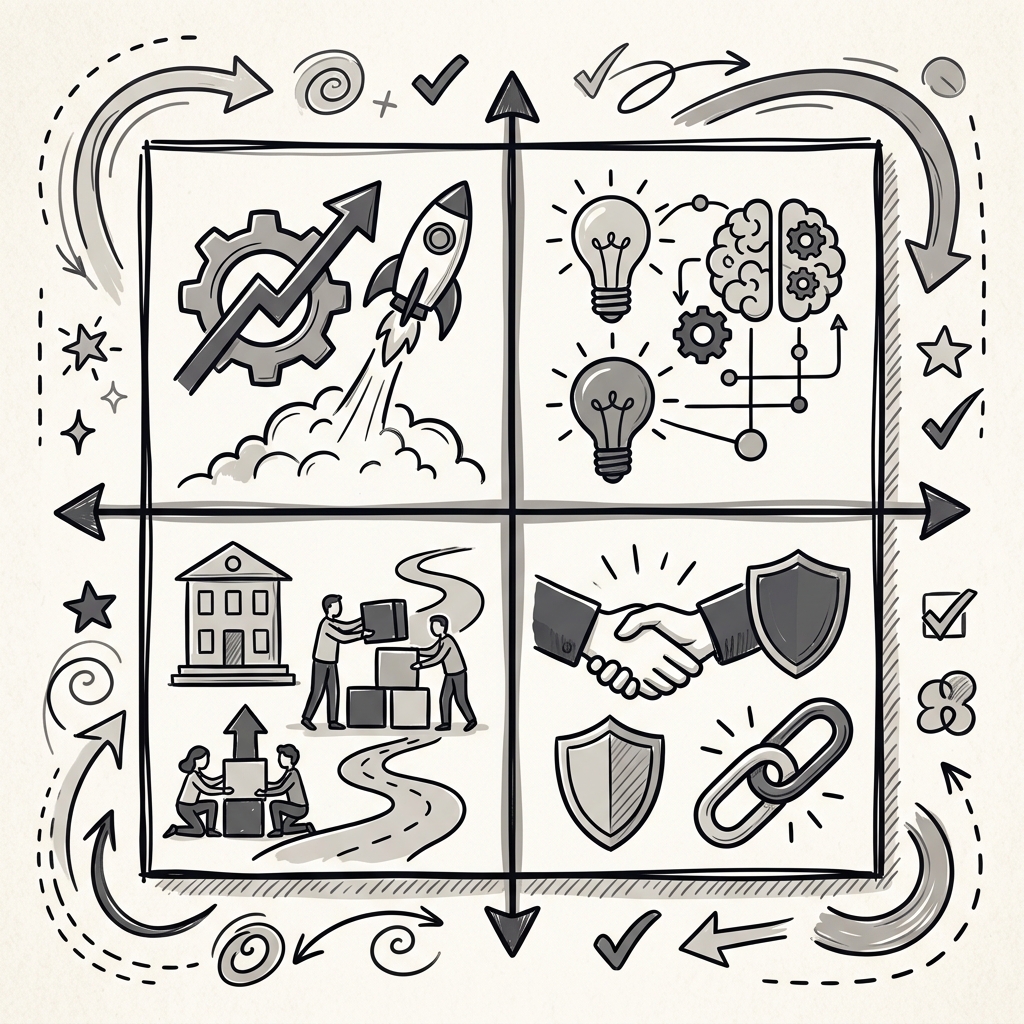
TOWS Matrix: Forging the Inventory into an Offensive Plan
Merely conducting a SWOT analysis is like writing the army's inventory on paper and leaving it on the desk; by itself, it is completely useless. After assessing the situation, you must combine this information and take decisive action. The TOWS matrix is the very general who takes this raw data and transforms it into a ruthless, rational battle plan. TOWS cross-references your data to create four distinct strategic action plans and ignites the company's reaction capacity.
SO Strategy (Maxi-Maxi): Ruthless Offensive
In this strategy, you use your greatest internal strengths (Strengths) to aggressively attack the biggest external opportunities (Opportunities). It means sending your fastest and best-equipped armored units straight to that valuable hill left empty by the enemy. For example, if you have a massive cash reserve (Strength) and a brand-new, unrivaled market is emerging (Opportunity), you use your cash to rapidly buy the best startup in that market and instantly become an absolute monopoly.
ST Strategy (Maxi-Mini): Armored Defense and Deterrence
This is the strategy where you use your existing strengths (Strengths) to block incoming external threats (Threats) or entirely neutralize their impact. It is like putting forth your thickest steel shields against the enemy's approaching artillery fire. For instance, if a very aggressive new competitor enters the market (Threat), you strategically slash your prices relying on your existing loyal customer base and robust supply chain network (Strength), making it financially impossible for the competitor to survive in the market.
WO Strategy (Mini-Maxi): Advancing by Completing Deficiencies
This is the action plan where you use external opportunities (Opportunities) to rid yourself of your internal weaknesses (Weaknesses) or directly compensate for them. If your army lacks a certain type of heavy weapon (Weakness), you strike a deal with new allies outside (Opportunity) to close that gap. In the business world, if your company's software infrastructure is extremely outdated (Weakness), you can utilize new government grant programs designated for technological transformation (Opportunity) to upgrade your systems and eliminate your deficiency.
WT Strategy (Mini-Mini): Full Cover and Strategic Retreat
This is a strict survival strategy applied when you are at your absolute weakest (Weaknesses) and simultaneously face the greatest external threats (Threats). If your army is severely wounded and the enemy heavily outnumbers you, the only logical move is to dig deep trenches, downsize the troops, or retreat to a safe zone. If a company is both heavily indebted (Weakness) and a global economic crisis erupts (Threat), the only solution is to rapidly close loss-making factories, shrink departments, and hold cash to wait out the storm.