The Architecture of Integrity
Power, when unchecked, will always choose the path of least resistance; a flawless structure is one that relies on mechanical balance rather than the goodwill of individuals.
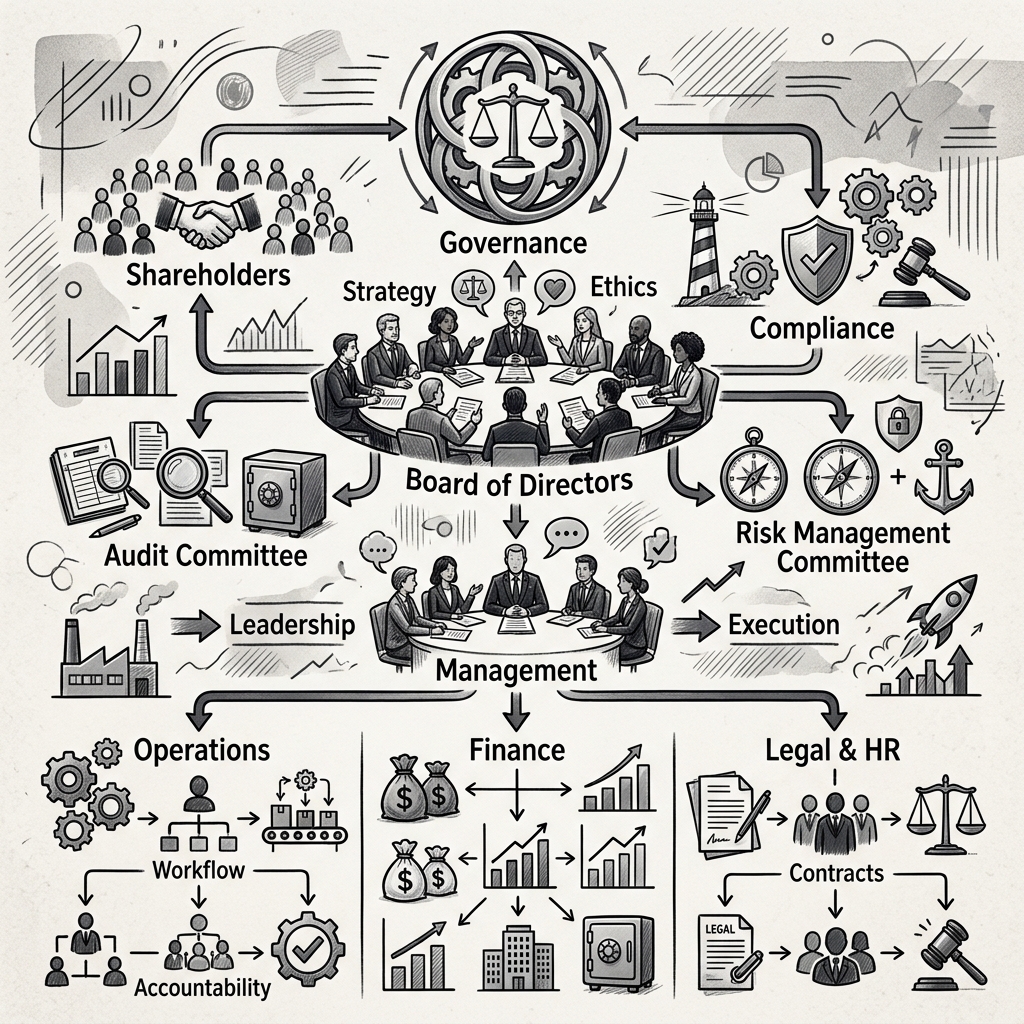
A corporation reaching massive proportions does not guarantee its immortality. No matter how financially robust a structure may be, without internal control mechanisms, it is destined to collapse under its own weight. Corporate Governance is the definitive set of rules, practices, and processes by which a company is directed and controlled, ensuring that power is properly balanced across different organizational layers.
As companies scale, the true owners (shareholders) become separated from the professional managers (executives) running the daily operations. This separation inherently breeds conflicts of interest. Corporate governance steps into this very gap, ensuring that every action taken by the management guarantees the long-term benefit of the shareholders. Weak governance is the absolute root cause of corporate bankruptcies and financial scandals.
The Four Pillars of Governance
Corporate governance is not merely a single compliance rule; it consists of four foundational mechanisms that support the entire weight of the corporate structure.
Transparency
This is the principle of openly, fully, and timely sharing the company's financial performance, risk exposures, strategic shifts, and board decisions with investors and the public. Investors must have total visibility into how the machine they funded actually operates. Transparency eradicates information asymmetry.
Consider this as the headlights of a high-speed train traveling at night. No matter how powerful the train's engine (corporate production) might be, if the headlights (transparency) are turned off, neither the passengers (shareholders) nor the conductor (management) can see where they are heading. Any vehicle moving in total darkness will eventually derail.
Accountability
Accountability ensures that executives and the board of directors answer directly to the company's owners for the outcomes of their strategic and operational decisions. Just as successes are rewarded, failures or rule-breaking must bear clear consequences and sanctions. Authority can be delegated, but accountability can never be outsourced.
Imagine accountability as having a highly responsive braking system. If a driver (executive) is given the authority to press the gas pedal, they must also be ready to explain why they were at the wheel when a crash occurs. A system without brakes or driver penalties is an open invitation to disaster.
Fairness
Fairness dictates that the rights of all shareholders are protected equally, from massive institutional investors down to the individual holding a single share. It specifically prevents majority shareholders or powerful executives from using their leverage to crush minority owners or siphon corporate resources for personal gain.
Think of fairness as the strict rule governing how a massive pizza is sliced. If the person holding the knife can carve out the best part for themselves and leave only the crust for everyone else, fairness is absent. Fairness is the unbreakable scale that ensures everyone receives the exact quality and proportion of ingredients matching their initial financial contribution.
Responsibility
Responsibility means the corporation fulfills its orderal and legal obligations not just to shareholders, but to the broader society, the environment, its employees, and the regulatory framework. Acting orderally and staying within legal boundaries is the bedrock of long-term reputation and survival.
This concept is akin to a factory treating its wastewater before releasing it into the river. The factory might produce heavily and generate massive profits, but if it poisons the river, the downstream townspeople will eventually march up and shut the factory down. Long-term corporate survival is only possible by not destroying the surrounding ecosystem.
The Board of Directors and the Agency Problem
The Strategic Role of the Board
The Board of Directors is the supreme supervisory and approval body elected directly by the shareholders. The board does not meddle in daily operational tasks. Instead, it hires the executive team (primarily the CEO), audits their performance, determines their compensation, and fires them if necessary. The board's primary mission is to set the strategic direction and prevent the management from going off-course.
Think of the board of directors as the parliament in a kingdom (the company). The king (CEO) makes daily decisions, commands the armies, and runs the state. However, the parliament represents the people (shareholders). Without the parliament's approval, the king cannot arbitrarily double his own salary or launch a baseless war. Thus, the king is prevented from using his supreme authority for personal corruption.
The Anatomy of the Agency Problem
The most dangerous fault line in corporate structure is known as the Agency Problem. This occurs when the agent (the CEO) prioritizes their own personal interests over the long-term interests of the principal (the shareholders). For instance, a CEO might execute a highly risky acquisition or cut all Research and Development (R&D) budgets just to maximize their year-end bonus. The CEO gets insanely rich that year, but five years later, the company faces bankruptcy due to lack of innovation.
This mechanism is exactly like a tenant (the CEO) burning your antique wooden furniture in the fireplace to keep the house warm during winter. The tenant feels warm, comfortable, and successful in the short term. But at the end of the day, the landlord (the shareholder) discovers that the most valuable assets of the house have been permanently destroyed. The entire purpose of corporate governance is to build iron gates that prevent tenants from burning the furniture.