The Architect of Market Dominance
Indecision is the most unforgivable crime on the industrial battlefield; an entity trying to be everything to everyone ultimately becomes nothing.
The Mathematics of Corporate Survival
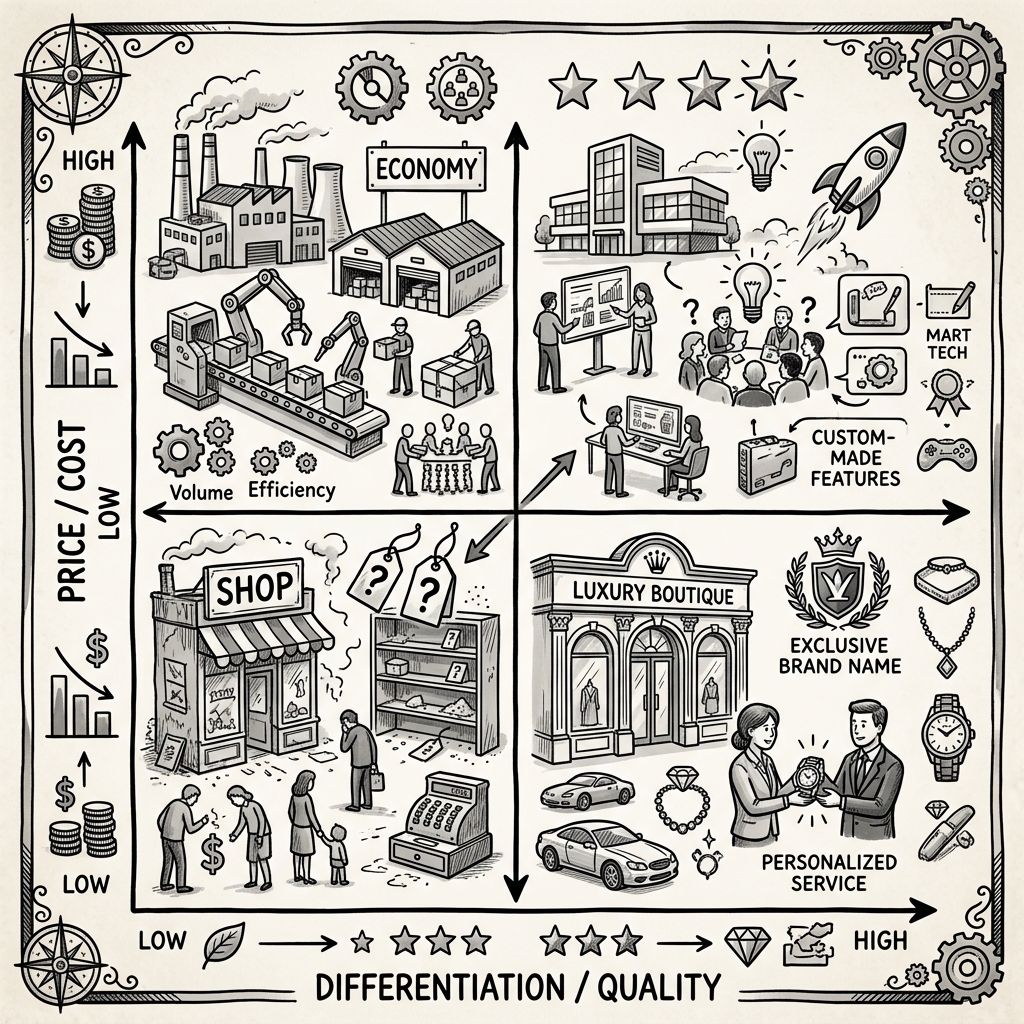
A company generating more profit than its rivals is never a random accident. In the business world, this mechanical superiority is called competitive advantage. Professor Michael Porter demonstrated that for institutions to survive long-term, they must firmly anchor themselves to one of three fundamental strategic architectures. This single structural choice dictates everything from the factory assembly line to the marketing budget.
Cost Leadership Strategy
Cost leadership is the obsessive practice of stripping away every single redundant penny in the manufacturing process to achieve the absolute lowest operating expenses in the industry. The secret to this strategy is not necessarily slashing retail prices, but drastically crushing internal costs. To achieve this, a corporation must build massive economies of scale. When an assembly line produces ten million units instead of a thousand, the fixed factory overhead per unit drops to near zero. Massive bulk negotiations with suppliers are relentlessly conducted, logistics networks are shortened with millimeter precision, and systemic waste is completely eradicated.
Differentiation Strategy
If a corporation chooses not to compete on price, it must construct a value proposition that is unequivocally more unique, higher quality, or more prestigious than anyone else on the market. The differentiation strategy relies on creating a brand perception or engineering marvel where the consumer gladly accepts paying a massive premium. This pathway demands enormous research and development (R&D) budgets, vast innovation laboratories, and a flawless marketing machine. For the company, operational expenses are remarkably high, but the profit margin on the final sale is astronomical.
Focus Strategy
Rather than battling giant sharks in the open ocean, the focus strategy aims to dominate a highly specific target demographic or a narrow geographic region (a niche market). The company deliberately refuses to serve the broader market. The focus mechanism can be either "Cost Focus" or "Differentiation Focus." The ultimate objective is to establish an uncontested monopoly within a small pond that massive conglomerates ignore because it lacks global volume.
The Umbrella Metaphor and the Price of Indecision
To materialize this strategic architecture, imagine attempting to sell umbrellas in a massive open market. You have two logical choices: You either manufacture millions of basic, all-plastic black umbrellas and establish the ultimate monopoly on cheap rain protection (Cost Leadership), or you engineer an unbreakable, carbon-fiber umbrella with a custom handle for high-end clients seeking extreme quality (Differentiation).
However, what happens if you attempt to combine both? If you dictate, "Let's make it relatively cheap, but paint the handle gold to look premium," the resulting product fails completely. It is not high-quality enough for true luxury buyers, and it remains entirely too expensive for budget shoppers. Porter calls this fatal positioning error being Stuck in the Middle. Faceless, indecisive corporations stranded in this zone inevitably collapse into bankruptcy.