The Physics of System Bottlenecks
The strength of a chain is not measured by its thickest link, but by the breaking point of its weakest one; the only way to accelerate the system is to repair that vulnerability.
When you observe any business, a product manufactured in a factory, or a service from the outside, you might think that each department works perfectly within itself. However, there is an invisible braking mechanism that prevents companies from reaching massive speeds. The Theory of Constraints (TOC), developed by Eliyahu Goldratt, argues that the output of any production or business system is always determined by the slowest and weakest link in that system. According to this philosophy, any improvement effort outside of the weak link (the bottleneck) is merely a waste of time and money.
The Weakest Link Theory of Production
Companies generally invest in all departments simultaneously to increase overall efficiency. However, the nature of a production line is that each step is dependent on the other.
The True Definition of a Bottleneck
A bottleneck is the processing step within a system that has the lowest capacity and therefore dictates the speed of the entire system. A factory might have hundreds of super-fast machines, but if just one of them operates slowly, the total production volume of the factory cannot be even one unit higher than what that slow machine produces. The other fast machines will only produce massive piles of parts (inventory) waiting to be processed.
The Plumbing Network Metaphor
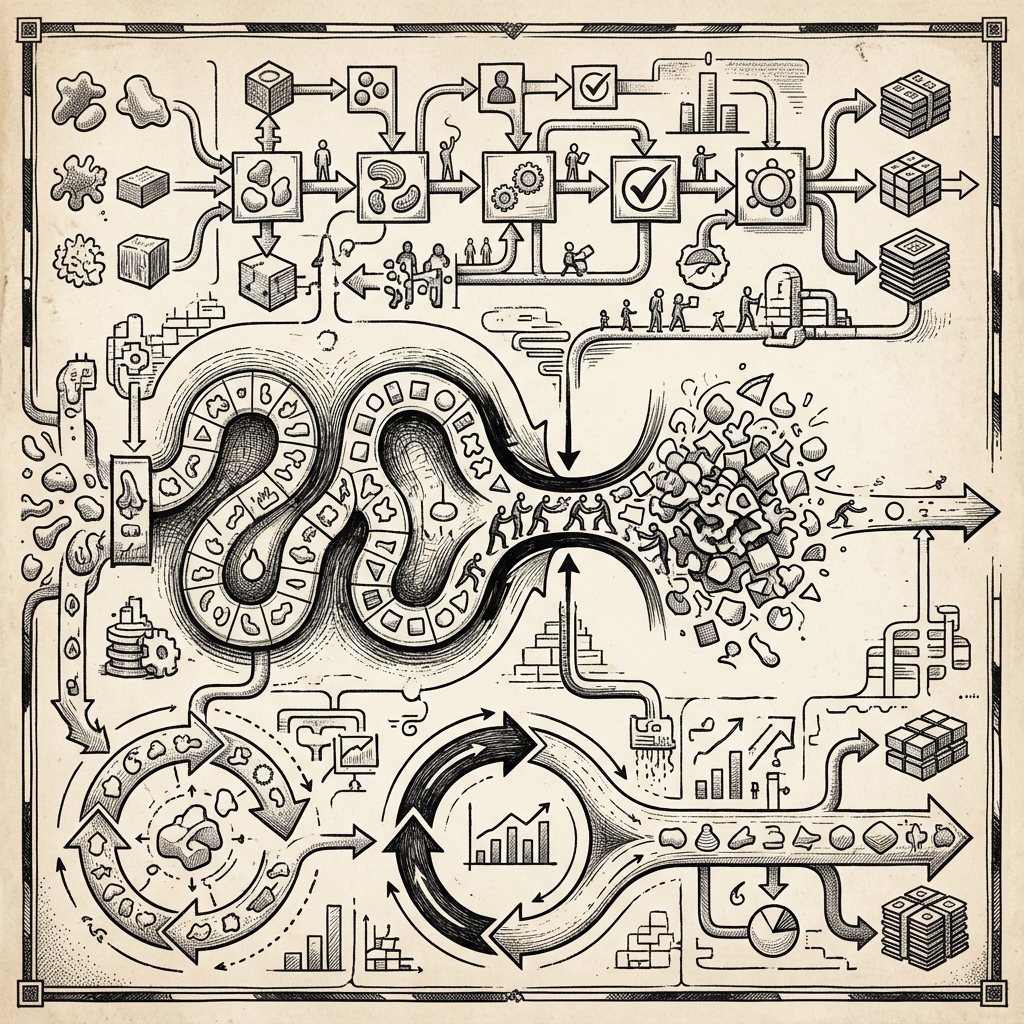
Think of the Theory of Constraints as a long plumbing network where pipes of different thicknesses are connected sequentially. The flow rate of water from the faucet is not determined by the size of the widest pipe in the system. The speed of the water is exactly equal to the width of the narrowest pipe (the constraint point) in the middle. If you want the water to flow with more pressure and volume, making the wide pipes even more gigantic is of absolutely no use. The only way to increase the output of the system is to identify that narrowest pipe and widen it.
The Five Focusing Steps of Constraint Management
Goldratt established a very sharp and sequential management mathematics to find and eliminate these weak links. This mathematical approach is known as the Five Focusing Steps.
1. Identifying the System's Ultimate Constraint
The first step is to find the narrowest pipe. Wherever there is a continuous accumulation of materials on the production line, wherever workers are constantly waiting, or where delays occur, that is the constraint of the system. The company must focus all its attention on this exact point.
2. Exploiting the Bottleneck to its Maximum
Once the bottleneck is found, instead of immediately spending money to physically enlarge it, we must try to use its current capacity to one hundred percent. It must be ensured that this slow machine or department does not stop during lunch breaks, is not occupied with unnecessary reporting, and works entirely focused on production. The weak link must never be idle.
3. Subordinating Everything Else to the Slowest Pace
The other fast machines in the system must not continue to produce at their own speed. If the fast machines run at full throttle, a massive mountain of work will accumulate in front of the bottleneck machine, which inflates storage costs. The entire system must lower its rhythm and speed to match this slowest machine; everyone must move at the same pace.
4. Elevating the Bottleneck's Physical Capacity
If the first three steps have been applied and the speed of the factory has still not reached the desired level, then it is time to open the safe. A new worker is added to the weak link, a more powerful motor is installed, or a second machine is purchased to do that specific job, physically widening the narrowest pipe.
5. Avoiding the Inertia Trap and Repeating the Cycle
When you widen the narrowest pipe, the system accelerates. However, the water will this time get stuck at the second narrowest pipe in the plumbing. A system can never be without a constraint; when the old bottleneck is resolved, a new bottleneck is always born. Therefore, the process must return to the first step without falling into complacency.
The Illusion of Local Optimization
The most common mistake companies fall into is the blind spot called "local optimization." When each department tries to increase only its own efficiency, it actually damages the overall company.
Why Speeding Up Can Be a Waste
When the bottleneck machine processes 10 products per hour, increasing the speed of the preceding machine from 50 to 100 per hour does not make money for the company. On the contrary, it chokes the system by doubling the accumulation in between. Any improvement outside of the narrowest pipe is an illusion; it is a waste of the company's money and energy.
The True Center of Profitability
Profitability is possible solely and exclusively by accelerating the weak link. The eyes of the entire company must be on this single point of constraint. Understanding the system holistically requires being willing to slow down the fast-running horses in order to treat the limping one.