The Weed and The Spade
A band-aid applied to a superficial symptom is merely the most dangerous concession given to a disease to grow in the dark; true resolution always lies hidden beneath the soil, at the root.
In business and engineering, the problems we encounter are often just the tip of the iceberg. Machines breaking down, products coming out defective, or customers complaining are not root causes; they are merely outcomes (symptoms). Root Cause Analysis is the art of finding and destroying the actual structural, educational, or managerial errors behind these outcomes. The sharpest sword in this art is the 5 Whys technique.
We can think of this technique as clearing a harmful weed in a field. If you only pluck the leaves of the weed (a superficial solution), that weed will grow back stronger next week. However, if you dig into the soil with your hands and pull out the deepest root that feeds the weed (the root cause), it will never grow again. Solving problems in companies is exactly that process of digging the soil.
The Chasm Between Symptom and Root Cause
A production line stopping in a factory is an immediate crisis. Sending a technician there to quickly fix the breakdown is like putting a band-aid on a bleeding wound. The band-aid stops the bleeding momentarily but does not question why the wound opened in the first place.
Superficial Fixes
Superficial solutions are designed only to save the moment.
- If a machine's fuse blows: Just installing a new fuse.
- If a customer complains: Just issuing a refund.
- If a worker makes a mistake: Just warning or firing that worker.
All these actions are merely plucking the leaves of the weed in the field. This approach absolutely guarantees that the company will experience the exact same problem again in the future and bear the same costs repeatedly.
Digging for the Root
The root cause is the actual systemic gap that creates the problem. If a worker makes a mistake, the true root cause is not the worker's carelessness; it is the inadequacy of the training provided to that worker, the poor working environment, or the machine design that allows that mistake to be made (lack of Poka-Yoke). Solving the problem from its root requires digging deep into the soil.
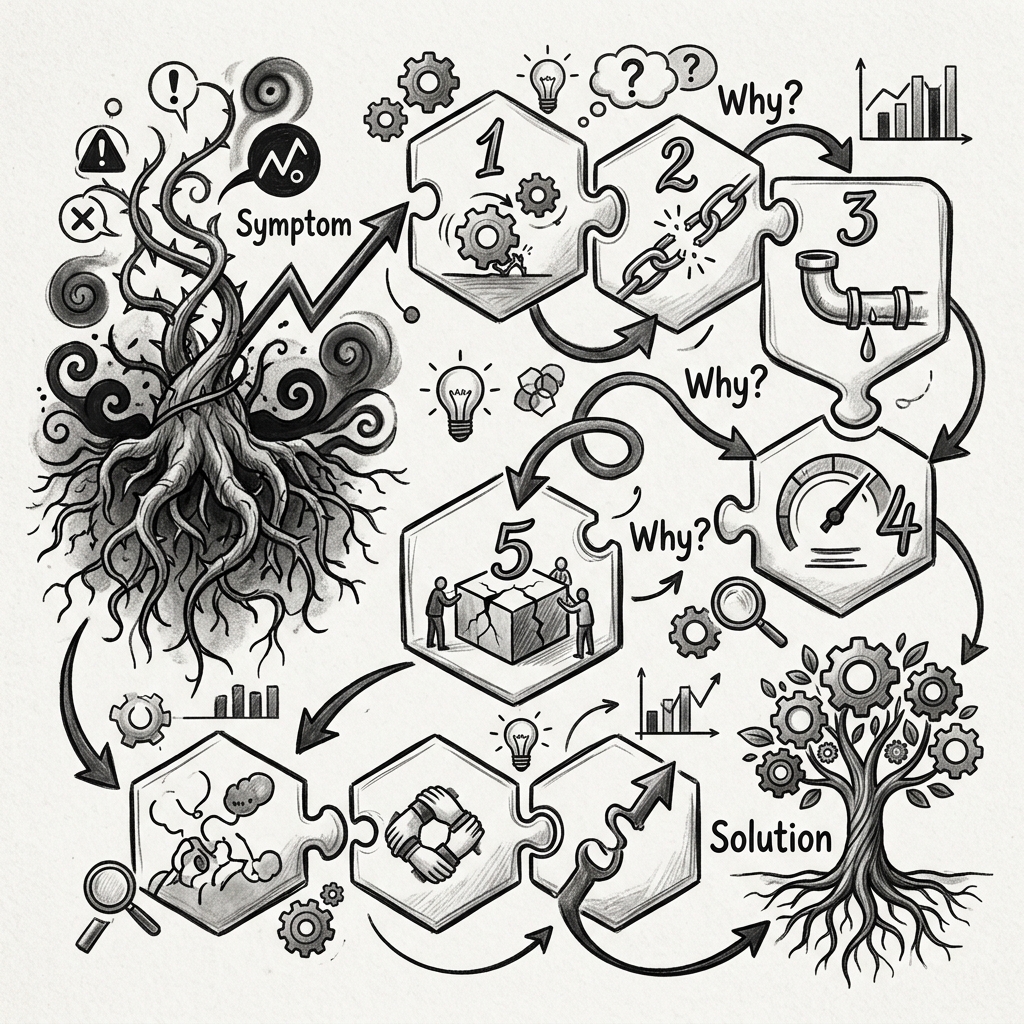
The Architecture of the 5 Whys Technique
Developed by Sakichi Toyoda, the 5 Whys technique is a relentless journey toward the center of the problem by asking the question "Why?" consecutively, usually five times. It is a questioning algorithm.
First Why: The Physical Cause of the Problem
This is the immediate observation right after the event.
- Question: Why did the machine stop?
- Answer: The motor overheated and burned out.
Second Why: The Disconnect in the Process
This is the technical glitch behind the physical cause.
- Question: Why did the motor overheat?
- Answer: There was insufficient lubrication, increasing friction.
Third Why: Human or Task Error
This is the operational negligence that led to the technical glitch.
- Question: Why was there insufficient lubrication?
- Answer: The oil pump broke and couldn't pump oil.
Fourth Why: Lack of Procedure and Planning
This is the managerial or systemic rule gap behind the negligence.
- Question: Why did the oil pump break?
- Answer: The pump had passed its useful life but wasn't replaced.
Fifth Why: The Systemic Root (The Actual Disease)
This is the fundamental organizational failure that started the whole chain.
- Question: Why wasn't the expired pump replaced?
- Answer: Because the factory does not have a planned maintenance schedule (PM) and an auditing mechanism to track it.
Rules of Success in the 5 Whys Technique
There are some vital engineering and psychology rules to follow when applying this powerful technique:
- Rely on Data, Not Assumptions: Every answer given to a "Why?" question must be based on actual physical evidence on the factory floor (Gemba), not on guesses in a meeting room.
- Blame the Process, Not the People: If the "why" question leads you to the answer "Because John was careless," you are on the wrong path. The correct answer must always be, "What was the system design that allowed John's carelessness?"
- Stopping at the Right Place: Sometimes the root cause is reached in 3 steps, sometimes in 7. The number 5 is just a symbol. The real rule is to stop when you find an actionable root that can change the system.
| Solution Approach | Point of Intervention | Long-Term Result |
| --- | --- | --- |
| Band-Aid Fix | Symptoms (Outcomes) | The problem constantly repeats |
| Root Cause Analysis | Systemic Error (Cause) | The error is eliminated forever |