The Mathematics of the Vital Few and Output Optimization
When effort is distributed equally, mediocrity is inevitable. Systemic success is achieved by focusing energy solely on the critical fault lines that create asymmetric impact.
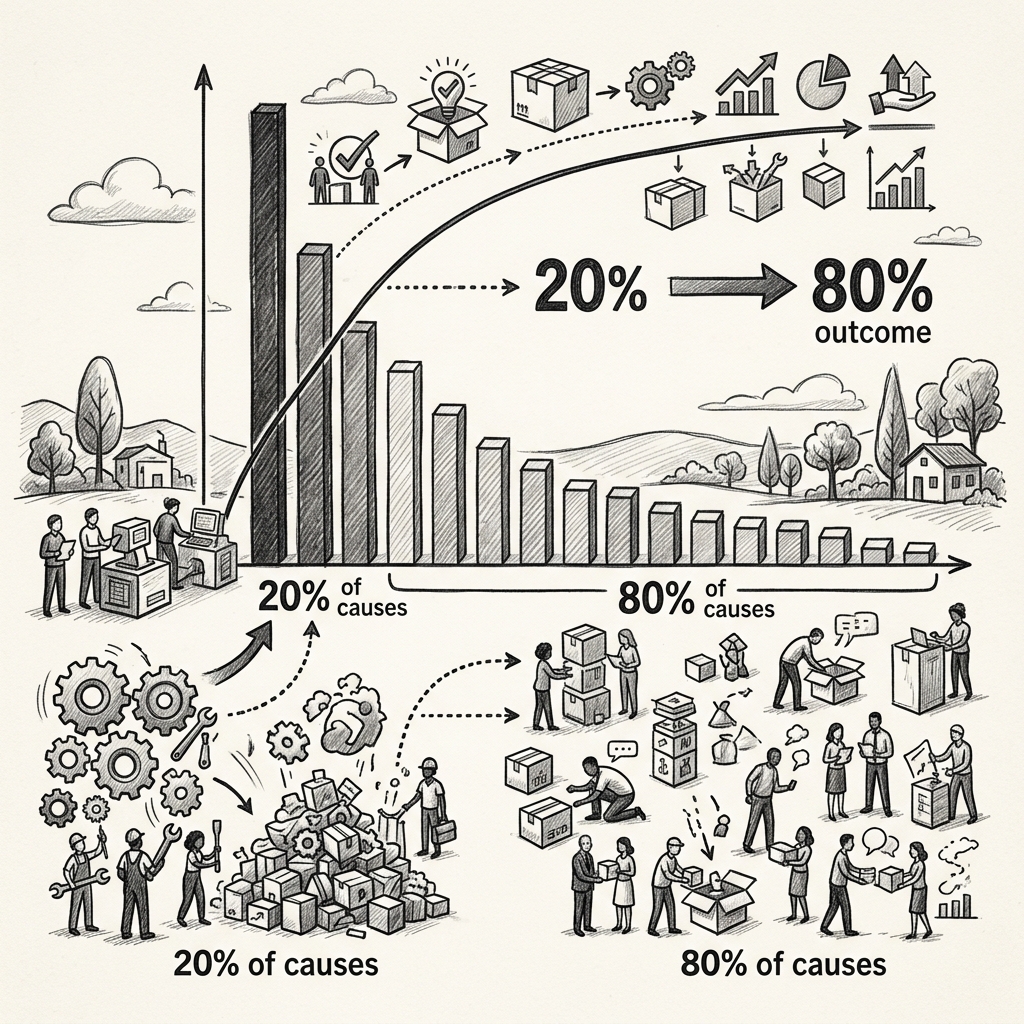
The business world is a massive optimization arena where resources are perpetually scarce. While managing constrained components like time, money, and human capital, companies often make the mistake of treating all problems as if they were of equal magnitude. However, nature and mathematics prove that events are never distributed equally. Pareto Analysis, also known as the 80/20 Rule, is a monumental strategic lens revealing that 80% of outcomes or problems in the business landscape stem from merely 20% of causes. This rule is the most ruthless and precise filter determining where an engineer or an executive must focus their attention.
Architectural Foundations of the Pareto Principle
The Pareto principle was born when Italian economist Vilfredo Pareto observed that 80% of the land in Italy was owned by just 20% of the population. This disproportionate ratio appears everywhere, from defect rates on a factory floor to a corporation's overall sales revenue.
Asymmetry Between Effort and Result
Traditional thinking assumes that effort and result always exist in a linear (equal) relationship. Managers in a typical company try to divide their energy equally among 100 different problems on their desks. However, the Pareto principle completely dismantles this linear logic. A vast majority of outputs are generated by a tiny percentage of inputs. In a manufacturing plant, 80% of quality defects are caused by the incorrect calibration of just 20% of the machines on the assembly line. Understanding this mathematical asymmetry is the first massive step toward altering a company's destiny.
The Vital Few and the Trivial Many
When quality engineering guru Joseph Juran applied this principle to industrial quality management, he introduced the concepts of the "Vital Few" and the "Trivial Many" into the literature. Within the massive pile of issues a company needs to solve, there are only a handful of key problems; these constitute the vital few. The remaining hundreds of minor issues are the trivial many. A successful leader's primary duty is not to waste energy on the trivial many, but to identify and eradicate the vital few that cause the company the most severe hemorrhaging.
Resource Optimization and Strategic Focus
Strategy is as much the art of deciding what NOT to do as it is deciding what to do. Pareto Analysis allows companies to direct their limited resources with pinpoint accuracy.
Filtering Problems by Severity
Every company faces customer complaints or production defects. If an organization attempts to solve every single complaint simultaneously, its operational capacity will instantly deplete. By utilizing Pareto analysis, all complaints are ranked from largest to smallest based on their frequency or financial cost. Through this data-driven filtering, it becomes mathematically proven that the single error gnawing the most at the company's profitability is far more lethal than 50 other minor errors combined.
Directing Energy to Root Causes
We can conceptualize the Pareto principle as the triage management of patients in a massive hospital emergency room. Imagine 100 patients arriving at the ER one night. Only 20 of these patients are in a truly critical, life-threatening condition, and they require 80% of the doctors' total effort to survive. The remaining 80 patients merely have minor scrapes or slight aches. If the chief physician distributes the limited number of doctors and medical supplies (the company's resources) equally to the 80 people with scrapes under the logic of "equal energy for everyone," they will instantly lose the 20 patients in critical condition. Doctors must direct 80% of their energy to those 20 lethal cases (the vital few). In times of crisis, companies must also focus their energy not on minor frictions, but on the massive 20% of problems that will actually sink the ship.
Pareto Analysis in Quality Engineering
In Six Sigma and Quality Engineering methodologies, Pareto is the absolute backbone of decision-making. It is utilized to define and prioritize problems entirely through data, rather than relying on gut feelings.
Defect Detection and Categorization
Defective products coming off the assembly line are not just thrown into a single bin. Each defect is categorized based on its type (e.g., scratches, misaligned assembly, missing parts) and counted to determine frequency. The resulting bar chart (the Pareto chart) shows quality control engineers with undeniable clarity exactly which machine they need to shut down. Isolating defects one by one is thousands of times more effective than chanting a generic slogan like "let's improve quality."
The Cumulative Line and Prioritization Formula
A true Pareto diagram does not consist merely of bars; it features a cumulative curve climbing from left to right over those bars. This line represents the percentage weight of total defects. The quality engineer tracks this line and stops exactly at the point where it crosses the 80% threshold. The 2 or 3 categories remaining to the left of that point become the engineer's sole targets for the month. The trivial pile remaining on the right side is momentarily ignored.