The Price of the Invisible Leak
You cannot inspect quality into a product, you must build it into the system from the very beginning; because every defect that slips through the line geometrically expands until it reaches the customer, extracting its final price in brand reputation.
In the modern business and manufacturing world, quality often acts as an invisible shield; its presence is rarely appreciated, but its absence leads to catastrophic failures. The Cost of Poor Quality (COPQ) represents the sum total of all financial and reputational losses a company must endure when it fails to do things perfectly the first time. The slightest error made during the design, production, or delivery of a product snowballs over time, crushing the company's profitability. The cost of poor quality is not just about throwing a defective product into the trash bin; it encompasses wasted time, lost customers, and massive corrective overtime.
We can visualize this scenario as a tiny, invisible leak in the plumbing of a newly built house. Installing that water pipe correctly with high-quality materials during construction might only cost a few extra dollars. However, if that leak remains hidden behind the wall, months later when the house floods, replacing the swollen hardwood floors, moldy walls, and ruined electronics will cost thousands or even tens of thousands of dollars. The mathematics of business errors work exactly the same way: The closer the defect is to its source, the cheaper it is to fix; the closer it gets to the customer, the more devastating its price becomes.
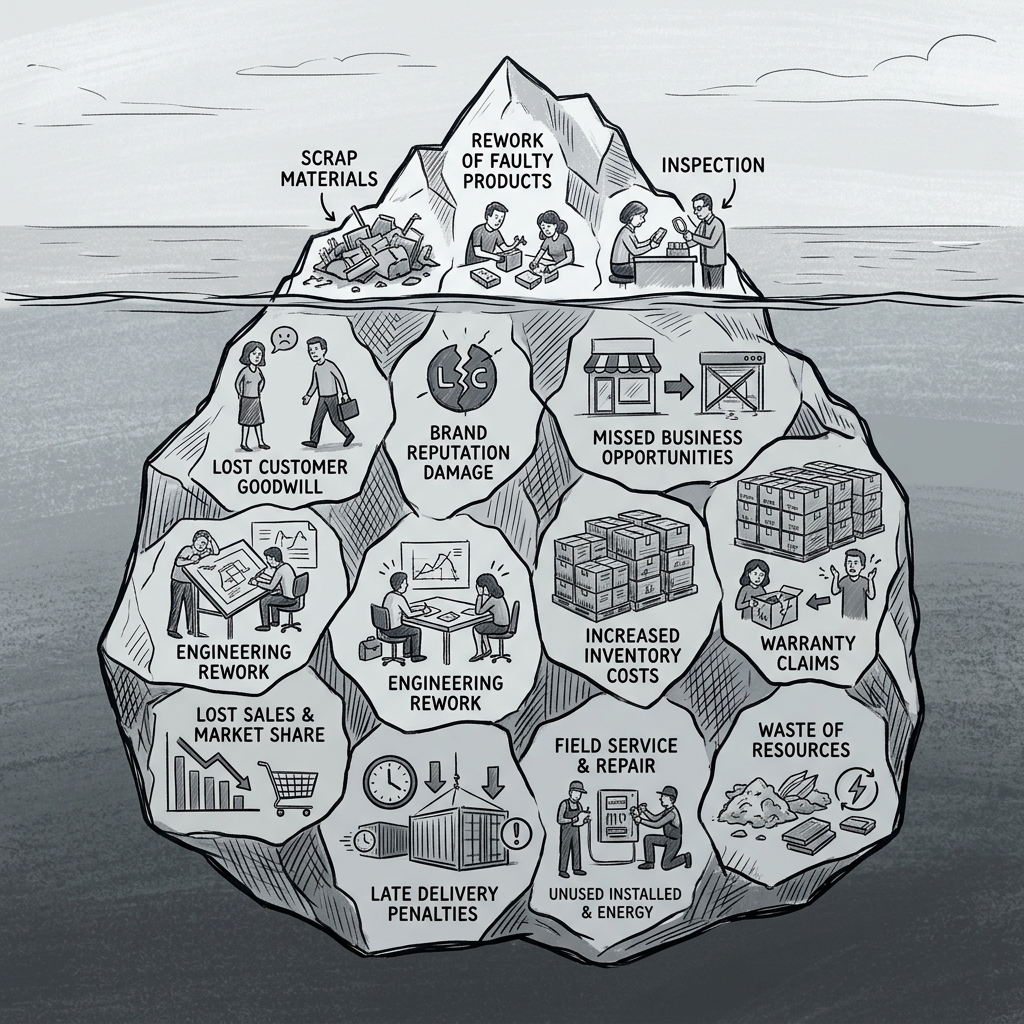
The Pillars of COPQ and Exponential Compounding
The cost of poor quality is analyzed through four main pillars. These pillars are categorized based on where and when the defect is detected. The golden rule in business is this: Every 1 unit of investment made in prevention and appraisal costs yields 10, or even 100 units of savings in internal and external failure costs.
Internal Failure Costs: The Silent Factory Crisis
Internal Failure Costs are the financial burdens generated by defects detected within the company's own boundaries (factory, warehouse, office) before the product ever reaches the customer.- Scrap and Waste: This involves discarding manufactured goods that are so defective they cannot be salvaged. Not only are the raw materials wasted, but all the energy and labor invested up to that point evaporate.
- Rework: This is the extra time and effort spent correcting a defective product and bringing it back up to the required standard.
- Capacity Loss: Because time is spent fixing defective products, the assembly lines or employees who could have been producing brand-new, healthy products are tied up.
Returning to our plumbing metaphor; internal failure occurs when the plumber notices a small leak before leaving the house, tears down a single tile, and replaces the pipe. It is annoying and takes a few extra hours, but the damage is strictly contained to that single tile.
External Failure Costs: The Disaster at the Customer's Home
External Failure Costs emerge when a defective product or service leaves the company's doors and is discovered by the customer. This is the most destructive and expensive type of cost in the entire system.- Warranty Claims and Returns: These are the direct costs incurred when a customer returns a broken product to be replaced or repaired. Shipping, service networks, and spare parts push these expenses to massive proportions.
- Customer Loss and Brand Damage: A customer encountering a defective product doesn't just return it; they vow never to shop with that brand again and broadcast their bad experience to their network. The lost future sales (Opportunity Cost) are often immeasurably large.
- Lawsuits and Recalls: Especially in critical industries like automotive or healthcare, a defective product harming a customer leads to multi-million-dollar lawsuits and massive product recall crises.
In the plumbing metaphor, this is when the plumber leaves without noticing the leak, and months later, the entire house is submerged in water. Not only is the pipe ruined, but all the furniture and floors are destroyed; furthermore, the homeowner will never hire that plumber again.
Prevention Costs: Doing It Right the First Time
Prevention Costs are deliberate, proactive investments made during the design and planning phases to ensure that defects never occur in the first place. These are not merely expenses; they are the company's future armor.- Training and Development: The cost of educating employees to perform their jobs flawlessly.
- Process Design and Engineering: Intelligently designing the production line from scratch (Poka-Yoke) so that making an error becomes physically impossible.
- Quality Planning: The meticulous process of selecting the right suppliers and defining the exact specifications of raw materials.
When installing the plumbing, choosing the most durable steel or highest-standard pipe and providing the plumber with the best tools represents a prevention cost. You pay slightly more upfront, but the probability of a leak drops to absolute zero.
Appraisal Costs: Inspection and Verification Mechanisms
Appraisal Costs are the expenditures made to inspect, test, and verify whether products and services meet the established quality standards.- Inspection and Auditing: The physical, chemical, or visual examination of products by quality control experts at various stages of production.
- Testing and Calibration: Subjecting products to durability, performance, or safety tests, and the continuous cost of calibrating the highly sensitive equipment used for these tests.
Once the plumbing is done, the plumber pumping high-pressure water into the pipes to test for any leaks and using measurement devices to verify the pressure is an appraisal cost. The goal is to catch the defect before it is permanently sealed behind the wall (before internal failure).