The Relentless Patience of Water
Greatness is not the result of rare, massive explosions, but the inevitable mathematical consequence of microscopic steps repeated persistently every single day.
When progressing in the corporate world, what usually comes to mind are innovation projects run with massive budgets taking years to complete. Executives search for that magical "big idea" that will change the company's destiny in a single move. However, this approach is incredibly costly and inherently fraught with extremely high risks. True and permanent operational excellence is not built on rare miracles, but through an uninterrupted force of will. Kaizen (Continuous Improvement), the most powerful weapon of Japanese management philosophy, shatters this misconception and ties growth to mathematical certainty.
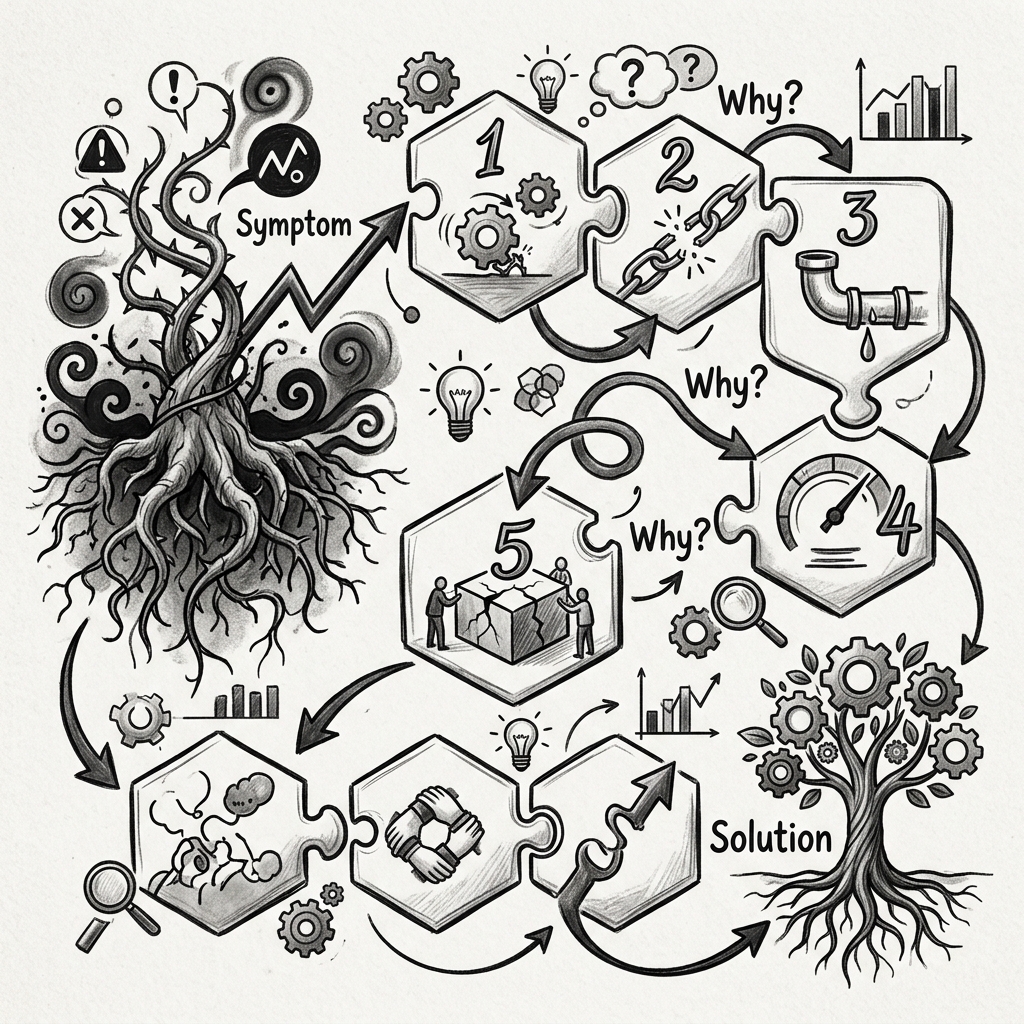
Think of the Kaizen philosophy as trying to shatter a massive, hard rock blocking your path. To remove this rock, you could buy a large amount of dynamite (a major innovation project) and try to blow it up all at once. This method is highly expensive and carries the risk of damaging the surroundings. Moreover, if the dynamite fails to detonate, you are left with nothing but an exhausted budget and an unconquered obstacle. The Kaizen approach, on the other hand, is a tiny drop of water placed on that massive rock. A small drop falling on the exact same spot, every single day, relentlessly. Initially, there is absolutely no visible impact on the surface; but as time progresses, those microscopic drops of water combine to carve into the stone, crack it, and eventually shatter the colossal rock into pieces. Water is not stronger than dynamite; it is simply more persistent.
The Engineering Logic of Compound Improvement
Continuous improvement is a structural defense mechanism built against the natural human tendency toward complacency. Companies tend to freeze their business processes at the point where they are "good enough." Kaizen, conversely, argues that perfection is not a destination, but an infinite journey.
Mathematical Growth and the Power of Time
If every worker in a factory finds a tiny idea to do their job just 1% better every single day, the cumulative impact of this development reaches staggering proportions. The ruthless math of compound interest steps out of financial calculations here and turns into an operational weapon.
- Attempting a 20% leap with a massive annual innovation is akin to a risky gamble.
- Achieving a 1% improvement weekly guarantees that by the end of the year, you will be exponentially far from your starting point, at an unreachable level of efficiency.
Tiny steps reduce the cost of failure to absolute zero. A flawed 1% experiment can be instantly reversed, causing absolutely no financial harm to the corporation. These microscopic steps do not merely cure physical bottlenecks on the assembly line, but also treat organizational blindness. For the true strength of a company lies not in how many high-tech robots it owns, but in how many problem-solving human minds it has actively engaged.
Cultural Transformation and Worker Autonomy
In traditional corporate structures, ideas for improvement only come from top management. Engineers plan in their offices, and the workers on the floor simply execute that plan. This is a massive waste of collective intelligence.
- In the Kaizen system, the person who knows the job best is the operator who performs it every day.
- The duty of top management is not to generate ideas, but to build a safe ecosystem where thousands of minds on the floor can generate them.
A worker who saves three seconds a day by relocating a single screw on a machine is the first drop of water falling on that massive rock. Having everyone involved in the process, from the base of the system to its peak, also eradicates alienation in the workplace.
The Core Pillars of Operational Excellence
For Kaizen to evolve from a mere motivational speech into an unrivaled operational powerhouse, it must be deeply integrated into specific mechanical processes.
The PDCA Cycle (Plan, Do, Check, Act)
Every step of improvement must rely on a scientific method, not a random trial-and-error process.
- Plan: Break the problem down into microscopic pieces and find the root cause. Analyze complex systems down to their microscopic flaws.
- Do: Test the tiny solution locally without halting the entire factory. Designate a pilot zone.
- Check: Measure the data of the test result; was there a genuine improvement? Trust lean math, not assumptions.
- Act (Standardize): If it worked, hardcode this new method into the entire system as a new rule (standard). Thus, that rock is cracked, never to seal again.
Building Upon Standardization
If you do not have a standard, you cannot improve. To climb a ladder, you must first step on a solid rung. Standardizing the current condition prevents backward sliding. Every 1% step taken is locked in as a new standard; thus, the system never slips backward. Over time, this structural locking mechanism transforms the company into an efficient, agile, and cost-effective war machine that competitors can never hope to reach.