Sprint Planning And Velocity
Capacity is measured by data, not hope; a team's velocity is a cold projection of how much work they have actually completed in the past.
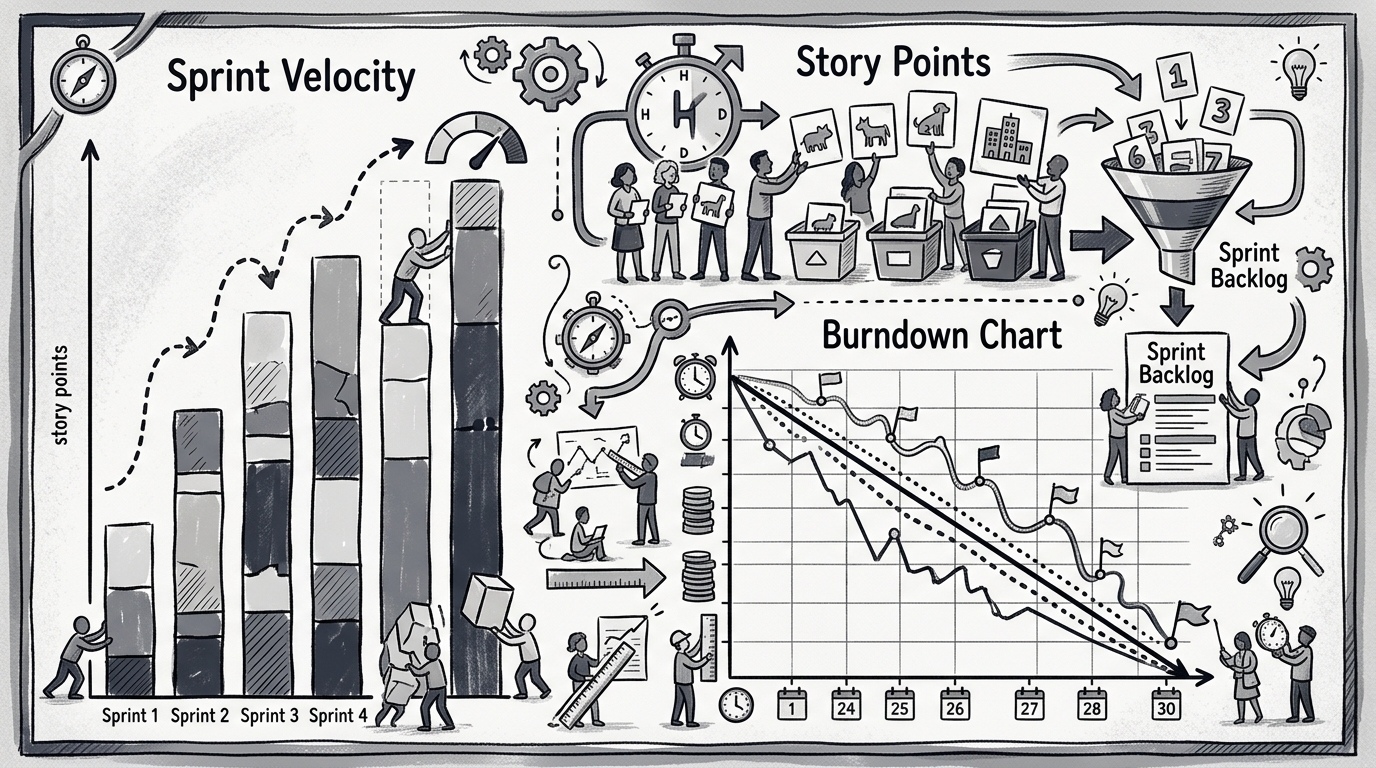
Sprint planning is the ritual where agile teams forge a clear contract regarding what they can achieve within their upcoming short timebox (typically 2-4 weeks). Items are pulled from the product backlog prioritized by the Product Owner, and the development team estimates the complexity of these tasks using relative units of measure like "Story Points." Utilizing relative effort estimation instead of hour-based estimates bypasses human tendency to misjudge time, shifting the focus to the technical difficulty of the work. Once planning is complete, the team commits solely to the selected items and shuts its doors to new external requests, entering an uninterrupted tunnel of focus.
The core metric evaluating the efficiency of navigating this tunnel is "Velocity." Velocity is the total number of story points a team fully completes (Done) during a single sprint. This figure is shaped not by management pushing the team, but by the team's own organic capacity, offering a reliable mathematical foundation to forecast future delivery dates. The clearest visual representative of this process is the Burndown chart. By plotting the remaining amount of work day by day, this chart instantly reveals if the team is deviating from its target, allowing for course correction before the sprint concludes.