Project Management Waterfall And Gantt
Traditional structures reject surprises; every step of the project is frozen from day one, trapping uncertainty within a rigid calendar.
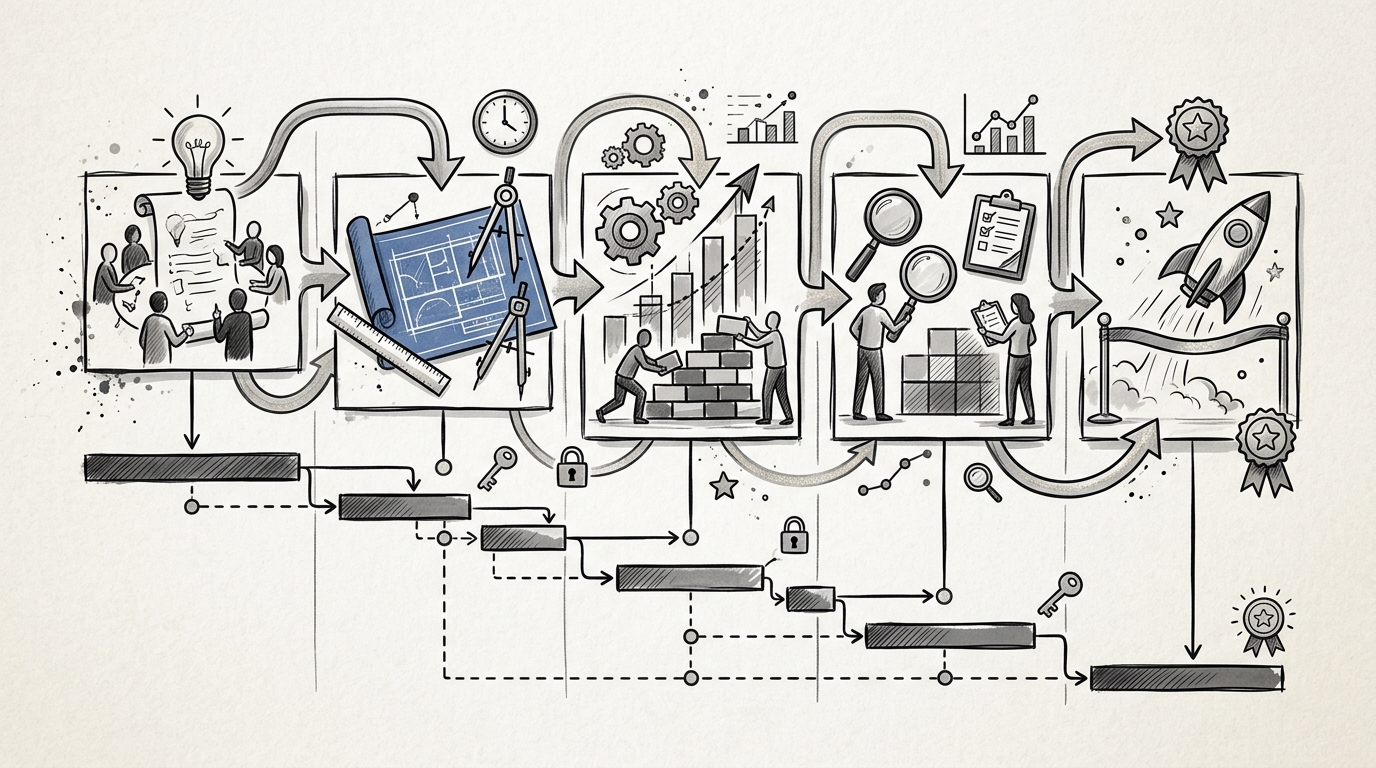
The Waterfall methodology is a sequential project management approach born from the engineering discipline of the industrial revolution. In this system, one phase must be fully completed before the next begins; production cannot start before design is finished, and testing waits for production to conclude. This hierarchical and dependent structure provides an unmatched control mechanism for processes where requirements are clear from the outset and the cost of change is catastrophic, such as bridge construction or massive infrastructure projects. The Waterfall model concretizes the scope of the project by suffocating uncertainty at the very beginning through analysis, budgeting, and rigid contracts.
The most powerful visual tool for this predictability is the Gantt chart. Developed by Henry Gantt, this matrix pairs time and tasks on a horizontal axis, revealing the concept of the "Critical Path." Any delay on the critical path directly pushes back the delivery date of the entire project. Managers monitor complex dependency networks through this chart to ensure resources are allocated to the right work package at the exact right moment. However, the rigid nature of the system makes it cumbersome when responding to sudden shifts in customer expectations; the product that emerges at the end of a months-long development phase might be a solution the market no longer desires.