Hypothesis Engineering and Early Experiment Architecture
The pursuit of perfection is the greatest resource waste in an untested laboratory; the true engineering victory lies in discovering reality at the lowest cost and highest speed.
The traditional business world dictates making massive plans behind closed doors for months or even years before building a product. However, in the modern competitive landscape, it is mathematically impossible to flawlessly predict what the customer actually wants in advance. The vast majority of new ideas launched into the market fail, not because they are technically impossible to build, but because they perfectly manufactured something with massive budgets that nobody wanted to buy. You can create an engineering marvel, but if there is no one to use it, it is just an expensive hobby.
The system developed to solve this profound problem is called lean production and experimental architecture. This approach rescues companies from acting like gamblers at a casino table and transforms them into a rigorous science laboratory that conducts controlled experiments. The objective is to test assumptions in the open field with real customers, thereby experiencing disappointment and capital erosion at the very beginning of the project when very little money has been spent. Risk is reduced not by time, but by the volume of real customer data collected.
The Building Blocks of Systematic Learning
The modern product development process relies on a precise navigation system rather than pushing forward with sheer brute force. This system, through the combination of a few fundamental components, turns the company into a continuous engine of discovery. At the inception of a project, everything is merely a guess; the goal is to transform these guesses into proven facts as quickly as possible.
The Build Measure Learn Engine
The most fundamental operational mechanism companies use when developing a new idea is not holding endless meetings in a closed corporate environment. Instead, the raw idea is immediately transformed into a concrete experiment and forcefully collided with the real world. Building the idea in its most primitive form is the Build phase. Tracking with sensors and analytics how the customer reacts to this primitive structure and whether they actively use it is the Measure phase. Validating or completely correcting the core strategy based on the obtained numerical facts is the Learn phase.
Think of this mechanism as the highly sensitive navigation computer of a rocket launched to a distant planet in the depths of space. When the rocket leaves the launch pad, its trajectory is never flawlessly accurate. Wind, atmospheric pressure, or gravitational anomalies push it off course every single second. As the rocket travels through space, it measures where it is instantaneously with its sensors, and learns its trajectory again with small engine thruster firings, making millimeter-precise corrections. The faster this feedback cycle operates, the less the rocket deviates from its final target. When companies launch a product into the market, rather than stubbornly sticking to plans drawn on paper, they course-correct and repair themselves in mid-air through this exact engine.
The Minimum Viable Product
The cheapest and fastest way to test an idea is to create a core version of the product that contains its simplest and most fundamental function. Often, companies heavily misunderstand this concept, assuming it means releasing an incomplete, constantly crashing, or low-quality product to the public. However, the real goal is to directly test the customer's actual underlying need without the distraction of flashy features. The product must contain just enough function to prove whether a business idea can commercially survive. The user interface may not be visually flawless, but the core solution it offers must work perfectly.
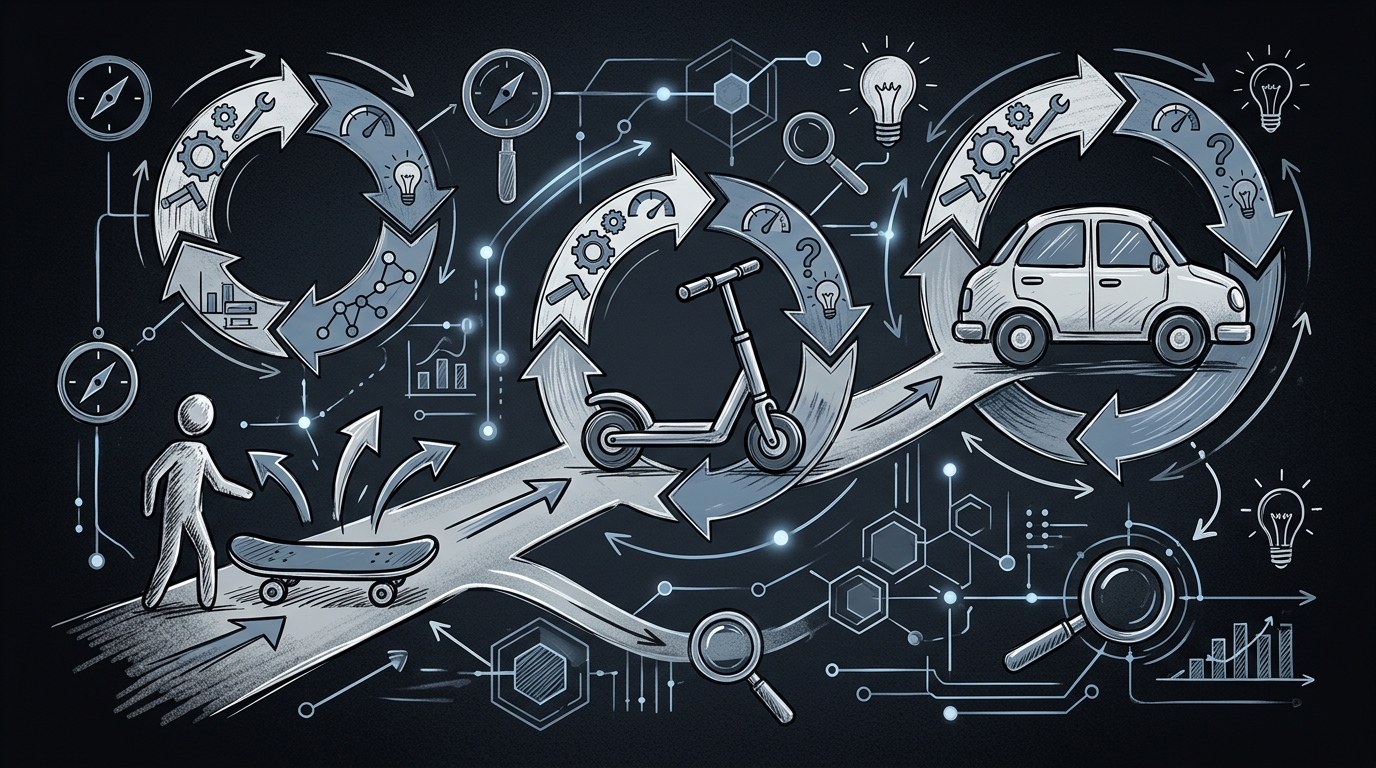
Think of this as designing a transportation vehicle for a person who desperately wants to travel faster from one city to another. Your ultimate vision might be to produce a four-wheel-drive autonomous automobile with air conditioning and a premium sound system. But if you spend your budget producing just a beautiful steering wheel or a single rubber tire and present it to the customer, the customer cannot travel anywhere with it; the experiment fails completely. Instead, in the first iterative stage, you provide a flat wooden board with four wheels attached—a working skateboard. Although it lacks a radio, the customer can physically move with the skateboard, and you mathematically validate their desire to travel from point A to point B. Then you attach a steering column to make a scooter, then add pedals to turn it into a bicycle. At every investment step, the product must be a complete, usable, and value-generating system in itself.
The Pivot vs Persevere Decision
In light of the gathered data, the most critical survival decision corporate boards must make is whether to stubbornly continue walking on the current operational path. If the customer is abandoning the product, it is proven by hard data that the plan is fundamentally flawed. At this critical juncture, while fiercely protecting the company's main goal and vision, the strategy and the product must be radically shifted in another direction. This is called pivoting. Conversely, if the data is highly positive and growth metrics are accelerating, insisting on the same strategy with even more resources—meaning persevering—is strictly necessary. It is essential to view a pivot not as a tragic failure, but as a cheaper path to victory discovered before completely exhausting the capital reserves.
Imagine this dire situation as an intelligent mouse desperately looking for cheese to survive inside a dark and complex maze. The mouse enters a long corridor with great excitement but faces an impassable, solid concrete wall. Despite crashing into this wall—which signifies zero customer demand—the mouse does not try to tear down the wall by hitting its fragile head against it repeatedly. Persevering on the wrong path is simply breaking your skull on that concrete. The intelligent mouse, however, immediately accepts its mistake, turns back, and routes into another completely different corridor. The ultimate goal and the vision of survival remain exactly the same; only the operational path utilized has changed.
Innovation Accounting and Real Metrics
A highly uncertain startup or a massive corporate R&D project cannot be accurately measured with the lagging numbers used by traditional legacy companies, such as quarterly gross sales, net profit, or total market share. The success of a project that is still crawling is measured strictly by how fast it learns and how deeply it integrates the customer into its ecosystem. Many startup founders use flashy but entirely hollow numbers, such as total website page views, the total number of free app downloads, or social media follower spikes, to artificially impress investors or the board of directors. However, the true metric that keeps a software company alive is how many of the people who downloaded the product actually returned to use it the next day or the next week. Actionable, hard numbers reveal the true health of the system, while fake vanity numbers only inflate executive egos.
Think of this next-generation accounting format as measuring the biological growth of a newly planted apple seed in a harsh garden. During the first few critical months after putting the seed in the heavy soil, you cannot measure the project's success by asking, "How many kilograms of apples did the tree yield today?" The tree is not even visible above the ground yet. If you focus solely on the final harvest, you will falsely assume the seed has failed and physically uproot it. But a true agricultural engineer measures success by how deeply the seed's invisible roots grip the soil beneath, and how much the tiny sprout grows in millimeters every single week. In the harsh world of corporate innovation, the depth of those invisible roots is the customer's unbreakable addiction and retention to the newly built product.