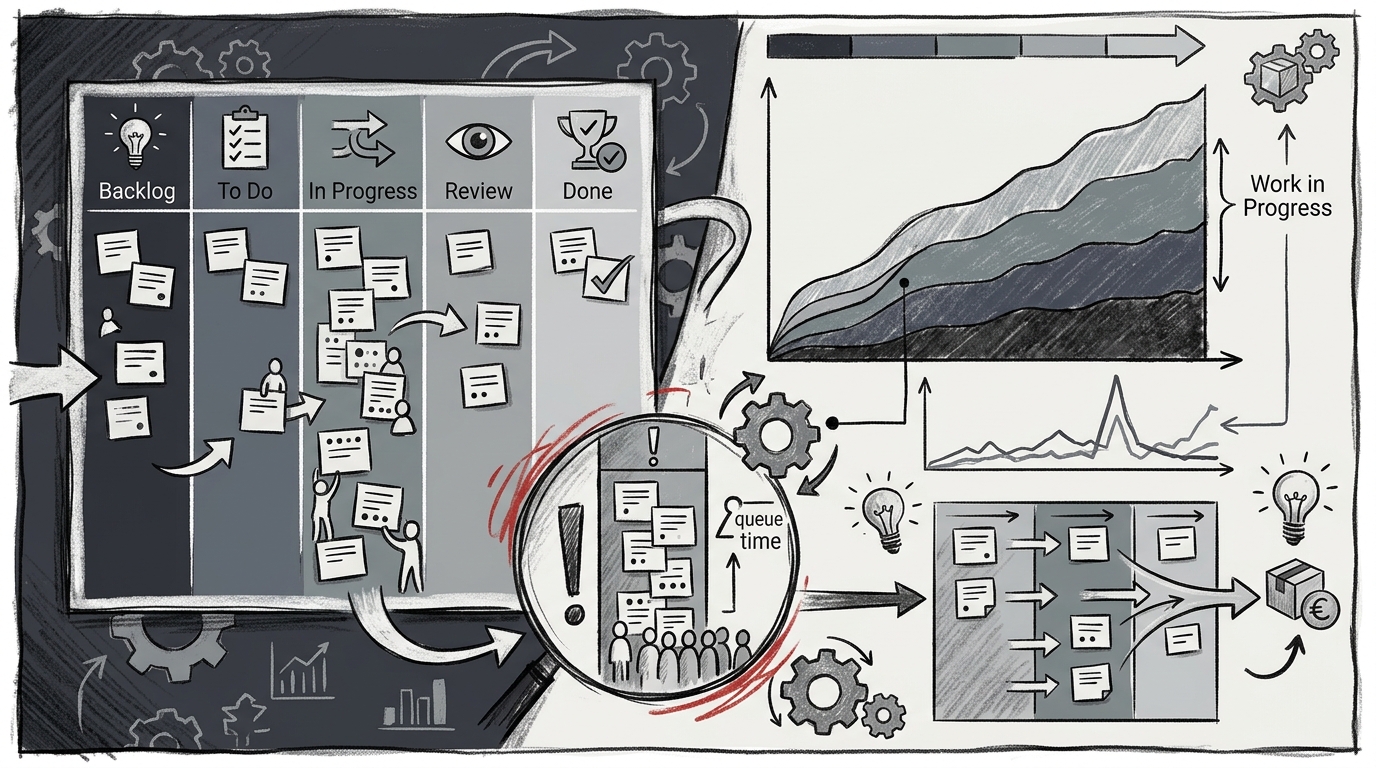
Kanban Cumulative Flow
Starting a task does not create value; value emerges only when it flows unhindered from one end of the system to the other and is completed.
Born on the production lines of Toyota, the Kanban philosophy has transcended physical boundaries to become the most powerful flow management system for digital knowledge work. Unlike Scrum's time-boxed and restrictive cycles, Kanban adopts a continuous liquid flow model. The core mechanics of the system rely on WIP (Work In Progress) limits. When the work limit in a column is reached, the team is forced to focus on resolving the current bottleneck rather than starting new work. This "pull" logic cures teams of the disease of starting too many tasks and finishing none, drastically reducing the Lead Time for delivery.
The most analytical way to audit the health of this continuous flow is through Cumulative Flow Diagrams (CFD). Projecting the columns on the board as area graphs over a timeline, this tool exposes hidden bottlenecks in the system like an X-ray. If the band for the analysis column widens over time while the testing column narrows, it mathematically proves that the analysis team is producing work faster than necessary, while the testing team has exceeded its capacity. Managers look at these expanding and contracting bands to govern resource shifting operations not by intuition, but directly by data.