Engineering The Customer Mind
Applying a perfect solution to the wrong problem is like plating the deck of a sinking ship with gold. Success lies in understanding the problem correctly, not just building the solution.
Design Thinking and the Design Sprint are the most powerful error-prevention systems a company uses when developing a new product. Most companies lock themselves in their laboratories to develop a product they believe is perfect for months, only to bitterly realize upon launch that no one actually wants it. This process represents a radical mindset arguing that a product must be shaped by empathizing with the pain points in the customer's real world, not on an engineer's desk.
We can think of design thinking as a blind tailor making a suit for a new customer. The tailor touches the customer's body with their hands, feeling the measurements physically rather than just looking at numbers on a paper. Then, instead of immediately cutting expensive silk fabric, they sew a rough garment from cheap cloth (a prototype) and have the customer wear it. If the cloth suit is too loose or tight, the tailor makes immediate adjustments. The expensive silk is only cut when this cheap model fits perfectly. Companies, similarly, must risk failing fast with cheap prototypes before investing millions of dollars in code or manufacturing hardware.
The Five Phases Of Design Thinking
This methodology consists of a structured cycle that moves step-by-step but constantly allows for looping backward (iteration) when necessary.
1. Empathize
This is the starting point of everything. It is essential to understand what the customer is experiencing, rather than just what they are saying. People often cannot articulate their problems accurately. A company's duty is to enter the customer's world like a skilled detective, feel their exact pain, and uncover the real issue. If you own a restaurant, you cannot design the menu from your office; you must sit at the customer's table to feel how uncomfortable the chair actually is.
2. Define The Problem
Hundreds of different data points and observations collected during the empathy phase are condensed into a single, focused problem statement in this phase. Asking the right question is half the answer. "Why aren't people buying our product?" is the wrong question. "How can we make it easier for our customers to have a quick breakfast while commuting to work in the morning?" is a correct and well-defined target.
3. Ideate
This is the phase where boundless and crazy ideas are thrown onto the table to solve the defined problem. At this stage, boundaries of logic or cost are temporarily suspended. The goal is not to find the safest route, but to discover the most unique path. Having ten people in a room attacking the same problem from completely different angles ignites the spark of innovation. Mind maps and brainstorming are the fuel of this process.
4. Prototype
This is the stage where the best ideas are selected and tangible, extremely cheap, and rough versions are built. A prototype could be a physical mockup, an application screen drawn on paper, or a box made of cardboard. Its purpose is never to look perfect; its purpose is to be just functional enough to test whether the idea works in the real world. Remember, making a mistake on a cheap paper mockup is free, but making a mistake on a hundred thousand lines of written code can drive a company into bankruptcy.
5. Test
This is the final phase where the produced cheap prototypes are placed directly into the hands of target customers, and their reactions are measured. Where does the user struggle while using the prototype? Where do they smile? Which button can they not find? All these data points are collected. If the test fails, it is wonderful news! Because the company has learned exactly where they would make a mistake before producing the actual product, and they can loop back to previous stages (like ideation or definition) to fix it.
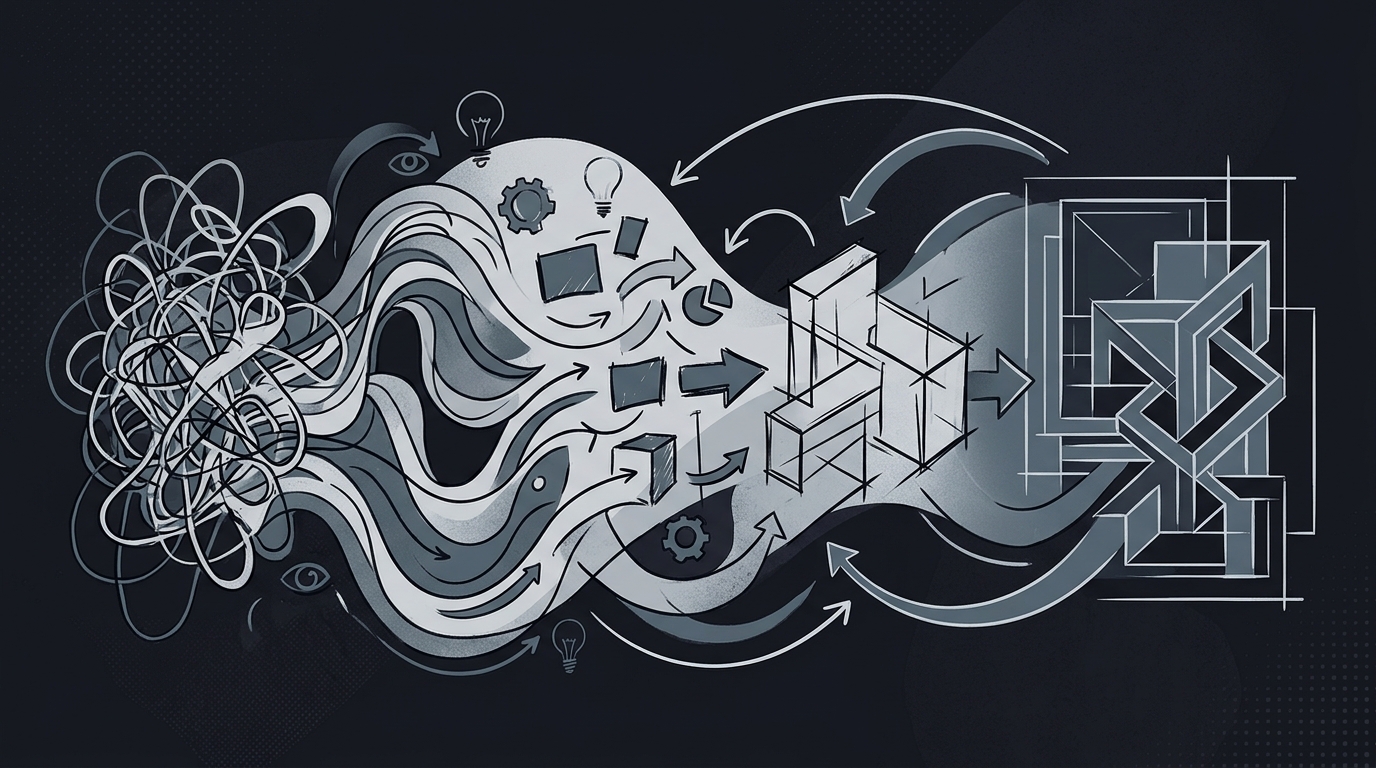
The Architecture Of The Design Sprint
A Design Sprint is an operational formula that compresses the potentially months-long Design Thinking process into exactly 5 days with a ruthless time constraint.
The Power Of Compressed Time
Time is the greatest pressure element that accelerates decision-making. If you give a team six months to solve a problem, they will solve it in six months. If you give them five days, they will solve it in five days. The Design Sprint eliminates endless internal meetings, unnecessary email chains, and analysis paralysis within the company. The problem is defined on Monday, and a solution tested with real customers emerges by Friday.
The Fast Failure Strategy
You do not need to build an idea completely to understand whether it will succeed in the market. A Design Sprint works almost like the art of illusion; it presents the customer with an empty cinema set (a prototype) where only the exterior is painted. The customer interacts with this set, and the company learns whether the idea is valuable in just one week. The moment it is realized they are on the wrong path, the only thing lost is five days, not five years.