Autonomous Factories and Neural Network Integration
The silence of machines is not inefficiency, but the product of flawless communication; systems that talk to each other build an invisible defense web that eliminates surprises and errors long before they occur.
In the modern manufacturing world, we have reached the limits of muscle power and manual control. For businesses to produce faster, flawlessly, and at a lower cost, it has become mandatory to equip physical machines with digital intelligence. Industry 4.0 is a new industrial revolution where every gear, belt, and motor in a factory is connected through invisible data links. This revolution eradicates traditional blindness on production lines, elevating data to the position of the most valuable raw material.
Industry 4.0 and the Digital Evolution of Manufacturing
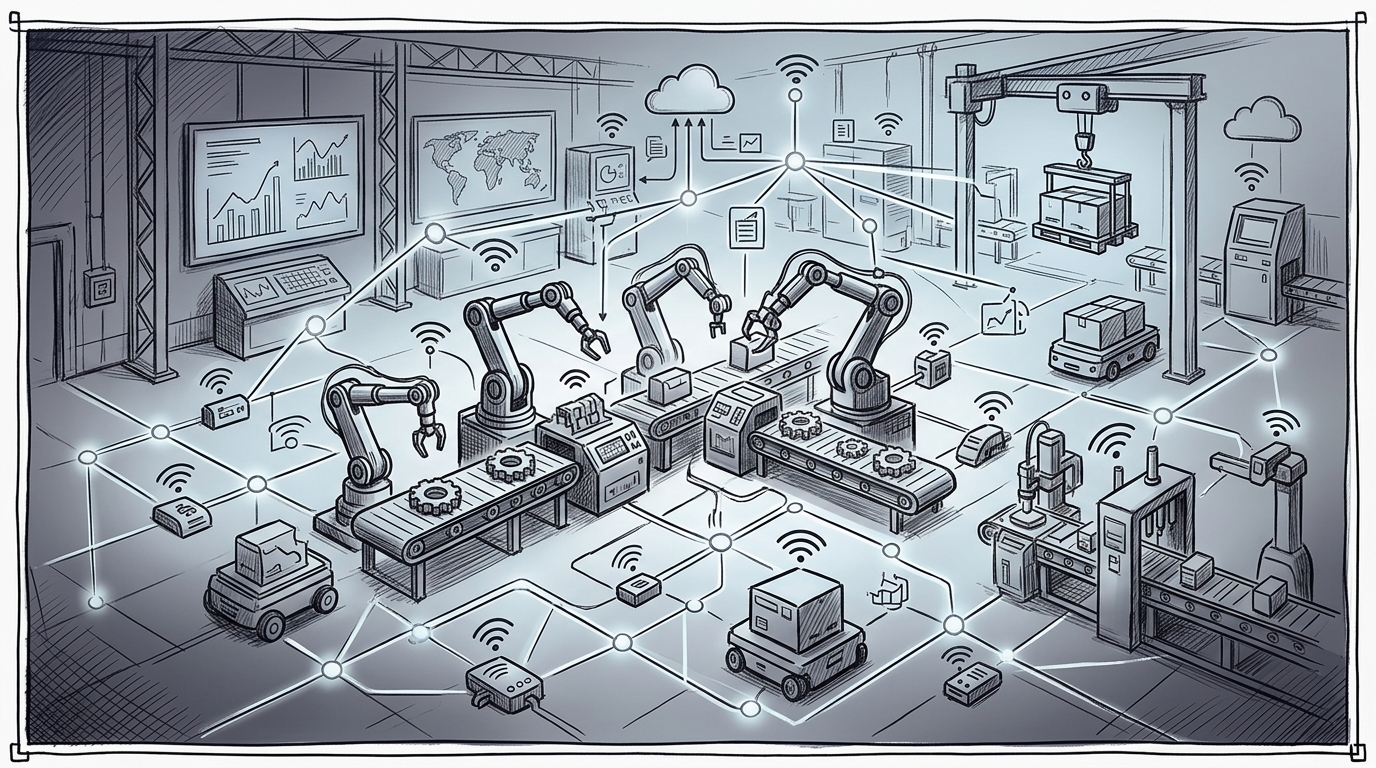
Industry 4.0 signifies that machines in factories are no longer dumb piles of iron simply executing orders, but autonomous units that understand their surroundings and can make independent decisions based on real-time situations. In this architecture, every corner of the production facility operates as part of a massive nervous system.
The Internet of Things (IoT) Concept
The Internet of Things (IoT) is the connection of every machine on the shop floor to the system and the internet via highly sensitive sensors. These sensors instantly measure a machine's temperature, speed, vibration, and energy consumption, transmitting this data to a centralized core.
Think of Industry 4.0 and IoT integration as replacing completely blind and deaf workers with super-smart robots that instantly see everything, feel everything, and communicate with each other through telepathy. Previously, a worker could only see the component directly in front of them, whereas now, a machine can instantly sense a slowdown at the far end of the factory and adjust its own working pace within seconds accordingly. This structure allows every moment of production to be monitored with absolute transparency.
Machine-to-Machine (M2M) Dynamics
Machine-to-Machine (M2M) communication is the direct data exchange between two different pieces of hardware without any human intervention. When a robot on the first assembly line completes its task, it immediately sends a "Part incoming, get ready" signal to the robot on the second line, without waiting for approval from a centralized human controller.
We can think of this integration like smart cars driving in traffic, constantly communicating with each other. When the car in front suddenly hits the brakes, the car behind senses this faster than any human driver and automatically slows down. In a factory environment, M2M manages chain reactions; if a minor delay occurs at one station, the entire facility recalculates its internal rhythm to compensate for the delay or optimize the waiting time.
Dark Factories
Dark Factories are massive production bases where the manufacturing process is executed entirely by unmanned, autonomous systems, physically removing the human element from the equation. Because there is no need for human presence, fundamental requirements like keeping the lights on, heating, or cooling the factory become obsolete.
You can imagine this model as a gigantic, automated clock mechanism. Once energy is supplied to the clock, the gears turn on their own, and there is no need for a human from the outside to open the casing and intervene. Dark factories maximize capacity by reducing human-induced errors in production to absolute zero while completely eliminating interruptions caused by shift changes, breaks, or fatigue.
Big Data and Continuous Analysis
The digitalization of a factory means millions of gigabytes of data flowing every second. Big Data is used to collect this massive, complex pile of information to extract meaningful patterns, trends, and warnings. If the data is not processed, it is merely a digital pile of garbage; however, when analyzed through artificial intelligence algorithms, it transforms into a company's strongest strategic compass.
Predictive Maintenance Systems
The most costly event in manufacturing is the sudden breakdown of a machine, causing the entire factory to halt. In traditional systems, machines are either repaired when they break (reactive maintenance) or their parts are replaced on specific days according to a calendar (periodic maintenance). Predictive Maintenance, on the other hand, analyzes the historical and real-time data of the machine to predict exactly when a failure will occur with mathematical precision.
Think of this process as a machine sensing that it is going to get sick (break down) days in advance from a slightly elevated body temperature or altered breathing (vibration), and whispering to the central system, "Slow down, I am going to stop" (IoT). Predictive maintenance is like a time machine that automatically orders the relevant spare part long before disaster strikes, killing the failure before it is even born. Consequently, healthy parts are not thrown away pointlessly, surprise downtimes are avoided, and the company is saved from millions of dollars in losses.
Autonomous Decision Making and Self-Healing
The system does not just predict failures; it also optimizes itself to preserve machine health. An algorithm that detects a motor overheating can temporarily reduce the machine's rotational speed by 5% without asking a human operator, allowing the temperature to return to a normal level.
You can think of this mechanism like the immune system in the human body. When a minor virus enters your body, your white blood cells destroy it long before your conscious mind even realizes what is happening. Smart factories also repair their own minor internal technical issues autonomously, without upper management ever knowing, ensuring the continuous flow of production.