The Corporate Nervous System
Disconnected minds cannot move toward a unified goal; massive structures only become unshakable when tethered to a single truth.
You can think of the Enterprise Resource Planning (ERP) concept as the central nervous system that keeps a massive organism alive and ensures every single part functions in perfect harmony. Inside any corporation, there are many different departments: finance, production, human resources, warehousing, and purchasing. However, when these departments do not speak to one another, the corporation begins to move like a blind and deaf giant.
In traditional corporate structures, every department keeps its own data in its own private ledger or spreadsheet. The numbers seen by the sales department might be entirely different from the numbers the warehouse holds. This is known as "Silo" management; everyone lives inside their own closed box and has no idea what is happening in the next room. Enterprise Resource Planning shatters these walls and unites the entire company around a single, powerful brain.
The Invisible Backbone of the Corporation
The growth of a company naturally means an increase in its complexity. In an organization where hundreds of employees perform thousands of different transactions, even a single second of information delay can cause massive financial losses. ERP systems collect all this flowing data into a centralized database called the Single Source of Truth. Now, everyone looks at the exact same reality, at the exact same time.
To truly understand how this centralized architecture operates, we must examine its foundational organs individually:
Finance and Accounting (Breath Control)
One of the most critical organs of a company is its finance department. Without an ERP, when the end of the month arrives, people struggle to combine hundreds of different spreadsheets, making human error inevitable. Thanks to an ERP system, every single product that leaves the warehouse instantly transforms into an invoice and reflects on the company's income statement in seconds. This is like monitoring the breathing of a body at all times; you can see exactly where the money is going and where it is coming from with zero delay.
Production and Planning (The Muscular System)
The production line is the muscular power of the company. However, if the brain does not tell the muscles when to move, energy is wasted or the reaction is too late. With ERP, the exact moment a customer approves an order, the machines on the production floor automatically plan when and how much they need to produce. The specific stage of a product, machine speeds, and downtime durations are instantly recorded into the system.
Purchasing and Inventory (Energy Reserves)
If you realize you are out of gas at the last moment while driving, you will be stranded on the road. Purchasing and inventory management are the energy reserves of the company. The ERP system calculates in advance when the materials required for production will run out. When the raw materials on the shelves drop below a certain threshold, the system automatically sends a new purchase order to the supplier. This ensures that production never halts and excess materials are not bought to rot in warehouses.
Human Resources (Cellular Regeneration)
The main elements keeping a company alive are its people. Recruitment processes, payroll payments, performance evaluations, and leave days are managed in a shared pool through the ERP system. The connection between an employee's efficiency on the production line and the bonus they receive can be analyzed with the click of a single button.
One Reality and Instant Reaction
We can understand the fundamental purpose of this entire system much more clearly through human reflexes. Let us imagine the central nervous system in our bodies, the brain and the spinal cord, as a giant piece of ERP software.
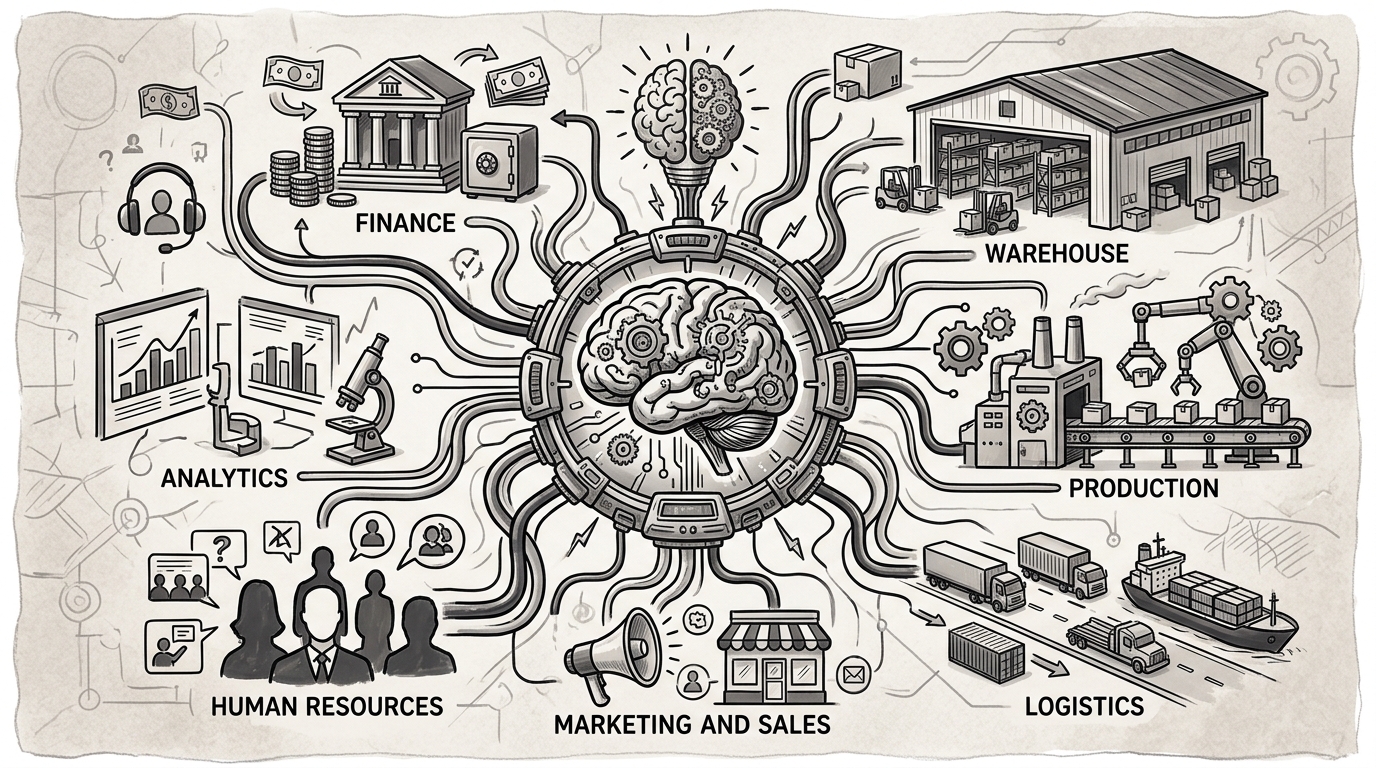
When the eye (the Sales department) sees a great danger or a massive opportunity ahead, it instantly transmits this information to the brain (ERP). Without wasting any time, the brain mobilizes the hands (Production) and the feet (Logistics). The hands quickly defend the body, and the feet quickly run toward the target.
However, if this nervous system is disconnected (the Silo structure), even if the eye sees the danger, it takes minutes for the brain to process it. The hands remain unaware and motionless, and ultimately, the body takes a severe wound. This exact scenario happens in companies; if the sales team sees a sudden spike in demand but relays this information to production weeks later, customers will encounter empty shelves, and the company will suffer a huge loss. ERP accelerates this information flow to the speed of light, making the company's reflexes flawless.
Enterprise resource planning is not merely a software application; it is a profound management philosophy. It forces departments speaking different languages to sit at the same table and teaches them one universal language. By doing this, time waste is reduced to zero, errors are automatically caught by the system, and managers can focus on designing the future with their data instead of endlessly chasing it.