The Geometry of Invisible Needs
Human desires are formless and immeasurable; engineering speaks exclusively in rigid numbers. A successful product is the result of a flawless translation between these two foreign languages.
Before manufacturing a product, the greatest danger a company faces is not the cost of production, but the cost of producing the wrong product. Customers do not understand complex engineering jargon. They only feel how a product should simplify their lives. The task of a company is to transform these abstract feelings into concrete, measurable commands that factory machines can execute.
At the heart of this translation process lie two foundational pillars: Voice of the Customer (VOC) and Quality Function Deployment (QFD). These two systems construct a massive bridge connecting emotional expectations to unbreakable engineering rules.
The Voice of the Customer and the Nature of Need
The Voice of the Customer is every expectation the market whispers, or sometimes shouts, at you. However, this voice is often scattered and lacks technical clarity.
Gathering Emotional Demands
When buying a car, customers do not walk into a factory and say, "I want this vehicle to have 400 Nm of engine torque and a suspension travel tolerance not exceeding 5 centimeters." Instead, they say, "I want the car to feel effortless uphill," or "I don't want to feel the bumps inside." These statements are entirely organic, emotional, and immeasurable. The data that companies collect through surveys, complaint hotlines, and market research forms the Voice of the Customer pool.
Listening to the Voice of the Customer is like trying to understand your surroundings in a pitch-black room using only your sense of hearing. You need a highly sensitive instrument to determine the source and shape of the sounds. If you attempt to feed these sounds directly into production, the resulting product will likely be entirely detached from expectations.
Quality Function Deployment QFD
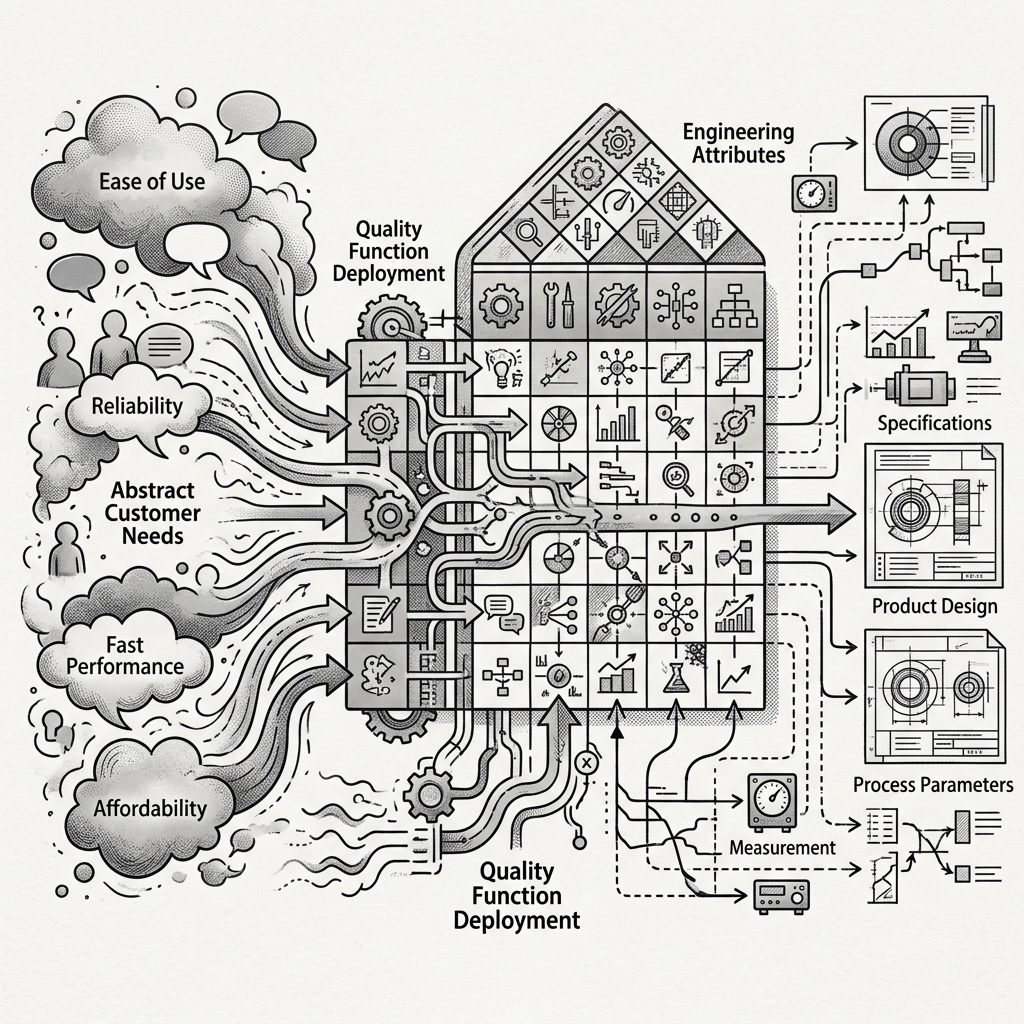
This is precisely where Quality Function Deployment (QFD) comes into play. QFD is a flawless mathematical system that takes those shapeless sounds you hear and converts them into millimeter-precise measurements on the factory floor.
QFD as the Ultimate Translation Device
Think of QFD as a massive, highly sophisticated translation device. Imagine you are in a restaurant. A customer speaks in a foreign language saying, "I am craving something sweet." This is an abstract desire. If the waiter simply repeats this exact sentence to the chef, the kitchen will not know what to do. However, the QFD device takes this sentence and translates it into the language the kitchen understands: "Set the oven to 180 degrees, use 200 grams of flour and 150 grams of sugar, and bake a cake for 40 minutes."
QFD takes the customer's request of "The car shouldn't feel bumpy" and transforms it into Technical Specifications like "Increase shock absorber resistance by 15% and widen tire sidewall thickness by 5 millimeters." Consequently, the engineers sitting at the design table know exactly what they need to work on. Communication breakdowns are entirely eliminated.
Anatomy of the House of Quality
The most renowned application tool of the QFD system is a specific matrix called the House of Quality. This matrix genuinely resembles the rooms of a house, with each section serving a distinct purpose.
The Left Wall Customer Expectations
The left wall of the house belongs entirely to the customer. This is where the answers to "What does the customer want?" are listed vertically. At the same time, the importance of these requests is scored.
- Usability Expectation: "The phone battery must last long."
- Durability Expectation: "The screen shouldn't break easily."
- Ergonomics Expectation: "It shouldn't be too heavy in my pocket."
If a long-lasting battery is more critical to the customer than being lightweight, its priority score is assigned accordingly.
The Ceiling Technical Requirements
Engineers reside on the ceiling of the house. Here, you find the numerical answers to "How do we technically fulfill these requests?"
- Battery Capacity (mAh):
- Glass Hardness Level (Mohs):
- Chassis Material Density (g/cm³):
The ceiling must consist of physical units that are completely measurable and testable in the factory.
The Center Room Relationship Matrix
This is the main hall where the actual translation occurs. The customer demands on the left wall and the technical measurements on the ceiling intersect in this room. The desire "The screen shouldn't break" is strongly linked to "Glass hardness level" on the ceiling. If a customer desire has no technical counterpart on the ceiling, that request has been forgotten in the product design. If a technical feature has no customer counterpart on the left wall, the company is wasting money on a feature nobody cares about.
The Right Wall Competitive Analysis
On the right wall of the house, an analysis is conducted to see how well other competitors in the market meet these exact same customer requests. If all competitors excel at "Lightweight design," the company might decide not to attempt a revolution in that area, but instead allocate its entire R&D budget to the "Battery life" issue, where competitors are weak.
Through this system, companies are saved from spending their resources blindly. Every single engineering decision is mathematically tethered directly to the money that will come out of the customer's wallet.