The Absolute Filter Stage Gate Mechanisms
Killing a flawed project on time is as vital a corporate capability as launching a good one; the cost of failure multiplies exponentially with every gate passed.
In the corporate world, product development is a highly costly endeavor that often begins with great excitement and optimism, but can lead to massive cash burn if left unchecked. When transforming an idea into a tangible product, companies face countless risks along the way: flawed market analysis, manufacturing costs spiraling out of control, or insurmountable technological hurdles. To keep these risks under strict control, optimize resource allocation, and prevent emotionally driven decisions, a rigorous management system known as the Stage-Gate Process is utilized.
The Stage-Gate process is a methodological framework that breaks down product development into manageable, distinct phases (stages) and places a strict management checkpoint (a "Gate") at the end of each. Fundamentally, this system prevents corporate management from falling into the psychological trap known as the "Sunk Cost Fallacy." It stops the dangerous mindset of thinking, "We've already spent millions, we can't turn back now," effectively preventing the compounding of severe financial losses.
The Core Anatomy of the Stage-Gate System
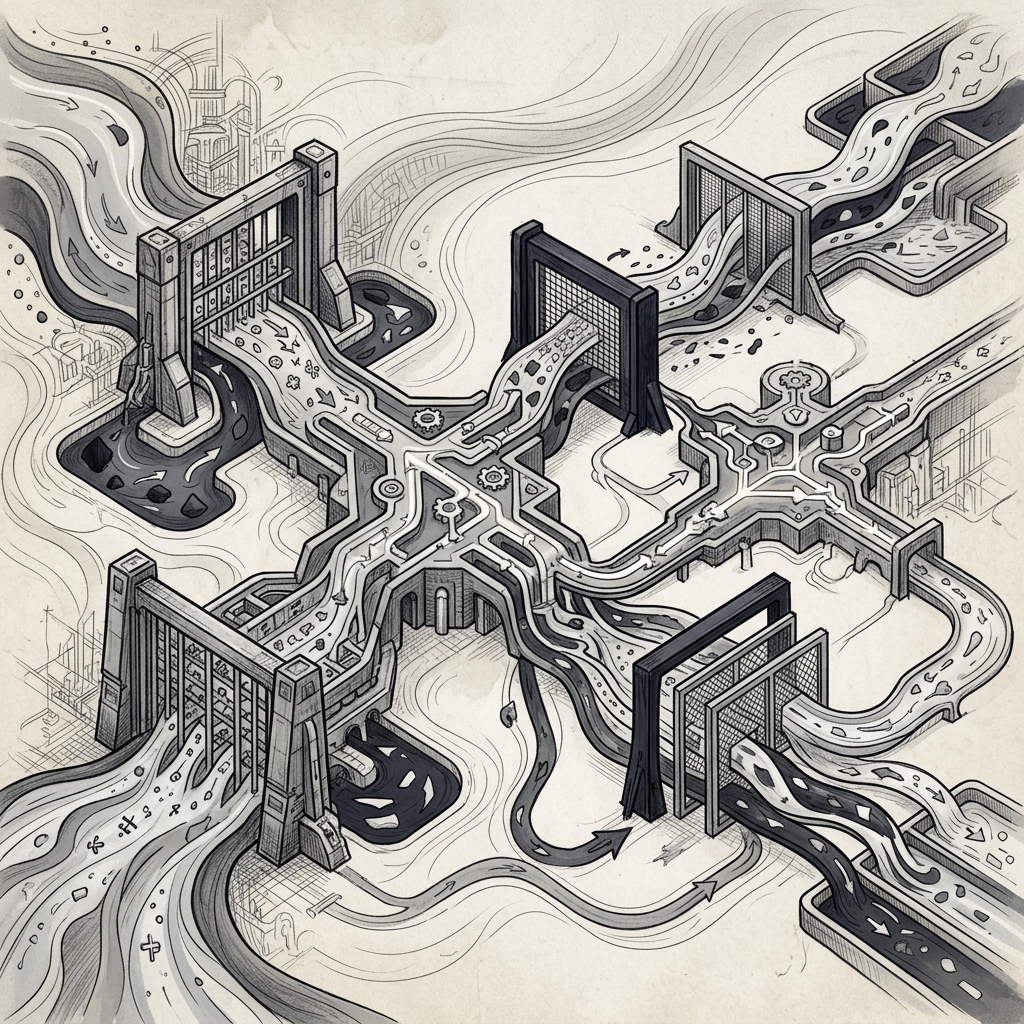
Think of this process as a sequence of highly secure checkpoints in an international airport. If your passport is invalid, your ticket is missing, or there is something dangerous in your luggage (representing a project that lacks market potential or is technically unfeasible), you simply cannot pass through the next gate. The airport authorities stop you right there, and you are never allowed to board the plane (enter the market). These absolute security filters ensure that a catastrophic flight (a commercial failure) is prevented before it even leaves the ground.
Gate Logic and Decision Mechanics
At each gate, a designated committee (the Gatekeepers) meticulously examines the project using very sharp, predetermined metrics. Following this evaluation, the committee can emerge with one of four distinct decisions:
- Go: The project meets all critical criteria flawlessly. The budget is approved, and the team may proceed to the next stage. (The passenger clears security smoothly.)
- Kill: The project's projected costs are too high, market demand is vanishing, or the technology is impossible to scale. The project is immediately terminated, and resources are cut off. (The passenger is denied boarding, and the ticket is canceled.)
- Hold: The project has merit, but current market conditions are unfavorable, or corporate budgets are currently constrained. The project is shelved for future consideration. (The passenger is sent to a waiting lounge; the flight is delayed.)
- Recycle: The project lacks crucial information or data. It is sent back to the previous stage so that specific details can be reworked and gaps can be filled. (The passenger is missing a document and sent back to retrieve it.)
These ruthless gates protect the company's most valuable assets—its cash reserves and time—from massive waste.
Standard Stage-Gate Phases
Modern organizations typically manage complex projects by pushing them through five fundamental stages. The gate following each stage dictates the project's fate based entirely on the concrete data produced during that phase.
Stage 1: Discovery and Idea Generation
This is the initial phase where the concept for a new product or service is born. The company's R&D teams, marketing specialists, or even direct customer feedback identify a potential problem and a suitable solution. There is no massive budget assigned yet; the goal is simply to see if the idea is broadly defensible.
At the first gate, the committee asks, "Does this idea align with our overall corporate strategy, and does it address a genuine fundamental need?"
Stage 2: Scoping
If the idea passes the first gate, the scoping phase begins. Here, a rapid, low-cost investigation into market potential, technical difficulty, and potential competitors is conducted. The objective is to determine if the project sits on a viable commercial foundation rather than just being a "neat idea."
At the second gate, the committee reviews early cost estimates and asks, "Is the time and energy we will spend on this truly worth the potential reward?"
Stage 3: Building the Business Case
This stage is the most critical and detailed phase that ultimately determines the project's fate. The product's design parameters are finalized, deep customer analysis is conducted, and a comprehensive financial projection is built. The capital requirements, expected revenues, break-even point, and Return on Investment (ROI) are presented in hard, precise numbers.
The third gate is the toughest security screening in the airport. If the financials show a negative ROI projection, no matter how shiny the project looks, the Gatekeeper must press the red Kill button without mercy. The sunk cost bias is explicitly rejected at this gate.
Stage 4: Development
With the business case approved, the project finally moves into actual production. Engineering, software, or design teams build a real, working prototype of the product. Designs leap off the paper and become tangible. Operational plans are solidified, and supply chain logistics are finalized.
At the fourth gate, the committee verifies that the physical prototype actually aligns with the standards, costs, and quality promised in the business case before moving to testing.
Stage 5: Testing and Validation
The prototype leaves the lab and is subjected to real-world conditions. The product is presented to pilot customers, beta tests are executed, and potential bugs are aggressively hunted down. The marketing department tests their sales scenarios live in the field.
At the fifth and final gate, the ultimate question is asked: "Are customers actually buying this, and does it perform exactly as advertised?" If the machinery is working flawlessly, the final "Go" is given for commercial launch, and the plane takes off from the runway.