The Biological Life Form of Products and Market Evolution
Every product launched into the market is a mechanical organism marching toward its own demise; true corporate triumph lies in financing new life before that death occurs.
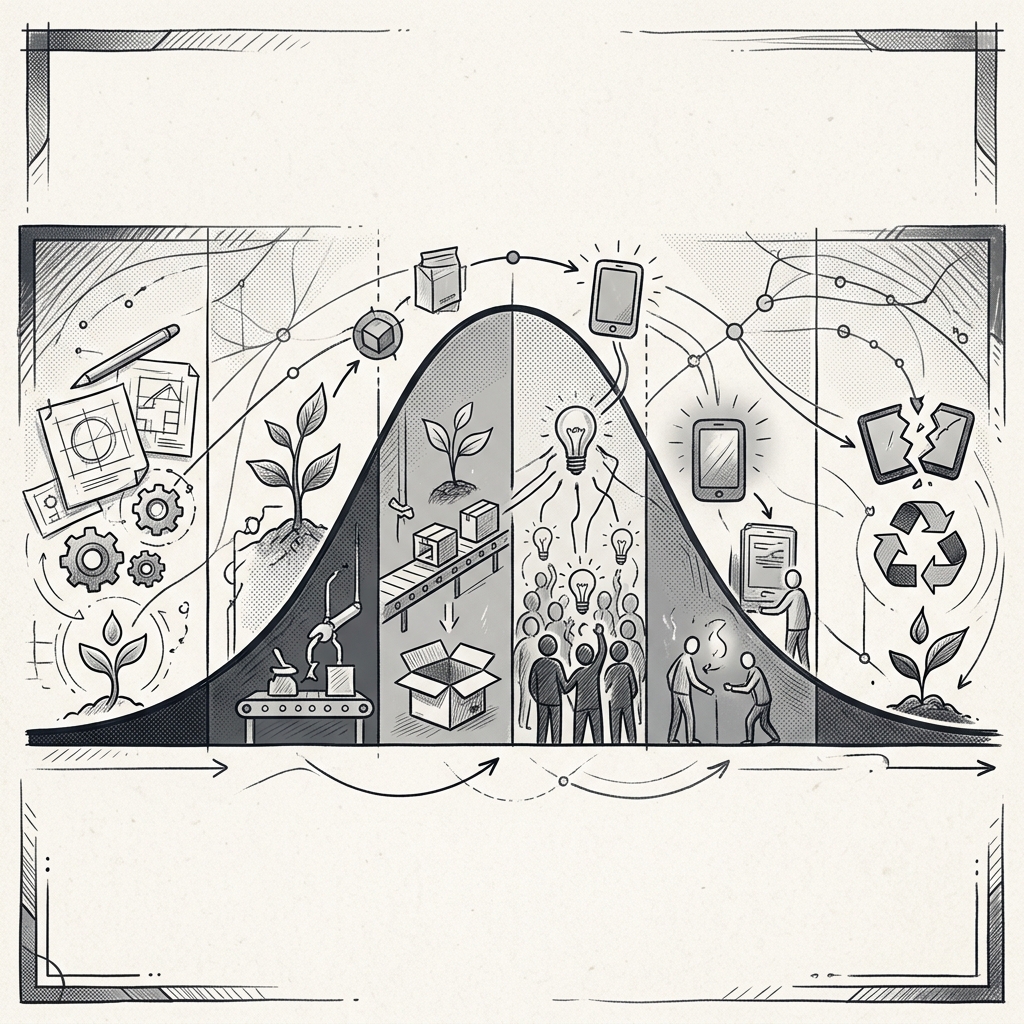
Just like living, breathing organisms, every commercial product introduced to the market has a lifecycle that results in its birth, growth, maturity, and eventual exit from the stage. This continuum is not a random market fluctuation, but a relentless evolutionary law known as the Product Life Cycle (PLC). A company's survival depends entirely on accurately reading this cyclical biological clock and timing its capital flow correctly.
We can think of the product life cycle as a human life. A product that requires constant care and investment in its infancy gradually strengthens and enters its youth. When it reaches adulthood, it finally has the power to support its family (the company). However, like all living things, it has a lifespan, and when it reaches old age, it must step aside for the new generations.
Introduction Stage (Infancy): Investment and Awareness
A newly launched product is exactly like a newborn baby. It cannot stand on its own feet, requiring constant attention and massive amounts of resources. At this stage, the company's primary goal is not to make a profit, but to ensure the product keeps breathing.
Cash Flow and Financial Burden
During the introduction phase, cash flow is strictly negative. Research and development costs, establishing production lines, and massive marketing campaigns cause a constant drain on the company's treasury. The baby is rapidly consuming its parents' resources. If financial endurance cannot be maintained during this phase, the product will perish before it even learns to walk.
Competition and Market Education
Direct competition is generally low at this stage because an established market does not yet exist. The company's biggest enemy is not rivals, but customer ignorance. Therefore, the marketing strategy focuses heavily on educating the market rather than hard selling. The customer must be taught why this new product exists and what problem it solves.
Growth Stage (Youth): Momentum and Scaling
Having survived infancy and learned to walk, the product transforms into a rapidly growing teenager. Customers now understand what the product does, and an explosion in demand begins. This period is both a thrilling and highly dangerous storm phase.
Sales Acceleration and Cash Conversion
In the youth phase, the sales curve climbs sharply upward. Cash flow finally crosses into positive territory. However, this generated revenue is usually reinvested back into the system to increase production and expand distribution networks. The product is growing rapidly and requires more nutrients.
The Arrival of Predatory Competitors
Smelling blood in the water, other companies (competitors) quickly rush into the market to grab a piece of the pie. The young product must now not only prove itself but also fight against fierce rivals. The strategic focus shifts to creating brand loyalty and aggressively expanding market share.
Maturity Stage (Adulthood): The Peak and Cash Cows
When the storm of growth subsides, the product becomes a mature adult with fully developed muscle and bone structure. This phase is the golden age where the product remains the longest and dictates the company's destiny. As an adult child, it must now provide for the family (the company).
The Cash Cow Phenomenon and Systemic Financing
A product in the maturity phase has long since amortized its R&D and marketing costs. Production processes are perfected, and costs have plummeted to the bottom. These products now turn into cash cows for the company. They carry the entire financial burden of the enterprise. The most critical point is this: the massive cash surplus generated here is utilized to finance the company's new babies (new projects in the introduction phase). If the revenue of a mature product is not transformed into new seeds, the company is doomed to die.
Profit Optimization and Defensive Warfare
The market is now saturated, and finding new customers is nearly impossible. Growth has halted. Companies attempt to steal each other's customers. The marketing strategy is built entirely on defense. The company offers price discounts to retain loyal customers, adds small new features to the product, and focuses on maximizing profit margins.
Decline Stage (Old Age): Exiting the Stage
No matter how powerful and profitable, every product eventually ages due to changing technologies or shifting customer habits. Demand falls, competition becomes meaningless, and staying on the stage becomes increasingly costly.
Ruthless Reality and Harvesting Strategy
Spending massive budgets to keep an aging product alive is strategic suicide. Instead, the company implements a harvesting strategy: all investments in the product are cut off, and only the final crumbs of profit it can generate on its own are collected.
Liquidation and Rebirth
When the product begins to drain the system's energy, it is time to pull the plug (liquidation). The remaining resources are transferred to the creation of a new baby product. Thus, the corporate biological clock resets itself, and the cycle begins anew.