The Innovation Funnel and Idea Mining
True innovation is not about finding more ideas; it is the ability to bravely and rapidly discard thousands of bad ones. Excellence is the single solid truth that remains.
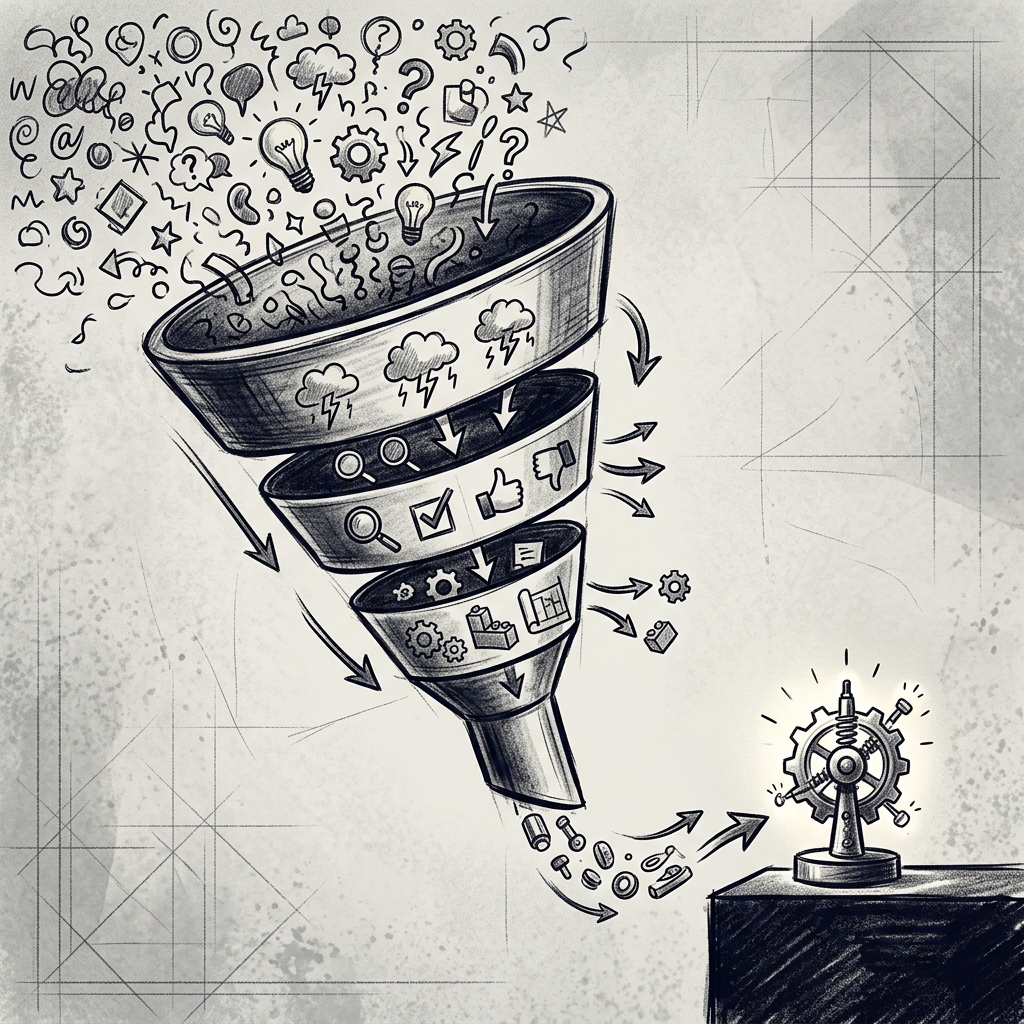
Developing a new product is often imagined as merely having a brilliant idea in a laboratory and immediately manufacturing it in a factory. However, in the real business world, the New Product Development (NPD) process is a highly ruthless, disciplined, and step-by-step mathematical elimination. A company might generate hundreds of brilliant ideas every year, but if it attempted to manufacture all of them, it would inevitably be crushed by costs and face bankruptcy. For this reason, companies throw their ideas into a massive funnel. The top of the funnel is very wide and crowded, but as you move down, the weakest ideas are filtered out and ruthlessly expelled from the system at every stage.
We can think of new product development as using a sieve in a gold mine. You take millions of tons of mud and rocks (hundreds of bad or ordinary ideas) and pass them through various sieves (testing stages). Stones, dirt, and worthless minerals fall away at each layer. In the end, only a few grams of priceless, shining pure gold remain. That successful new product launched into the market is that single piece of gold that managed to survive this ruthless elimination process.
The Mandatory Stages of Product Development
For a product to transition from a mere illusion into profit on a company's balance sheet, it must pass through six critical stages. Each stage is more challenging and requires significantly more capital than the last.
Idea Generation
This is the highest and widest point of the funnel. The primary goal at this stage is not quality, but quantity. New product concepts are continuously collected from company employees, customers, market research, and even competitor analysis.
- Brainstorming: A completely free-thinking environment where no idea is judged as absurd. A crazy idea from an engineer might spark a completely different commercial flame in a marketer's mind.
- Casting a Wide Net: It is the moment muddy water is first poured onto the mining sieve; it is not yet known if there is gold inside, but as much material as possible is gathered. The greater the quantity, the higher the chance of finding gold.
Idea Screening
This is the step where the hundreds of gathered ideas are put through a cold logic filter for the first time. The company ruthlessly discards ideas that do not align with strategic goals, are technically impossible to produce, or will face insurmountable legal barriers.
- Rapid Filtering: The only question answered is, "Can we and should we realistically do this?" There is no room for emotional attachment.
- Elimination Mechanics: It is the first rough cleaning stage where large rocks (obviously useless or illogical ideas) stay on top of the sieve and are immediately tossed aside.
Business Analysis
The few remaining ideas are now put through a strict financial X-ray. Producing the idea might be technically possible, but will it make money? The company mathematically calculates estimated manufacturing costs, the targeted selling price, and the potential profit margin.
- Profitability Test: If the product does not pay for itself within a few years and fails to meet the company's growth targets, no matter how brilliant it is, the project is halted instantly.
- The Power of Numbers: It is putting the gold dust through a chemical test; it might shine, but is it truly valuable? Numbers and mathematical projections never lie.
Product Development
This is where ideas, drawings, and financial spreadsheets are transformed into a physical or digital reality for the first time. Engineers and designers build a prototype (the first working model) of the product. This stage is where the funnel begins to narrow significantly and where the most money and time are heavily invested.
- Prototype Construction: The product is tested in a laboratory environment to see if it actually functions. Necessary safety and quality tests are conducted at this point.
- The Cost Wall: It is the critical threshold where the idea takes flesh and bone, but also where massive cash outflows from the company's treasury begin. Turning back becomes increasingly difficult.
Test Marketing
The prototype works and looks perfect, but will the customer actually buy it? Before the product is rolled out to the entire world, it is offered for sale in a small, isolated, and restricted market (for example, just a single city or a narrow user group).
- Real-World Observation: Customer reactions to the product, the effectiveness of advertisements, and price acceptance are tested with real money and real people.
- Risk Mitigation: Before sailing into the ocean (the global market), it is floating the ship in a small lake to check if it takes on water. If there is a flaw, it is fixed here before it is too late.
Commercialization
That single idea that successfully passes all stages, laboratory tests, and real customer trials now enters mass production and is fully launched into target markets with a massive marketing budget. The product is no longer a project; it is one of the company's lifeblood arteries.
- The Grand Launch: The ultimate operation where factories run at full capacity, logistic chains are established, and advertisements are broadcast everywhere. At this stage, the system is at full throttle.
- Pure Gold: It is the release of the flawless gold ingot into the display case after months of sifting, washing, melting, and hammering. Only the most resilient and powerful products can reach this stage.