The Flawless Pattern of the Blind Tailor
The true solution is born not from a brilliant idea in an engineer's laboratory, but from the echo of the user's silent struggle.
Traditional manufacturing logic attempts to build the perfect product behind closed doors and then force it onto the market. Enterprises often spend millions of dollars on ideas they believe are fantastic within their own offices, only to painfully discover that nobody wants to buy the product once it launches. The modern business methodology of Design Thinking completely reverses this nightmare. It builds the product not on the isolated engineer's desk, but directly around a real-world "pain point" that the customer is actively experiencing.
Imagine this entire process as a blind tailor trying to sew a flawless suit for a customer by only feeling with their fingertips. The tailor (the company) first touches the customer's shoulders, feeling their exact posture, dimensions, and curvature. Then, they sew a rough garment out of cheap cotton (the prototype) and have the customer wear it. They instantly feel where the fabric is too tight or where it hangs too loose. Only after all the flaws are found and corrected does the tailor cut the expensive silk fabric. This ensures that the costly silk (representing massive corporate time and capital) is never wasted. Failing fast and cheaply is actually the strongest armor that guarantees ultimate success.
The Five Phases of Design Thinking
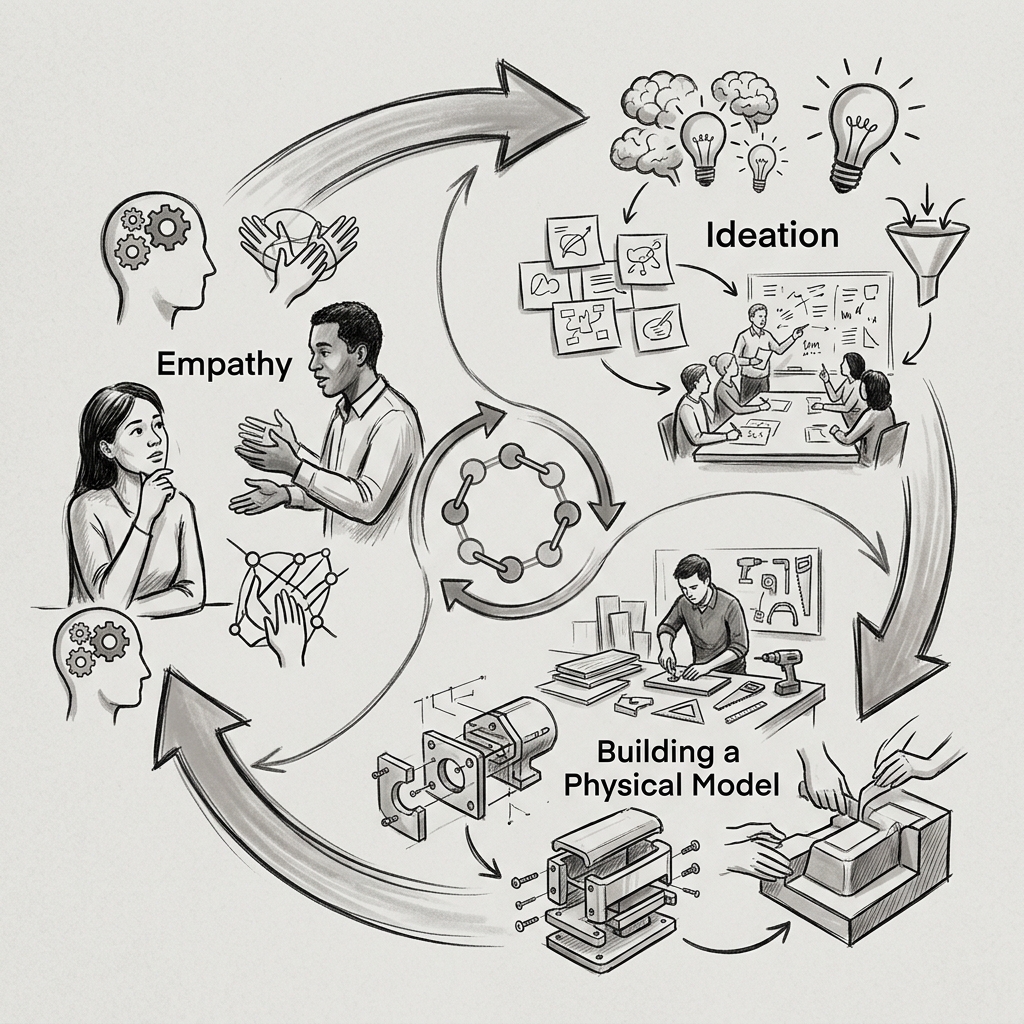
The design thinking methodology consists of five core phases that are deeply and structurally interconnected. These are not just one-time, linear steps to cross off a list, but living, continuous cycles where you constantly loop back to make necessary improvements.
The Empathize Phase
Empathy is the exact moment the blind tailor touches the customer's shoulders and feels the actual weight and truth of their physical posture. For modern companies, empathy is not just about listening to what the customer says; it is about actively observing what they experience out in the field. The product designer steps out of the building and into the customer's world to understand their daily struggles, frustrations, and hidden needs without any prejudice or judgment. Pure data and surveys are often cold and superficial; empathy, however, internalizes the user's actual pain. Many giant corporations fail at this very first step because they assume they can understand their customer from the comfort of a leather office chair.
The Define Phase
Once the customer's world is thoroughly understood, all the scattered observations are brought together to clearly and sharply define the core problem. This is the tailor realizing, "The customer's right shoulder is lower, which is why standard jackets always bunch up on that side." Defining the right problem is half the ultimate solution. In the business world, this is known as crafting a solid "Problem Statement". If a company focuses its energy on the wrong pain point, even the most perfectly engineered product will simply become a tool that no one cares to use.
The Ideate Phase
After the core problem is strictly diagnosed, the mind is set free in the ideation phase. At this critical point, limiting words like "impossible", "too expensive", or "ridiculous" are completely banned from the boardroom. The tailor imagines a thousand different cuts, stitching techniques, and patching styles. In this phase, companies freely put the most innovative, unconventional, and practical methods on the table to solve the defined problem. Initially, quantity (a massive volume of ideas) is targeted rather than pure quality. The sheer abundance and diversity of ideas incredibly increase the probability of discovering a truly unique and high-quality final solution.
The Prototype Phase
The most promising ideas are selected from the pool and quickly transformed into a physical, testable form. This is the tailor sewing a rough draft from the cheapest cotton cloth before ever touching the expensive silk with scissors. A prototype is never meant to be perfect, beautiful, or fully functional; it is built solely to test if the underlying logic and idea actually work in reality. A folded piece of paper, a simple cardboard model, or an un-coded, clickable digital screen (Low-Fidelity) can serve as a prototype. The main goal is to materialize an abstract idea into a concrete laboratory mouse while spending the absolute minimum amount of money and time.
The Test and Iterate Phase
The cheap prototype is immediately handed to the customer to measure their genuine, unscripted reaction. The tailor puts the rough cotton suit on the customer and asks them to raise their arms and move around. If the suit tears or restricts movement under the armpits, this is fantastic news for the company! Because only the cheap cloth tore, not the thousands of dollars worth of expensive silk. When companies test prototypes, they rapidly spot their own blind spots, improve the product based on harsh customer feedback, and restart the cycle. Failing fast, harmlessly, and cheaply is the safest, most profitable, and most practical path for businesses to reach the right solution.