The Synchronized Creation Engine
While traditional systems arrange time in a linear sequence, perfectly engineered structures fold time over itself to make impossible speeds mundane.
In the modern world of engineering and manufacturing, time is not merely a derivative of money; it is the absolute arbiter of market dominance. During the product development cycle, the lack of interdepartmental communication and the logic of sequential progression constitute the greatest systemic flaw, causing companies to hemorrhage both time and cash. "Concurrent Engineering," developed to solve this exact problem, is not just a manufacturing technique; it is a strategic philosophy that transforms time into a weapon against competitors.
Traditional Walls in Manufacturing Architecture
For decades, the industry viewed projects as a chain advancing step by step. Design finishes, manufacturing begins; manufacturing finishes, marketing steps onto the stage. However, this isolated system cannot keep pace with the velocity of the modern business world.
The Natural Bleed of the Waterfall Model
In the traditional "Waterfall" method, the operation flows in a single direction, like a descending river. First, the R&D or design team draws a product behind closed doors. When this months-long process ends, the blueprints are handed over to the manufacturing engineers. However, the manufacturing engineers usually realize that the design is unfit for mass production or excessively costly. The blueprints are sent back to design, revisions are made, and months are lost. Finally, when the product reaches the warehouse, the marketing team might reveal that the product is not what the customer actually wants. This sequential structure causes massive delays and waste because each department lives on its own isolated island. You can think of the traditional system as a relay race. While one athlete runs, the other three just wait. Time melts away as the baton is passed from hand to hand.
Parallel Processing and Simultaneous Engineering
To halt this ruthless loss of time and market share, engineers altered the core architecture of the system. Concurrent engineering is a communication-focused mechanism that initiates and advances all processes simultaneously.
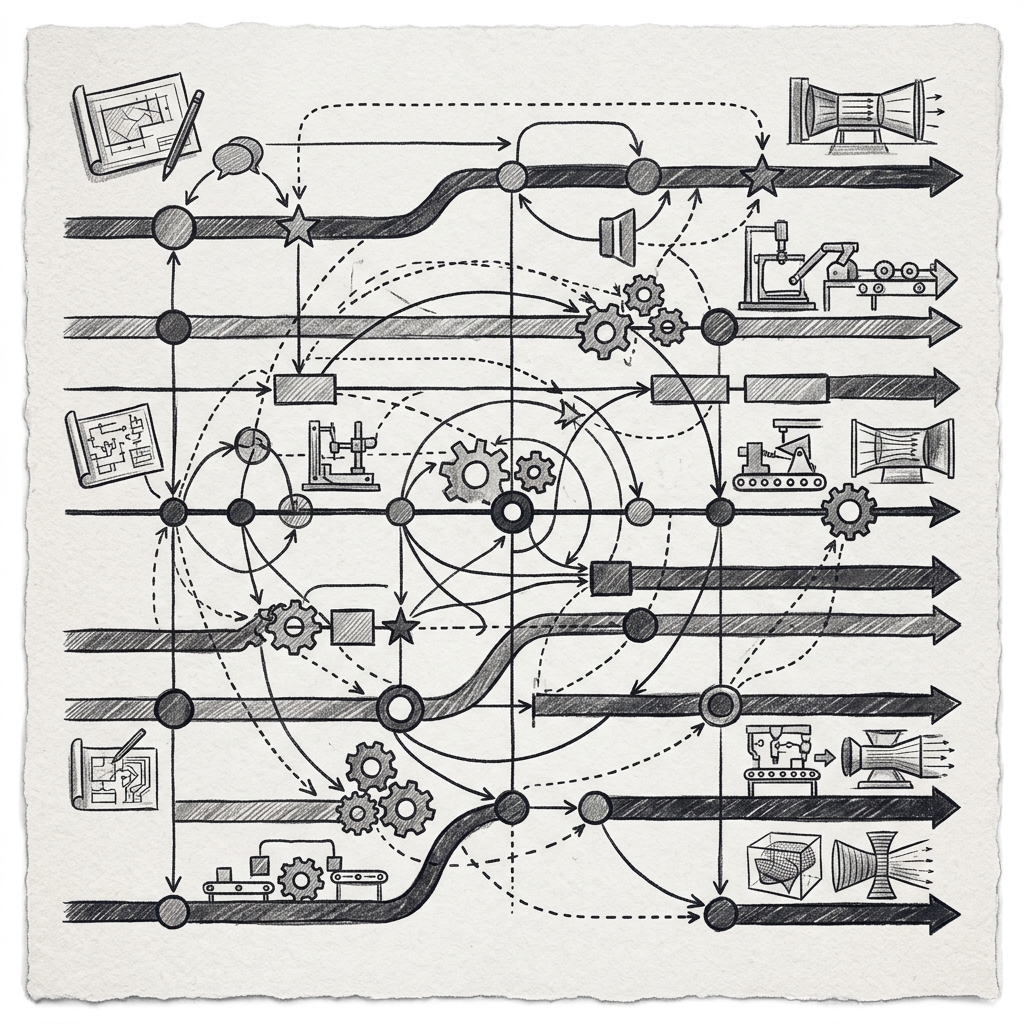
The Interdisciplinary Collision Room
In the philosophy of concurrent engineering, designers, manufacturing engineers, supply chain experts, and marketers sit at the same table from day one. While the product is still a conceptual idea, the manufacturing unit specifies which materials are easier to machine, and the marketing unit determines where the price point should be anchored. Thus, as the product is being designed, its assembly line and marketing campaign are simultaneously constructed.
Think of concurrent engineering as a synchronized Olympic swimming team. In the traditional method, one swims, passes the flag to the next, and it consumes an immense amount of time. In the concurrent method, everyone dives into the pool at the exact same moment. With perfect communication and choreography, everyone performs their role simultaneously without crashing into one another. They reach the finish line with zero lost time and massive collective force.
Converting Time into Market Share
The ultimate goal of concurrent engineering is to accelerate velocity. The time elapsed from concept to store shelves (Time-to-Market) dictates the destiny of corporations.
The Mathematical Multiplier of Speed
Entering the market early allows the product to be sold at a premium price. While competitors are still arguing at the drafting table, a company utilizing the concurrent model displays its product on the shelf. This causes the entirety of initial customer demand to pile onto that first product, allowing the brand to dominate the market. Every delayed week translates to a shrinking slice of the pie. Concurrent engineering is the strategy of cutting processing time in half to fill the market void before rivals can react.
The Eradication of Revision Costs
Another monumental victory is cost control. Discovering problems early saves companies from millions of dollars in losses.
The Strategy of Strangling Flaws Early
If you find a design flaw on the drafting board, the cost to fix it is merely an eraser stroke and a few hours of work. However, if you discover the same flaw on the mass production line, you must alter the molds of hundreds of machines, halt factories, and scrap defective products; the financial cost is catastrophic. Concurrent engineering ensures that flaws are detected while they are still on paper, primarily because the manufacturing engineer is present at the drafting table. Problems are strangled at their source before they can evolve into massive liabilities.