
The Corporate Skeleton and Architectural Rooms
The skeleton of a building determines how much load it can carry, while the layout of its rooms dictates how fast the people inside can communicate.
Running a company is not just about selling a great product or making smart financial decisions. It is also about constructing an invisible Corporate Architecture so that thousands of people can work simultaneously, at maximum speed, without colliding into one another. As a company grows, the number of people inside it multiplies, and tasks become increasingly complex. If everyone tries to do everything, communication breaks down and chaos ensues. Therefore, companies must design authority boundaries, communication flows, and departmental borders according to a specific architectural blueprint.
We can think of the organizational structure as the skeleton and rooms of a massive building. If this building is a hospital, the emergency room and the operating theater must absolutely be side-by-side (functional proximity). If you place these two rooms at opposite ends of the building, patients lose critical time in transit. Similarly, if you draw the walls (departments) incorrectly in a corporation, the flow of information slows down, decisions are delayed, and the entire system becomes dysfunctional. Organizational Design Models are the master blueprints of how this building should be constructed.
The Functional Organization Model
Dividing Rooms by Expertise
The functional model is the most basic and common structural design for a company. In this setup, the corporation is divided into departments based on specific functions or areas of expertise. Divisions like production, marketing, finance, and human resources operate as independent rooms within themselves.
Imagine this system as the kitchen of a massive restaurant. In one corner, there are chefs who exclusively grill meat (Production Department); in another corner, pastry chefs exclusively prepare desserts; elsewhere, assistants only chop garnishes. Everyone focuses solely on their area of expertise. This Functional Organization allows people to master their craft and maximizes operational efficiency. However, if communication breaks down between the meat chefs and the pastry chefs, a melted dessert might be served right next to a hot steak. In other words, the walls between rooms in this model are very thick, making cross-departmental conversation difficult.
The Divisional Organization Model
Constructing Independent Buildings
As companies grow and begin to serve different products, different customer groups, or different countries, the functional model becomes insufficient. At this point, the Divisional Structure comes into play. In this model, the company is divided into mini-companies (divisions) that can survive entirely on their own. For example, a giant automobile manufacturer might create one complete division just for trucks, and an entirely separate division just for passenger cars. Each division has its own marketing team, its own production line, and its own finance squad.
Think of this as a large university campus. The medical school has its own building, its own library, and its own cafeteria. The engineering school, on the other hand, operates out of a completely separate building with its own library. This allows each division (faculty) to focus purely on its specific goal and make rapid, independent decisions. Medical students do not have to wait for an approval from the engineering building. The biggest advantage is speed and flexibility; however, the downside is that building a separate library (e.g., a separate human resources department) for every single building is extremely costly.
The Matrix Organization Model
Tearing Down Walls for Dual Communication
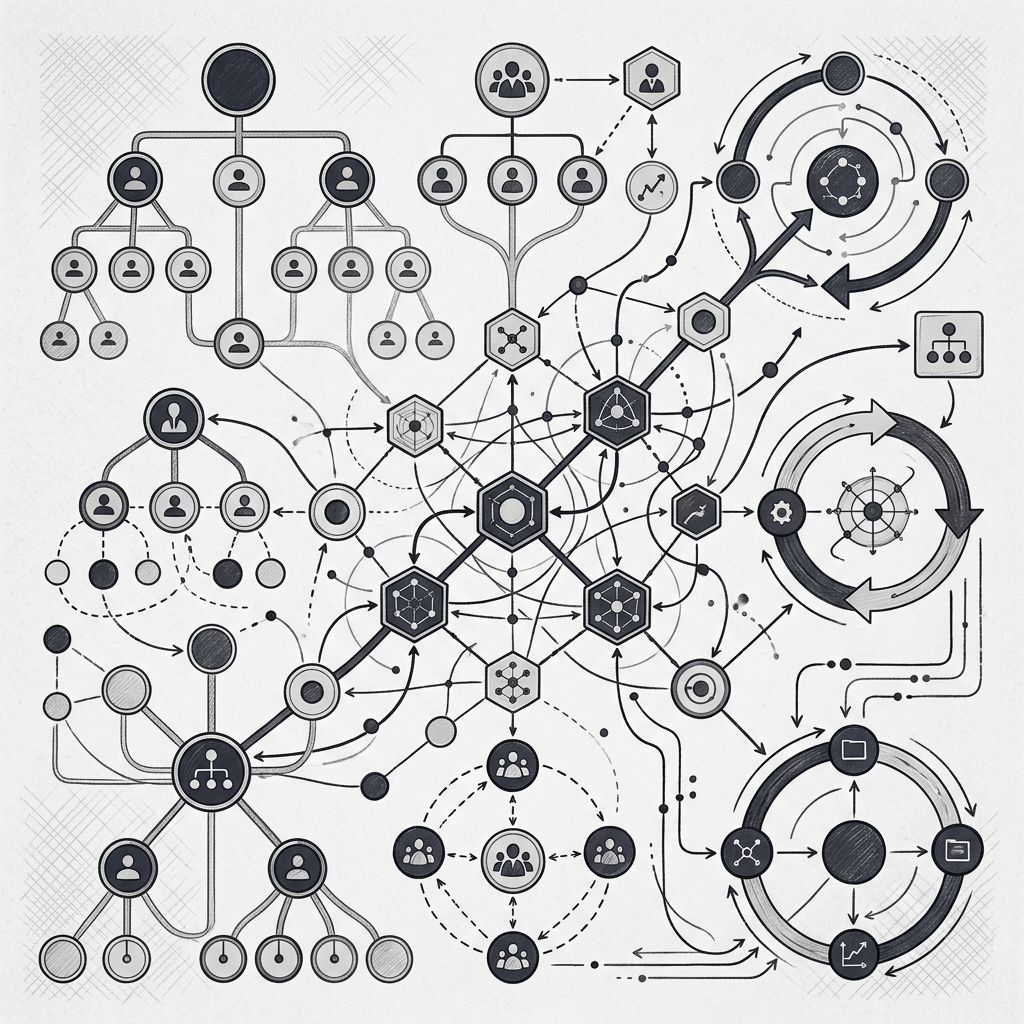
Companies managing modern, complex projects often need both deep expertise and rapid execution simultaneously. This is where the Matrix Structure comes in. The matrix structure combines the specialization of the functional model with the project-based speed of the divisional model. In this setup, employees report to two different managers at the same time: one is the manager of their specialized field (e.g., the Software Director), and the other is the manager of the project they are working on (e.g., the New Product Manager).
We can visualize this system as a modern movie set. A lighting technician is normally tied to the Chief Lighting Director (the expertise manager), receiving technical training from them. However, at the exact same time, they report to the Film Director (the project manager) on set. The technician learns how to set up the lights from the Chief, but learns where to aim the lights from the Director. This model completely tears down traditional walls, allowing cross-functional teams to collaborate seamlessly. The company gains tremendous speed in innovation. On the downside, receiving conflicting orders from two different bosses can cause immense stress and trigger power struggles.
The Impact of Architectural Decisions on Speed and Quality
What the Right Design Brings to the Company
An organizational structure is not just a simple Org Chart where a leader draws lines on paper to show who reports to whom. The model you choose is directly tied to your company's Strategy. If the most important goal for your company is to produce cheaply and flawlessly, you build a Functional model with thick walls where everyone executes their specific routine. But if your goal is to innovate rapidly, constantly develop new products, and invent new technologies, then you must build a flexible Matrix model where communication flows in all directions. When the right architecture is established, the company runs as smoothly as a well-oiled machine; but a poorly constructed architecture turns the corporation into a labyrinth of communication crashes and bureaucratic blockages.