
The Strategic Compass
A ship's trajectory is bound not by the stars, but by the unyielding mathematical alignment behind the helm.
The Heart of a Corporate Machine
Imagine a giant factory. Inside, there are thousands of gears, wheels, and motors. If every gear decides to turn in its own direction, the machine will shatter into pieces. Corporations and companies are exactly like this. Thousands of people come together with different skills and different thoughts. So, how can we make all these different parts move in a single, unified direction? This is where a very powerful, invisible force we call the Strategic Compass comes into play.
This compass has three main components: Vision, Mission, and Core Values. These are not just fancy words hanging on a wall; they are the main energy centers that align all the decision algorithms and operational mechanics of the organization to a single point.
The Lighthouse on the Horizon: Vision
Vision is that massive, glowing target your company wants to reach in the future. It is like a giant, shining lighthouse that a ship's captain sees far away through a telescope.- The Navigator: Vision tells you not where you are, but where you need to be in ten years. The light of that lighthouse shows you which way to turn the ship's bow, even in the darkest storms.
- The Source of Inspiration: It makes employees wake up in the morning not just to do a job, but to serve a giant purpose. When you ask a stonecutter, "What are you doing?", the difference between saying "I am breaking stones" and "I am building a massive cathedral" is the power of vision.
- The Focusing Power: If your vision is clear, you can say "No" to opportunities that come your way but would pull you away from the lighthouse. Vision keeps your energy focused on a single line without scattering.
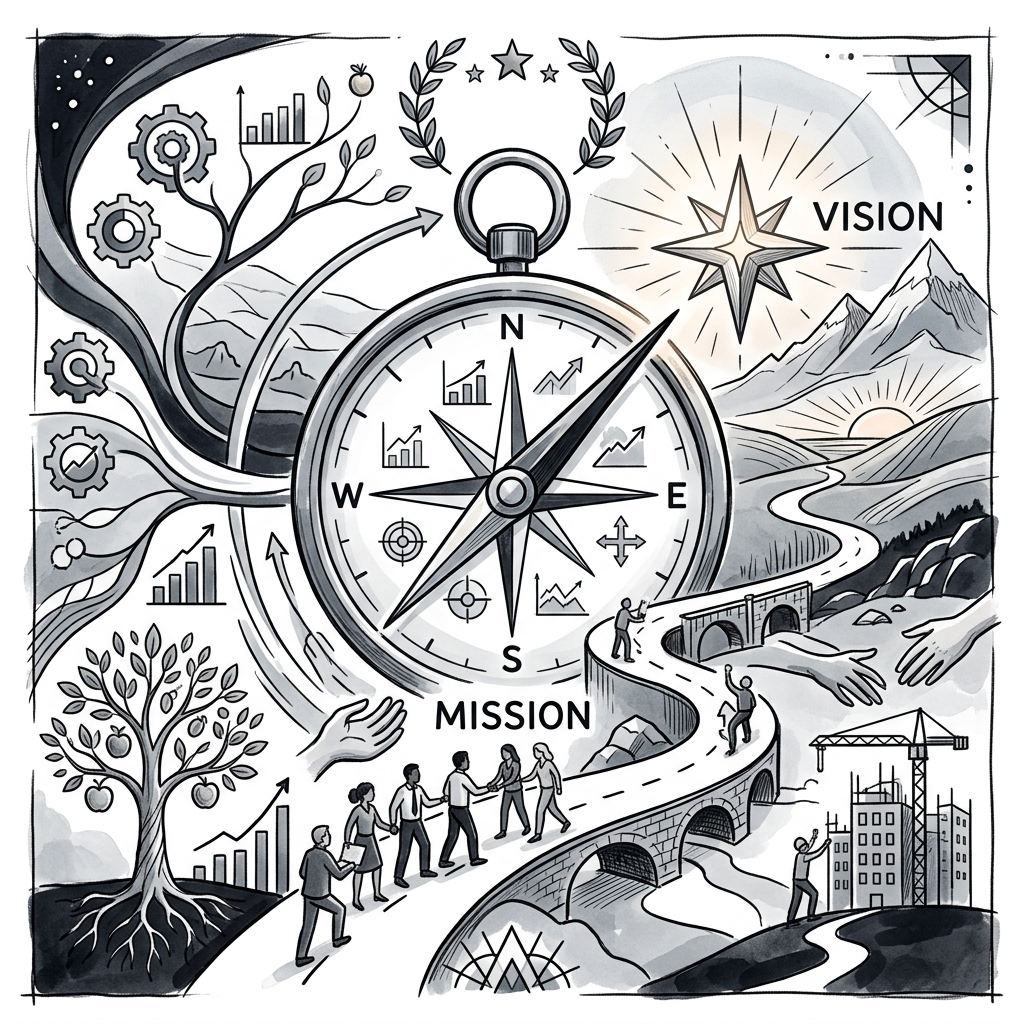
The Engine of the Machine: Mission
If the vision is that faraway lighthouse, the Mission is the engine of the ship. The mission is the answer to the question, "What exactly are we doing today to reach that lighthouse?"
- The Daily Task: Mission does not daydream. It is a worker who gets its hands dirty. What product are we producing? Which customer are we serving? What problem are we solving? These are the main gears of the mission.
- The Decision Center: Are you going to launch a new product? You immediately look at your mission. "Does this product align with our main task?" If it doesn't, you don't install that gear into the machine.
- Continuous Movement: Vision is in the future and can sometimes seem unreachable. But the mission is today. It is the mission that determines how the engine will run when the factory doors open every morning.
The Glue and the Brake System: Core Values
A machine needs more than just an engine and a steering wheel. It needs oil to prevent those gears from grinding against each other and breaking, and a brake to stop the system when necessary. This is exactly what Core Values are.
The Rules of Behavior
- Unbreakable Rules: Values answer the questions "What can we do?" and "What can we never do?" within the company. For example, if "Honesty" is a core value, a brake is applied to a project that will make quick money but is not honest.
- The Invisible Glue: What holds different people together are shared values. It is like the mortar that holds bricks together when building a house. If the mortar is not solid, the wall will collapse in the slightest wind.
- The Selection Filter: When hiring someone new or forming a partnership, your core values act as a filter. You do not include parts into the machine that do not fit your values. Because the wrong part will ruin the whole system over time.
Every single strategic decision must pass through these three filters. Does it serve the vision? Is it within the scope of our mission? Does it comply with our core values? If it fits all three, that decision slots perfectly into the gears of the machine.
The Operational Alignment Index (Audit Dashboard)
The work is not done once the vision, mission, and values are set. The real challenge is measuring whether this massive mechanism is working correctly every single day. If a car's wheels are not aligned, no matter how straight you hold the steering wheel, the car will slowly drift off the road. In organizations, Operational Alignment is of vital importance.
- Detecting Daily Discrepancies: Sometimes companies write "Customer Satisfaction" in their core values but keep the customer waiting for 10 minutes at the call center. This is a discrepancy. The values and daily actions do not match each other.
- Testing Decision Algorithms: Strategic audit dashboards measure how aligned every decision made is with the main goals. In this way, we can see exactly how far the organization has deviated from its course with mathematical precision (an alignment index).
- Early Warning System: When a gear in the system starts turning incorrectly, these are the indicators that give a warning before the machine breaks down completely. Thus, problems are solved before they grow, and energy loss is prevented.