
Corporate Defense Shield and Radar Networks
Structures that fail to detect dangers while they are still on the horizon are destined to shatter at the slightest tremor, like ships caught unprepared by massive waves.
Enterprise Risk Management (ERM) is a radar network used to anticipate, measure, and build a strong defense mechanism against any kind of danger and uncertainty a company might face. The business world is like a massive ocean where storms can break out and giant waves can rise at any moment. If a company wants to sail safely in this ocean, it is not enough to just know its course; it must also be able to see the icebergs, storms, and hidden rocks in the sea long in advance. ERM acts exactly at this point as a giant protection shield and early warning system surrounding the company.
The Radar System of Companies: Spotting Risks
A company should be like a careful person checking all around while walking down the street. What dangers are around? Where are the potholes? Enterprise Risk Management starts by giving these dangers a name first. This is called risk identification.
Sensors That See Storms in Advance
For companies, storms can come in very different forms. Sometimes a sudden change in the economy, sometimes a new law, or sometimes the moves of rival companies can be a storm. Just like the weather radars on the nose of a modern airplane, the ERM system monitors every movement around the company. In this way, danger is detected even when it is far away, buying time to prepare.
Finding Cracks in the Ship's Hull
It is necessary to find not only the storms outside but also the hidden problems inside the company. A tiny crack in a ship's hull can cause a massive disaster in the middle of the sea. System crashes, problems arising from production errors, or a small mistake made by an employee are internal risks. ERM acts like sensors placed in the deepest parts of the company, finding these cracks before they take on water and ensuring they are repaired.
Measuring the Size of Dangers: Damage Control
It is not enough to see a danger; it is also necessary to calculate how much damage it can cause. Is the thing coming towards you a small rain cloud, or a giant hurricane? Enterprise Risk Management calculates the size of these dangers with mathematical precision.
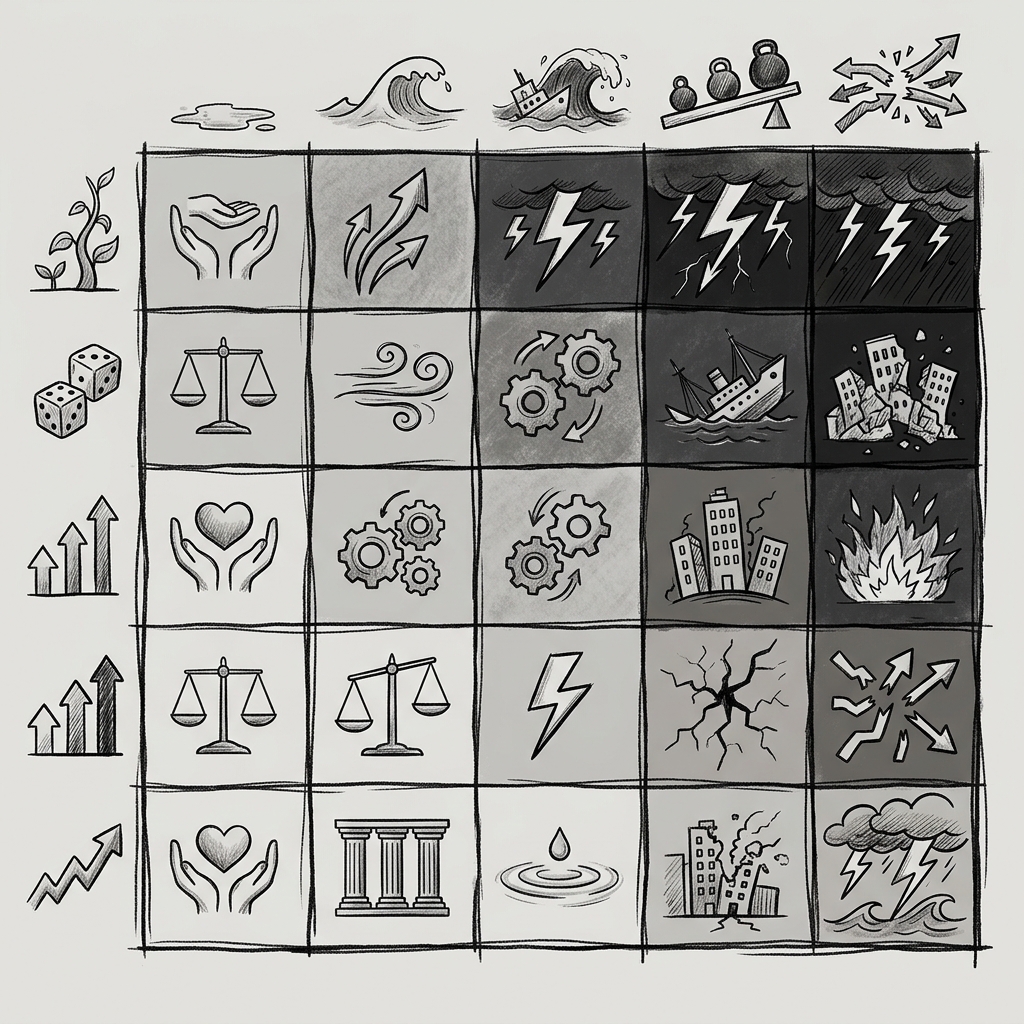
Scales That Calculate Earthquake Intensity
The damage every risk can do to the company is different. Some events are just small tremors rattling the windows, while others are severe earthquakes destroying buildings. Companies score every danger they face according to this intensity scale. Thus, it is determined in advance with numbers how much each danger will damage the company's main structure (for example, its factories, bank accounts, or customers). This scoring is like a compass showing where the company should spend its energy.
Crash Tests and Emergency Drills
Car manufacturers crash vehicles into walls to test how safe they are. ERM does a similar crash test for companies. It tests the company's endurance by asking questions like "What happens if our biggest customer leaves us?" or "How much money will be missing from our vault if our computer systems crash for a whole day?". Thanks to these virtual drills, who will do what and how the damage will be minimized during a real accident is planned second by second.
Activating the Defense Shields
We saw the danger, calculated its size; now it is time to stop it or break its impact. Enterprise Risk Management uses different shields against different dangers.
Setting Up Umbrellas and Lightning Rods
If there is a light rain outside, just opening an umbrella is enough. However, if there is a thunderstorm with lightning, you need to install a lightning rod on the roof of the building. Companies also set up such defenses against risks. For example, if the price of the dollar is going to change suddenly, the company makes special agreements with banks to protect itself. Just like the lightning rod absorbing the lightning and transmitting it to the ground, this ensures the danger is neutralized before it enters the company.
Backup Engines and Lifeboats
Sometimes it is impossible to stop the danger; then survival mechanisms kick in. If one engine fails while an airplane is flying in the air, the backup engine starts immediately, and the passengers feel nothing. Companies also back up their information systems for crisis moments, keep emergency cash ready, or make agreements with alternative suppliers. In this way, even if the main system stops, the backup engines keep the company flying.
Learning Radars and Continuous Improvement
The job is not done once a company sets up its shields. Because the world is constantly changing, the shape of dangers changes too. A defense system that worked last year might not be useful this year.
Memory Records and Error Analysis
When a good airplane crashes, its black box is examined to find where the error was. Enterprise Risk Management is somewhat like the company's black box. If the company experiences a crisis or narrowly escapes a danger, the causes of this event are investigated. The company learns a lesson from every mistake it makes and updates its radar system so as not to make the same mistake next time.
Regular Maintenance of Shields
Armors need to be oiled regularly so they do not rust. The ERM system must also be constantly checked. Every year, it is checked whether there are new dangers, defense mechanisms are tested, and stronger walls are built where deemed necessary. Thus, no matter what happens in the future, the company remains standing like an unshakable castle.