
The Shield of Accountability
Power, when unchecked, builds its own destruction every second; corporate structures can only go as far safely as their internal braking systems allow.
Governance: The Control Room of the Great Machine
Imagine a company as a massive factory. Inside this factory, thousands of gears, motors, and conveyor belts work constantly. But who stops this giant machine from going in the wrong direction, overheating and exploding, or damaging its own parts? The answer to this question is corporate governance. Corporate governance is the invisible control room of the factory.
As companies accelerate their growth, the weight of decisions increases. Allowing just one person or a small group to make decisions based on momentary feelings can endanger an entire structure. Governance is a safety net that ensures these decisions are made not with emotions, but with absolute rules.
Steering and Braking Systems
No matter how fast a car is, if it doesn't have a solid braking system and a reliable steering wheel, that speed is merely a danger. Corporate governance does not stop you from speeding up. On the contrary, by setting the right rules, it allows the company to accelerate much more safely. How decisions will be made, who will have what authority, and what will be done when rules are broken are all determined in this control room. Thanks to this, the company moves forward on its tracks like a train with a clear route, not like a leaf blown in the wind.
The Board of Directors: The Compass and Insurance of the Company
We understand how our factory or car works. But how do we know who is sitting at the steering wheel and who is supervising the route? This is exactly where the board of directors steps in. The board of directors is not the people doing the daily work of the company, but a group of experts who make sure those tasks are done in the right direction.
You can imagine them as radar systems placed in the captain's bridge of a giant ship. They constantly monitor the size of the waves, approaching storms, and the fuel status of the ship. While the workers in the ship's engine room only focus on their own tasks, the radar system sees the big picture.
The Mechanics of Preventing Conflict of Interest
One of the biggest dangers in a company is if the person holding the steering wheel drives the car towards their own home instead of the company's destination. In the business world, we call this a conflict of interest. When a decision-maker thinks of their own pocket instead of the company's benefit, it brings massive destruction. The board of directors is a balancing mechanism established to reduce this possibility to zero. Board members examine every major decision taken, cross-examine it, and check whether it aligns with the company's main goals. In this way, power does not accumulate in a single point; it is distributed and audited.
Transparency and Accountability
The biggest enemy of large mechanisms is darkness. Decisions made behind closed doors always raise suspicion. The two main pillars of corporate governance are transparency and accountability.
Transparency is making the walls of the factory out of glass. Anyone looking from the outside should be able to clearly see how the gears are turning, where the money is spent, and what the plans are. Information is not hidden or trapped inside the system; on the contrary, it is cleanly transmitted to investors and employees.
The Thermostat and Feedback Balance
Accountability, on the other hand, is being able to instantly find an answer to the question "Who did this and how will we fix it?" when the functioning behind these glass walls breaks down. Think of a thermostat; when the room gets too cold, it turns on the heater, and when it gets too hot, it stops it. Accountability is the thermostat of the company. If a mistake is made, the person responsible for this mistake is known, and the error is corrected immediately. No one can run away from responsibility. This system ensures that the company is reliable not only on paper but also in the real world.
Balancing Power: The Triple Control Mechanism
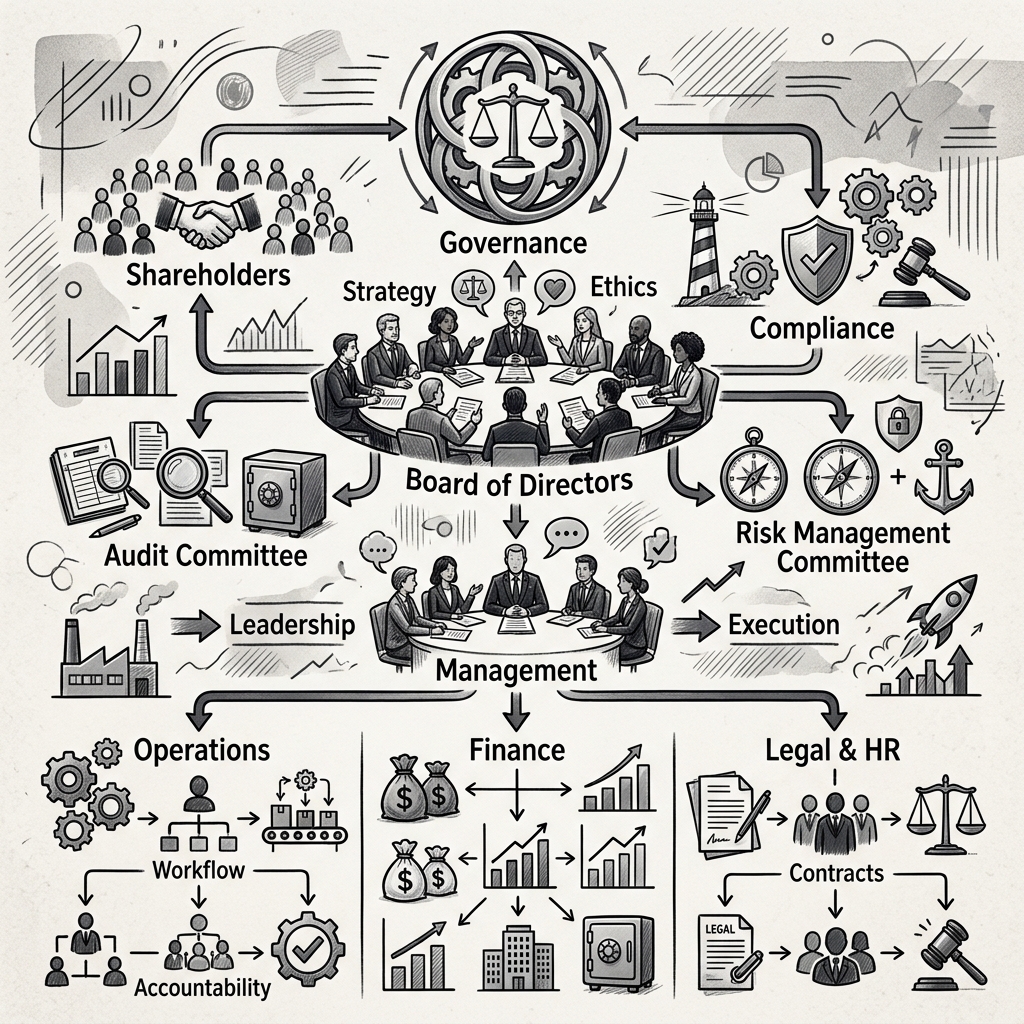
As companies grow, complexity increases. To solve this complexity, corporate governance establishes a balancing mechanism consisting of three main parts. These three parts are divided into shareholders, the board of directors, and the executive board (managers).
You can imagine this system as three main gears inside a giant clock:
- Shareholders: The owners of the clock; they want the clock to run.
- Managers: The motor power that moves the minute and hour hands of the clock.
- Board of Directors: The intermediate gear that establishes the connection between these two powers and ensures that the motor runs the clock at the right speed.
The Function of Independent Members
Within boards of directors, there is a special group called "independent members." These are outside experts who are not emotionally or financially tied to the company's internal workings. Because they come from outside the system, they can see the blind spots that no one inside can see. Since their own interests are not tied to the company's momentary profits, they do not hesitate to tell the truth. Like an independent spirit level checking whether a wall is straight in a construction site, they simply show what is right.