
The Kinetic Nature of Competition and Cost Engineering
A market is not a marathon where everyone runs side by side; it is a structural engineering test where some runners shed weights from their shoes to speed up, while others strap a motor to their backs.
Competitive strategies are the fundamental systems that determine how a company survives and stands out among its peers. Imagine a bakery, a toy factory, or a giant car manufacturer. They all essentially try to solve the same basic problem: Why should customers choose me instead of the others? To answer this in the business world, you can imagine being in a giant bicycle race. Everyone is trying to reach the finish line, but the type of bicycle each company chooses to ride is entirely different. These different strategies directly dictate the company's operational mechanics.
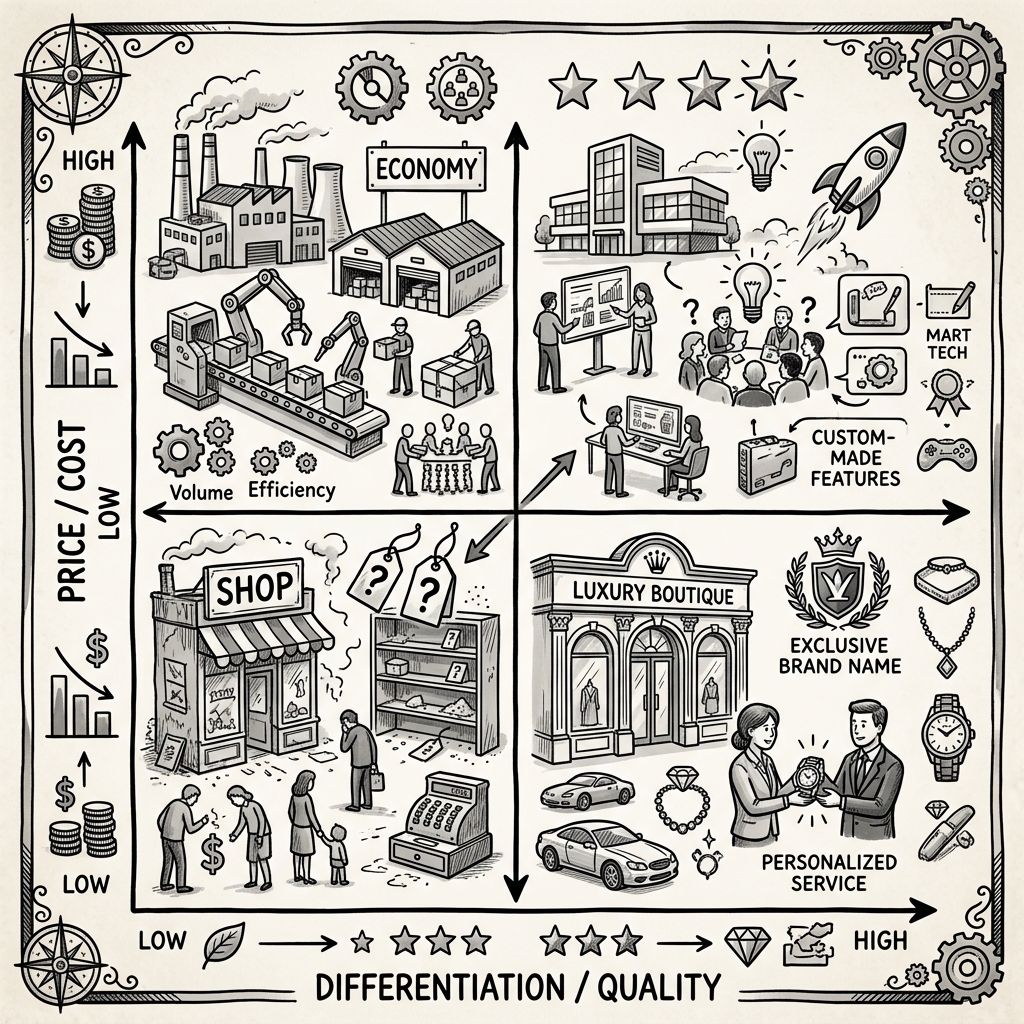
Known as Michael Porter's generic strategies, this framework defines asymmetrical (unequal) methods developed to gain market share. All the gears of a company are reprogrammed and assembled based on the strategy it chooses. Now, let's break down these core mechanisms by examining how each individual gear works.
The Cost Leadership Gearbox
Cost leadership is simply the art of producing a good or service much cheaper than the competitors. However, this does not just mean lowering quality; on the contrary, it is about identifying and eliminating all unnecessary weights in the background.
Shedding Unnecessary Weights
Imagine a racing bicycle. If the bicycle has a basket, heavy mudguards, and extra bells that you don't really need, you will spend more energy pedaling. A company that chooses cost leadership designs the processes in its factory so perfectly that not a single second is wasted on the assembly line. Materials are bought in bulk to make them cheaper. All the production cogs work so smoothly and are so well-oiled that costs drop to a minimum. The product offered to the customer is the same, but the company has built that product with so little expense that even if it lowers the price, it can still make a profit.
Operational Alignment
In a firm that is a cost leader, every employee and every machine must operate like simple but sturdy gears inside a clock. The margin of error is close to zero. Every detail, from packaging to shipping, is standardized. These companies cater to the largest crowd in the market because everyone wants to buy a cheap, functioning product.
The Differentiation Engine
The differentiation strategy is about making a completely unique and special product, rather than selling at the same price as your competitors, so that people gladly pay more for it.
Building a Unique Structure
If cost leadership is about making the bicycle lighter, differentiation is about adding bright LED lights, a special electric motor, and a custom-designed seat to the bicycle. Maybe this bicycle even balances itself! In the differentiation strategy, a feature inside the product completely separates it from everyone else. This could be a difference in quality, a magnificent design, or a technological innovation that competitors cannot copy.
Value in the Customer's Eyes
Companies that choose this strategy do not say, "I have the cheapest!" Instead, they say, "No one else has this feature!" To do this, the engineering and design workshop inside the company must be highly creative. It is like a master Lego builder constructing a giant, detailed spaceship instead of a plain house that anyone can build with regular bricks. Customers agree to pay extra to own that special spaceship.
Focus and the Micro Gears of the Market
The focus strategy involves serving a very small group with special needs, rather than the entire giant market.
High Pressure in Narrow Spaces
Think of a large, heavy bicycle with fat tires. This bicycle is slow on a flat road, but it can go places on snowy and muddy mountain roads where no other bicycle can travel. It serves only a small group of customers who specifically want to ride on those mountain paths. Companies pursuing a focus strategy do not divide their energy among massive crowds; instead, they create high pressure and impact in a small area, much like a magnifying glass focusing sunlight onto a single point.
Two Different Focus Models
The focus strategy is divided into two categories:
- Cost Focus: Offering the cheapest product in a small and specific market segment.
- Differentiation Focus: Offering a unique product tailored exclusively to that group in a small market segment (for example, special scissors made only for left-handed people).
When companies select one of these mechanisms, they must make all their decisions based on this architecture. Trying to be the cheapest and the most luxurious at the same time is like trying to break a speed record while equipping your bicycle with heavy winter tires; the system locks up, and you cannot move forward.