The Invisible Architecture and Corporate Decay
Systems never naturally evolve toward perfection when left to their own devices; they existentially drift toward the lowest energy state, which is absolute disorder.
The Role of Culture in Organizational Systems
Corporate culture is the most abstract yet strictly binding layer of a company's operations. Beyond the procedures written on paper, it is the fundamental infrastructure that determines how the system actually functions in reality.
The Power of Unwritten Rules
A company's culture is not reflected in the vision statements hanging on its walls. Culture is how employees make decisions when the manager leaves the room, how mistakes are handled, and what reflexes are triggered during a crisis. These unwritten rules operate much faster than formal procedures, acting as a block of code that automatically guides human behavior. A strong culture simplifies complex processes because employees inherently know what to do without needing to ask.
The Tendency Toward Corporate Entropy
The laws of thermodynamics in physics apply flawlessly to organizational structures. Entropy is the tendency of a closed system to move toward disorder, or chaos, over time. When a company is built, a massive amount of energy is expended to establish a specific order. However, if this system is left to its own devices, it begins to decay. Standards drop, rules are bent, and the boundaries of the organizational structure blur. This occurs not because the system is inherently flawed, but because it is the fundamental mathematics of nature.
Maintaining Order and the Need for Energy
Order is an artificial state and requires continuous external intervention to be sustained.
Continuous Energy Injected by Leadership
The only way to prevent chaos in the system is to pump fresh energy into it from the outside. In the business world, this energy translates to uninterrupted communication, transparent feedback, continuous training, and the uncompromising stance of leaders. The exact second the management team stops reiterating the vision and auditing standards, the flow of energy into the system is cut off. The moment energy is cut, entropy takes over. Leadership is mandatory not just to move a company forward, but to prevent it from collapsing under its own weight.
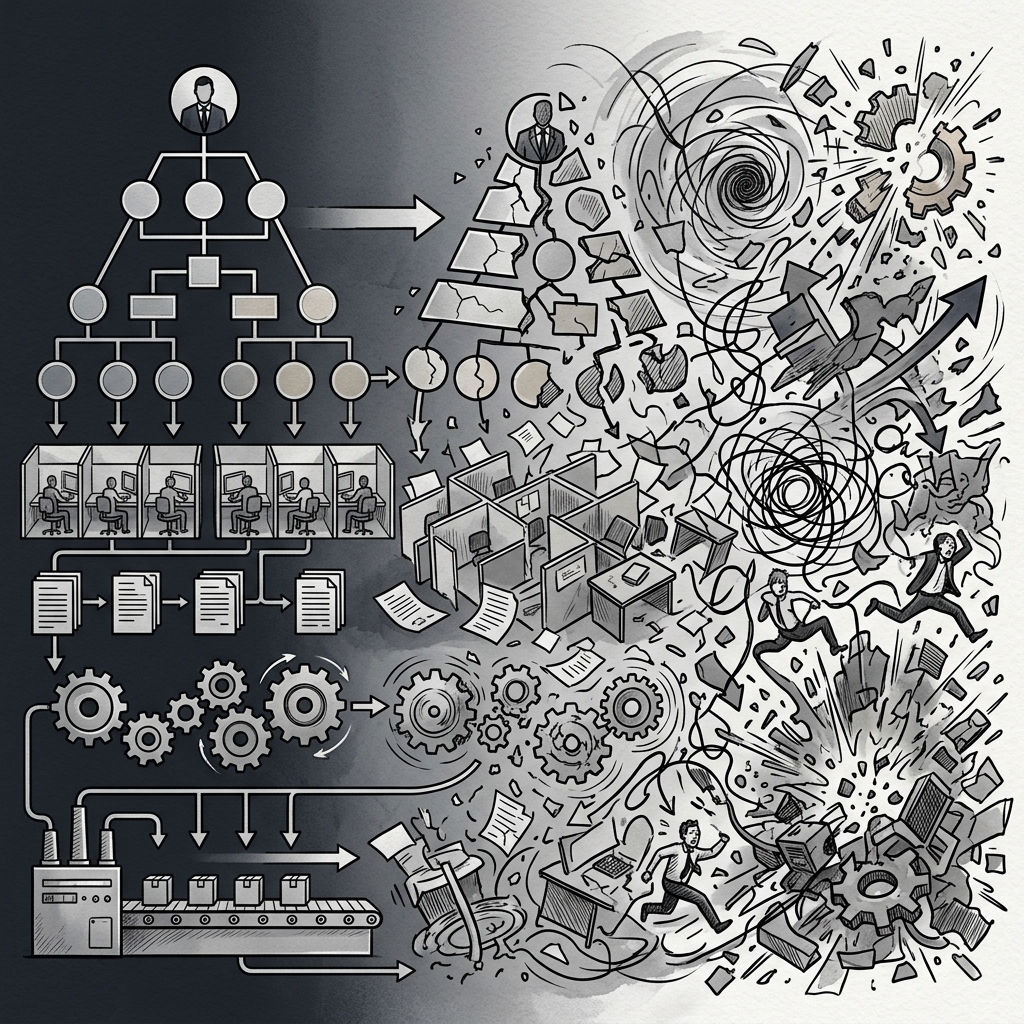
The Mathematics of Natural Decay
Decay does not require active effort; it is a passive process. The complication of internal company processes, the formation of inter-departmental silos, and the proliferation of unproductive meetings are all concrete symptoms of entropy. No leader wakes up and says, "Let's make our processes more inefficient today." Inefficiency is simply the natural outcome that surfaces when the necessary energy to do the right thing is not expended.
Cultural Erosion in the Business World
When corporate culture is not managed correctly, it begins to spawn toxic subsystems within itself. This erosion typically starts with small compromises and eventually disrupts the mechanics of the entire organization.
Weeds of Gossip and Rule-Breaking
Think of a corporate structure as an immaculate garden, cultivated with an immense investment of labor and capital. The moment you stop spending energy on the garden (nourishing the culture and upholding the rules), the system is left to itself. Even if you do absolutely nothing, weeds will start to grow. In companies, gossip networks, the habit of dodging responsibility, and a lack of discipline are these exact weeds. Growing orderly and beautiful flowers (transparency, work order, efficiency) requires constant watering and maintenance, whereas weeds require zero special attention to survive and multiply.
The Garden Metaphor: Maintenance and Intervention
Weeds do not take over the garden overnight; they slowly steal the water and sunlight (the company's focus and time) away from the flowers. Eventually, the originally planned structure of the garden completely disappears. Similarly, in an organization, when gossip and indiscipline spread, the energy that should be dedicated to the company's core mission is instead wasted on managing this chaos. Therefore, a manager's primary duty is akin to a gardener: periodically pruning the system, uprooting harmful habits, and nourishing the soil (the employees) with the correct vision.