The Mechanics of Friction and Structural Resilience
A crisis is not a load on the system; it is a ruthless spotlight illuminating its weak points. True resilience is not resisting the load, but converting its kinetic energy into a strategic advantage.
In the modern business world, stress and resilience are often discussed merely as psychological states of mind. However, from the perspective of operational excellence, these concepts are deeply structural, engineering-based mechanisms. Whether a company or a leader collapses during a crisis depends entirely on the quality of their built-in "shock absorbers" (resilience).
The Structural Difference Between Stress and Burnout
Many people view stress as an enemy that must be entirely eliminated. Yet, in engineering, a certain amount of stress (pressure) is absolutely necessary for an engine to operate.
Acute Stress (Short-Term Pressure)
Acute stress is temporary, goal-oriented pressure. It is the tension felt right before a new product launch or an unexpected presentation.
- Enhances Focus: The body and mind pump extra energy to solve the immediate problem.
- Performance Curve: This short-term pressure pushes performance to its peak.
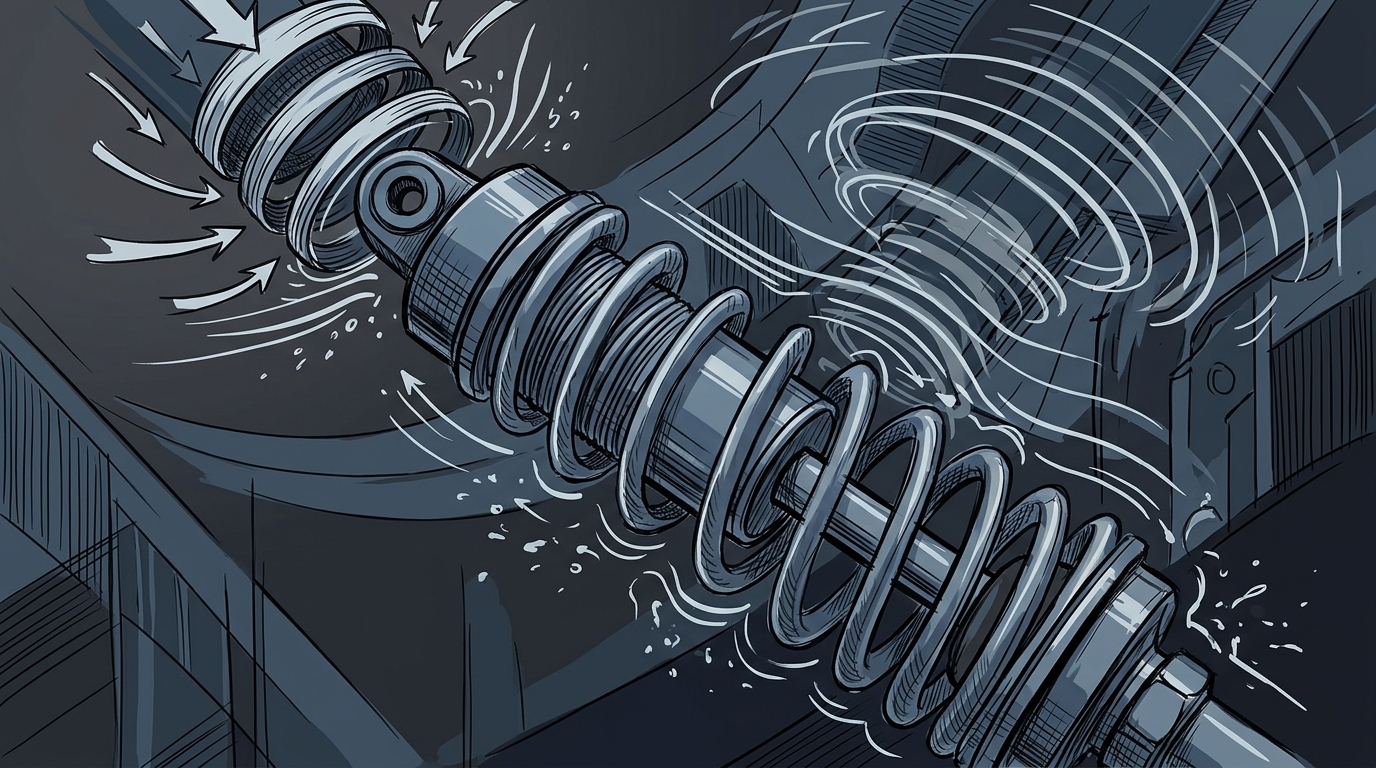
- Daily Life Metaphor: Think of this as the compression of a mechanical spring. As the spring compresses, it stores potential energy, and when released, it fires the arrow at high speed toward the target. Without compression, the arrow cannot fly.
Chronic Burnout (Structural Collapse)
Burnout, on the other hand, occurs when the compressed spring is never allowed to release. A system kept constantly under high pressure eventually loses its elasticity and shatters.
- Cognitive Paralysis: When leaders or employees are under continuous stress, they completely lose their ability to make logical decisions.
- Loss of Efficiency: No matter how much energy the system expends, there is no forward momentum; the internal parts simply grind against each other and wear out.
- Daily Life Metaphor: It is like pressing the gas pedal of a car all the way to the floor while simultaneously keeping the handbrake pulled up tight. The car doesn’t move an inch, but the engine overheats, and the brake pads burn to ashes.
Cognitive Load Management
The resilience of a leader or a team is not measured by how many different problems they can solve simultaneously, but by how they organize and sequence those problems in their minds.
Intrinsic Cognitive Load (Task Difficulty)
This is the unavoidable difficulty inherent in the task itself. For example, solving a complex financial model is naturally difficult.
- This load cannot be reduced; it can only become easier to carry through gained competence and experience.
Extraneous Cognitive Load (Unnecessary Friction)
This is the mental exhaustion caused not by the work itself, but by bad systems, constantly ringing phones, pointless meetings, and poorly designed software interfaces.
- Resilient systems are those that reduce this unnecessary friction to absolute zero.
- Daily Life Metaphor: Imagine a worker carrying a heavy boulder on his back (Intrinsic Load). If that worker has tiny pebbles inside his shoes (Extraneous Load), what ultimately breaks him is not the massive rock on his back, but the sharp pebbles stabbing his feet with every step. Mental resilience begins by first emptying the pebbles out of your shoes.
Organizational Resilience Architecture
Resilience is not just an individual trait; it is an architecture that must be coded into a company’s DNA. When macro-crises hit (economic downturns, supply chain snaps, etc.), how a company reacts depends entirely on this structural foundation.
Fragile Structures
These are systems that completely shatter at the slightest unexpected shock. If the entire operation relies on a single supplier or one key employee, the structure is highly fragile.
- Metaphor: A tower made of glass. It looks incredibly elegant and premium, but a minor earthquake will shatter it into thousands of irreparable pieces.
Resilient Structures
These are systems that take the hit, sustain some damage, but survive and return to their original form. They have built-in redundancies and Plan Bs.
- Metaphor: The heavy-duty shock absorbers on an off-road vehicle. When the vehicle hits a massive rock, the suspension doesn't stay rigid like concrete and break. The shock-absorbing springs compress, swallow the kinetic energy of the impact (the crisis), and prevent the vehicle from flipping over, allowing it to keep moving forward.
Antifragile Structures
These are systems that, instead of being harmed by shocks, actually grow stronger because of them. Crises force these structures to learn, adapt, and eliminate their hidden flaws rapidly.
- Metaphor: The human muscular system. By lifting heavy weights (introducing stress and shock), you physically tear your muscle fibers. However, when the system rests, it rebuilds those fibers thicker, stronger, and much more durable than before.