Decision Making Mental Models
A decision driven by emotion is merely a random dice roll generated by the mind; true analytical intelligence lies in dissecting complex problems down to their first principles and calculating the weighted mathematics of probabilities.
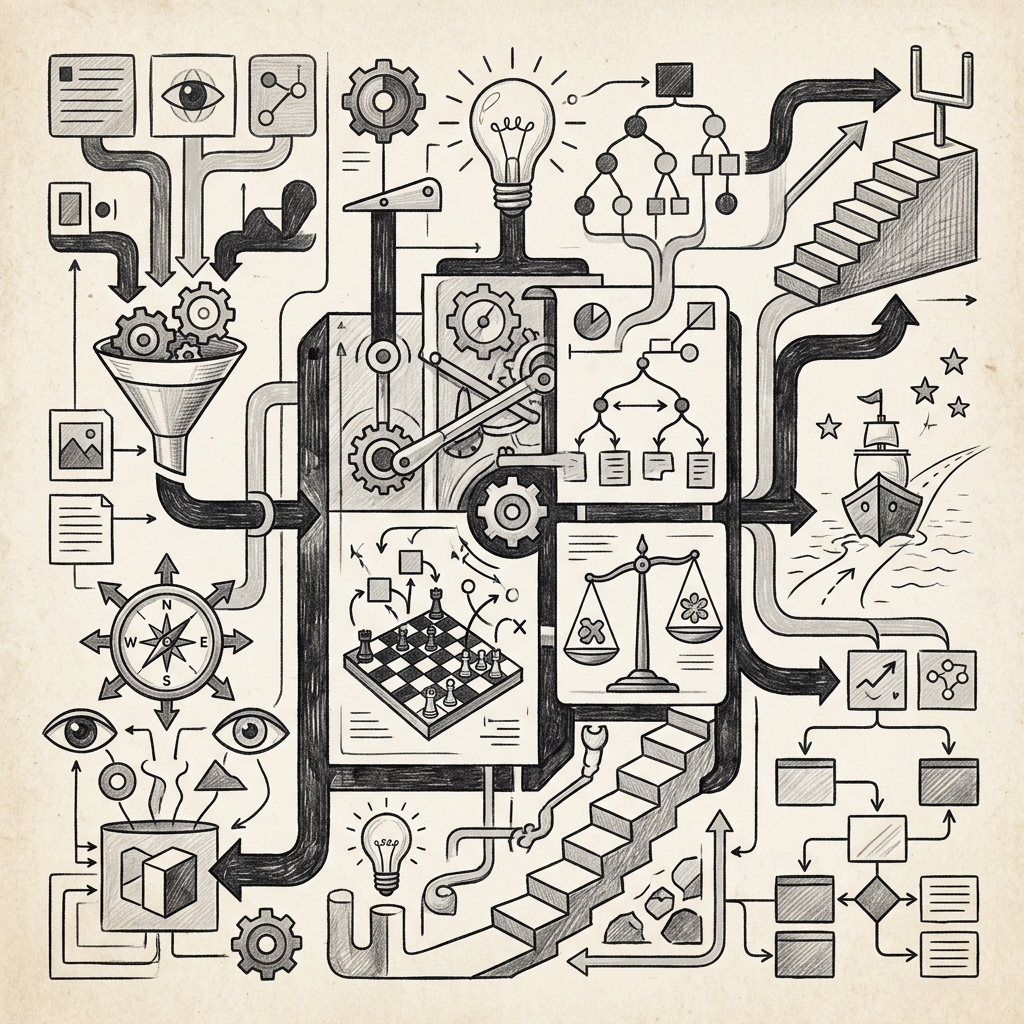
A significant portion of the daily effort expended by leaders and professionals is devoted to decision-making processes. However, the human mind is evolutionarily biased toward short-term relief, cognitive prejudices, and herd mentality. A correct decision requires transcending "gut feelings" and relying on objective frameworks. Mental models are cognitive tools that distill complex reality into simple, formulaic prototypes that the brain can process more rapidly.
In particular, "First Principles Thinking" necessitates stripping a problem of all its assumptions and breaking it down into its most fundamental physical or mathematical truths. While reasoning by analogy (how others are doing it) yields mediocre results, first principles enable innovative leaps (from 0 to 1). Furthermore, when selecting among various options, "Weighted Decision Matrices" mathematically reveal the most rational choice by assigning numerical scores to the importance of each criterion (e.g., Cost, Speed, Risk).