Intersection Engineering and Consensus Architecture
Conflict is not where the system breaks, but the fault line where a new bridge must be engineered.
Conflict is often a feared and hidden phenomenon in the business world. However, in professional management systems, conflict is not a disease to be avoided, but a massive energy source that must be harnessed. Just as the water from two different rivers violently churns when merging into the same channel, the collision of different departments and ideas creates the immense power that propels a company forward when managed correctly.
The most famous mathematical framework for conflict management in business is the Thomas-Kilmann Conflict Mode Instrument. This model divides human reactions during a disagreement into two main pillars: Assertiveness and Cooperativeness. Assertiveness is the extent to which you advocate for your own interests. Cooperativeness is the extent to which you accommodate the other party's interests. The intersection of these two pillars provides us with five fundamental strategies.
Cars at the Intersection: The Anatomy of Conflict
To understand these five strategies, imagine a workplace conflict as two cars unexpectedly coming nose-to-nose in a narrow intersection. Both drivers (employees or departments) urgently need to continue on their respective paths. At this exact moment, the strategy they choose will determine not only the immediate traffic flow but the fate of the entire city (the company).
1. Competing: Pressing the Gas Pedal
In the competing strategy, assertiveness is maximized, and cooperativeness is zero. Both cars at the intersection slam on the gas pedal. In this scenario, only the strongest, fastest, or most stubborn car makes it through, while the other is either crashed or completely flattened. In the corporate world, this method is useful during extreme emergencies or highly vital decisions (like issuing an evacuation order during a fire). However, constantly hitting the gas pedal in daily operations creates a toxic "Win-Lose" cycle, eventually leaving no undamaged cars at the intersection.
2. Accommodating: Pulling Off the Road
In the accommodating (or yielding) scenario, assertiveness is zero, and cooperativeness is at its peak. One of the drivers immediately turns off the engine, steps out of the car, and gestures to the other, saying, "Please, the road is yours." Even though they have their own urgent business, they step back completely just to avoid a fight. This strategy can be effective if the issue is trivial to you but critical to the other party (like choosing the color of a meeting room). However, a department that constantly yields will eventually transform into a completely crushed entity that never reaches its goals.
3. Avoiding: Abandoning the Intersection
In the avoiding strategy, neither assertiveness nor cooperativeness exists; both are zero. Both drivers simply leave their cars idling in the middle of the intersection and walk away. Instead of solving the problem, they ignore it. With the mentality of "it will sort itself out over time," traffic becomes completely paralyzed, creating miles of gridlock behind them. This method should only be used temporarily to cool down a highly explosive situation (like a bomb threat at the intersection). Otherwise, the company turns into a graveyard of unresolved issues.
4. Compromising: The Traffic Cop's Negotiation
In a compromise, both parties are moderately assertive and moderately cooperative. The drivers roll down their windows and negotiate: "Let half of my car pass first, then you inch forward, then I will go again." Both sides get only a fraction of what they want. There is mutual sacrifice, and no one is entirely happy. This is frequently preferred when budgets are slashed or time is extremely limited, acting as a "temporary but fair" band-aid solution.
5. Collaborating: Building a Traffic Light
The collaborating strategy is the absolute pinnacle of both assertiveness and cooperativeness. Instead of stubbornly holding their ground or fleeing, the drivers step out of their cars and work together. Right then and there, they engineer a smart traffic light for the intersection. If necessary, they even construct a brand-new overpass bridge. Now, there is no longer a tiny shared road, but an expanded system where everyone can pass at maximum speed. In business, this means instead of fighting over a limited budget pie, you invent a completely new revenue model to bake a much larger pie. It takes the most time, but it is the only permanent, structurally sound solution.
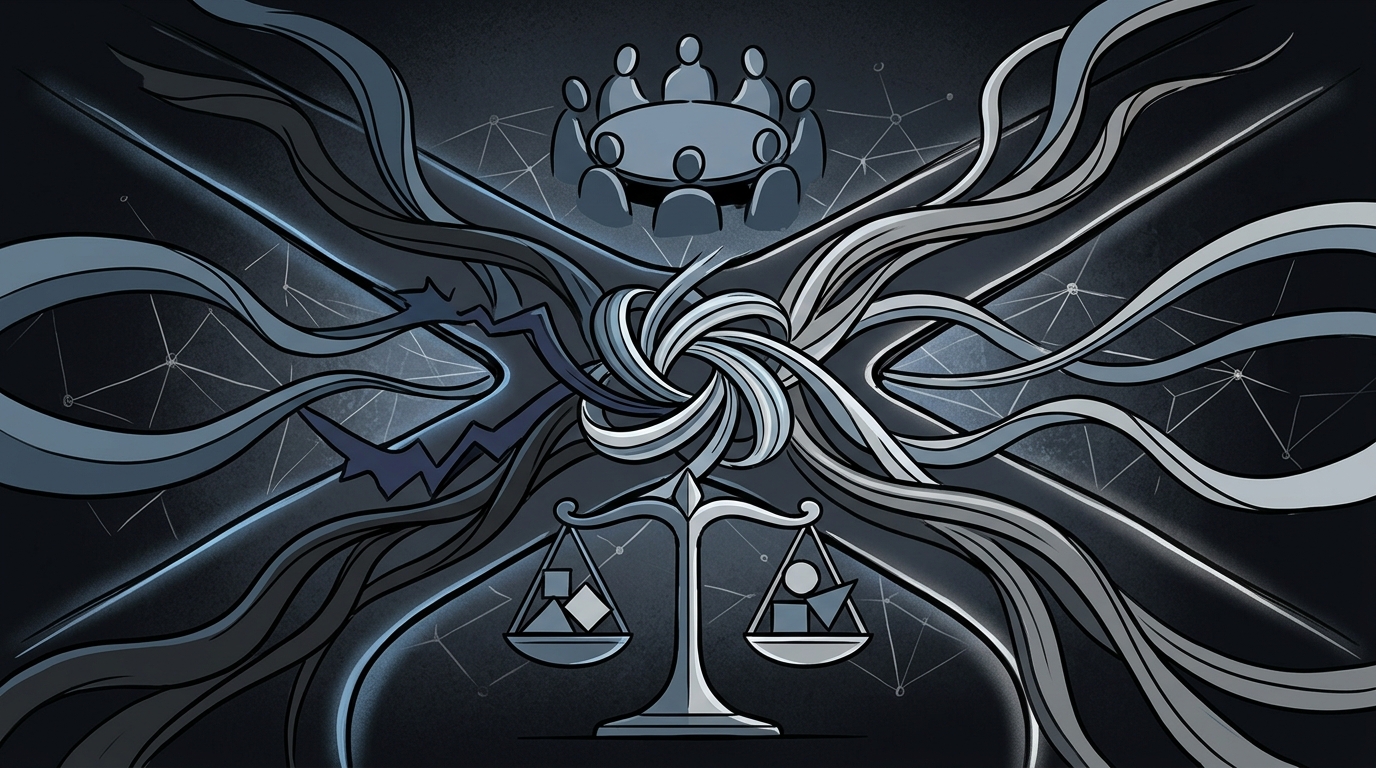
The Path from Conflict to Consensus
Resolving any disagreement is not merely about lowering the immediate tension. It is about building resilient buildings (systems) right on top of that fault line. Effective leaders use conflict as a laboratory for innovation.
Systematic Communication Filters
During conflict resolution, emotions must be entirely extracted, and a strictly data-driven foundation must be established. Instead of drivers screaming at each other right before the collision, they should analyze the situation strictly by looking at their engine temperature gauges and fuel levels. In the same way, companies must let financial and operational metrics do the talking. Emotions can lie and distort reality, but the raw numbers always reflect the true structural integrity of the intersection.