The Strategic Symphony and Seamless Cascade
A perfect strategy might be a flawless map drawn on a table; yet with a crew unable to read that map, the ship will always crash into the rocks.
Organizational success is measured not merely by the grand ambitions residing in the minds of top management, but by how accurately those ambitions cascade down to the very lowest levels of the organization without losing their meaning. Hoshin Kanri is a continuous alignment process—flowing top-down and bottom-up—that transforms strategic goals into operational reality.
Hoshin Kanri and Policy Deployment
Hoshin Kanri derives from the Japanese words for "direction/compass" and "management." It is a disciplined management system that demonstrates how a company's long-term vision connects to daily work. It ensures that the strategic objectives of top management (the CEO) are communicated and aligned flawlessly, passing through middle managers all the way down to the factory floor worker without any disconnection.
The Fundamental Notes from the Summit (True North)
Every organization has a long-term, unchangeable "True North" or ultimate goal. This goal is the main vision established by the CEO or the board of directors. Hoshin Kanri breaks down this massive, seemingly unattainable target into 3 to 5-year macro strategies. These strategies dictate the general direction of the company. However, unless this direction is clearly articulated to the subordinate units, it remains nothing more than a wish. The objectives set at the summit represent the most critical steps required for the organization to survive and gain a competitive advantage.
The Catchball Process: Strategic Idea Exchange
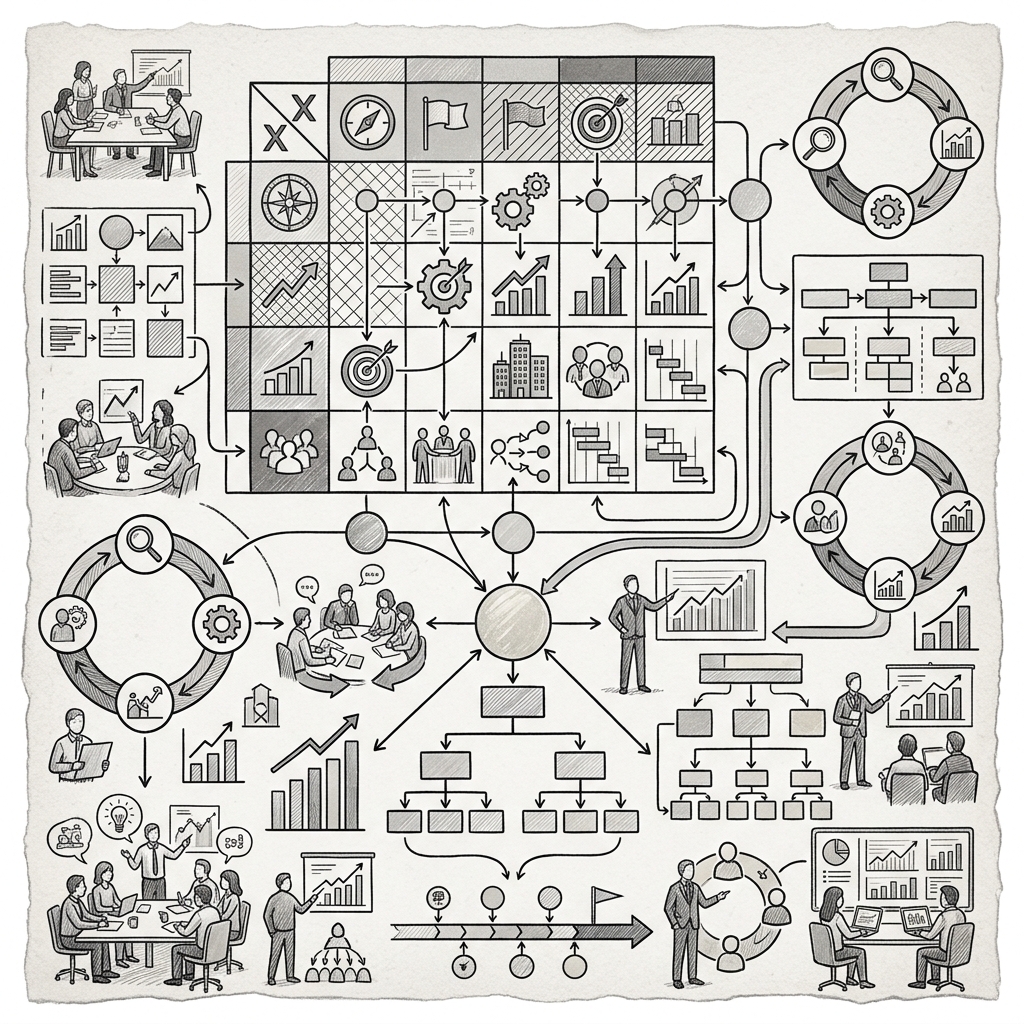
The most distinguishing feature of Hoshin Kanri is the "Catchball" process. Strategy does not cascade as a top-down dictation (order). A goal descending from the top is thrown like a "ball" to the manager at the next level down. The subordinate manager catches this ball, analyzes their own department's capacity, budget, and realities. If necessary, they add their own input or objections to the goal and throw the ball back up. This mutual passing continues until a complete consensus is reached on the objective. Thanks to the Catchball process, everyone in the organization understands the "Why" of the goal and has a say in "How" it will be executed. This breaks down resistance and increases ownership.
Daily Operational Alignment
Once goals are set and cascaded to every level, the process transitions into daily operational actions. No strategy can succeed if it is not tied to the daily routine of the employee at the lowest tier. Hoshin Kanri enables the machine operator on the factory floor to see exactly how a tightened screw or a prevented piece of scrap serves the company's global profitability objective. The strategy ceases to be an abstract concept and transforms into a measurable and trackable daily mechanic.
Orchestrating the Strategic Symphony
Consider Hoshin Kanri as the symphony of a massive orchestra. The conductor (top management) determines the main note (the strategy). However, every musician (employee) in the orchestra plays their own distinct instrument. The violinist uses a different technique, the drummer keeps a different rhythm. If the main melody (Hoshin) determined by the conductor is not communicated accurately to everyone, the orchestra produces nothing but noise. Yet, when every musician aligns their instrument to the main melody through the Catchball process, a perfect and flawless symphony emerges. Hoshin Kanri is that invisible conductor's baton, ensuring that hundreds of different people, doing hundreds of different jobs, move simultaneously toward a single goal (the main melody).