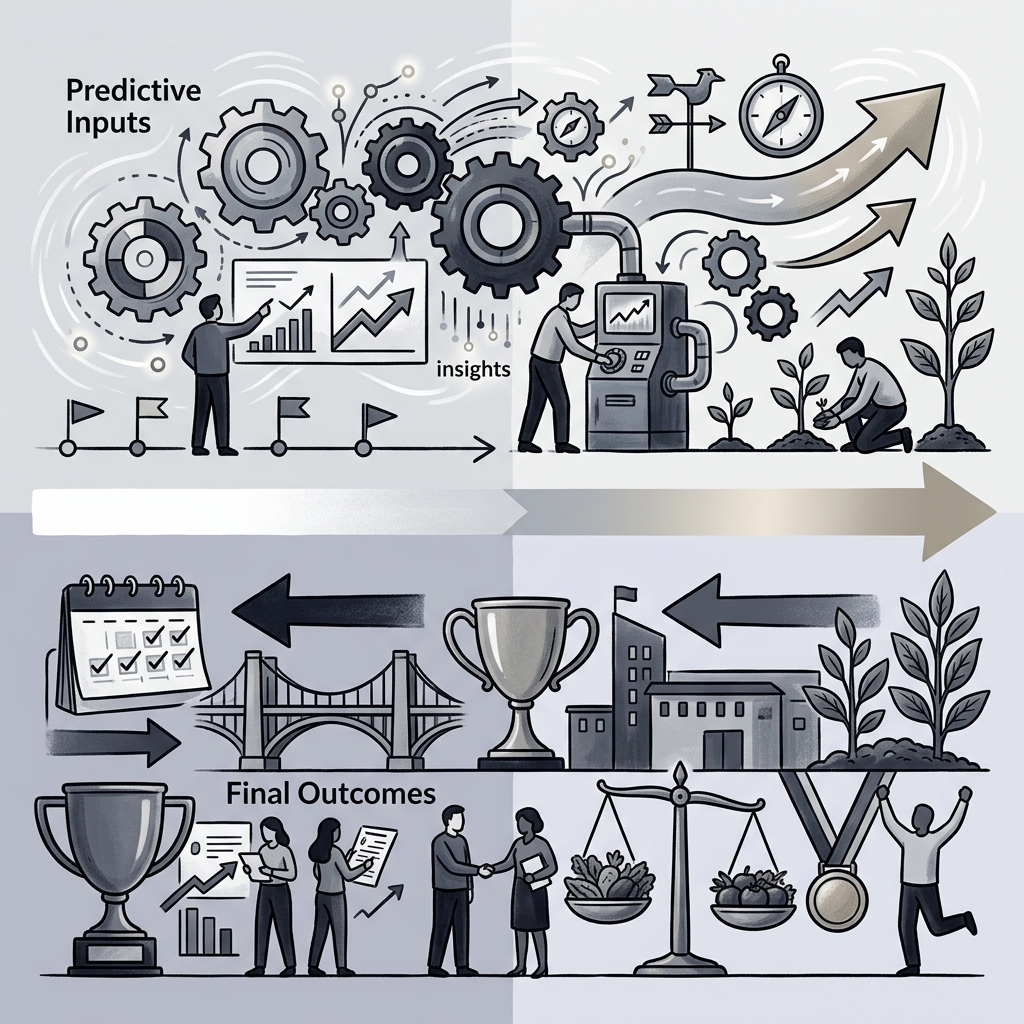
Leading and Lagging KPIs
You cannot alter the process by staring at the outcome; tomorrow's strategy cannot be drafted from yesterday's invoice.
The majority of enterprises tend to read success solely through the balance sheet of the past period. Lagging KPIs, such as profit, revenue, or completed production volumes, only prove that the event has already concluded and the opportunity for intervention is gone. These indicators act as the company's rearview mirror; they show you where you crashed but do not tell you how to steer. Operational excellence separates the power to predict the future from merely reporting the past.
Leading KPIs focus on the mechanics of the process and the seeds of future outcomes. If your ultimate goal is to reduce workplace accidents to zero (lagging), the leading data you must track should be "monthly safety training hours" or "near-miss reports detected." You forecast that by increasing training, accidents will decrease. True leadership is not about watching the scoreboard, but analyzing the real-time training performance of the players who produce that score.
Mathematically, every lagging metric is the integral of a series of leading metrics. If you want to maximize the output, you are obligated to measure the precision and real-time frequency of the inputs. This bidirectional measurement system eliminates surprises and transforms management from a reactive state into a proactive prediction machine.