
The Silent Thieves Gnawing at Capacity
Seeing machines constantly running in a factory (or people constantly busy in an office) often gives managers a false sense of security. Noise and movement do not always equate to value generation. A machine might be running, but perhaps it is running slower than it used to, or two out of every ten parts it produces are defective.
To measure true performance, we need a ruthless and naked metric that does not lie. In the TPM world, this metric is called OEE (Overall Equipment Effectiveness).
The Flawless Mathematics of OEE
OEE does not measure "how long" a machine ran; it measures "how long that machine was able to produce a perfectly quality product at its absolute maximum designed speed." It consists of three primary multipliers:
- Availability: How much of the planned time did the machine actually run? (Breakdowns and setup times lower this ratio.)
- Performance: While running, how close did the machine get to its design speed (ideal cycle time)? (Minor stops and speed losses lower this ratio.)
- Quality: What percentage of the produced parts were made right the first time (defect-free)? (Defective production and scrap lower this ratio.)
If a factory operates with 90% Availability, 90% Performance, and 90% Quality, managers often look at those "90%" figures and feel successful. However, OEE mathematics is unforgiving: 0.90 × 0.90 × 0.90 = 72.9%. This means 27% of the factory's theoretical capacity has vanished into thin air. The OEE target for a World Class company is generally 85% and above.
The Six Big Losses
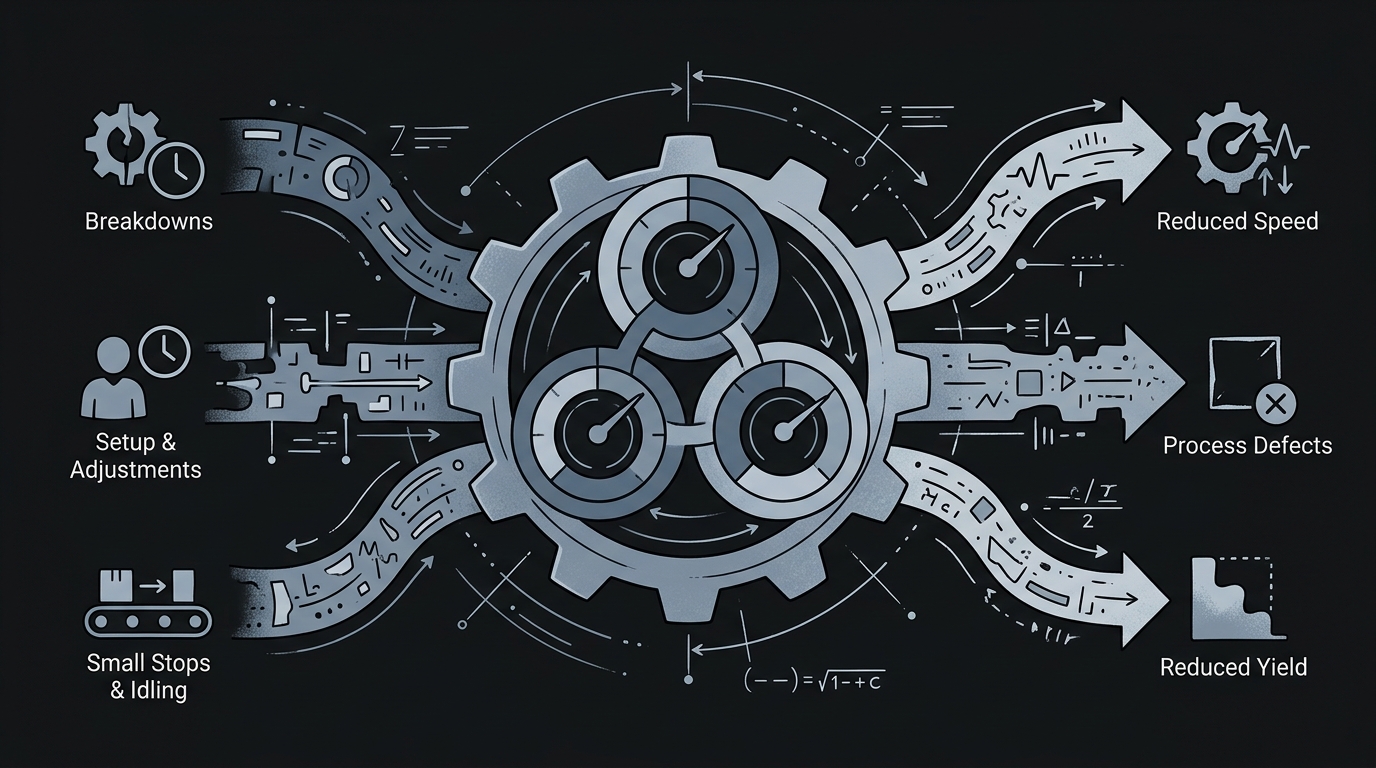
The enemies that lower OEE are not abstract. TPM classifies these enemies that drain the machine's time and energy as the "Six Big Losses":
Availability Losses:- Breakdowns: Complete halt of production due to equipment failure.
- Setup and Adjustments: Time lost during preparation phases such as die changes, part changes, or warm-up times (See: SMED).
- Idling and Minor Stops: Momentary pauses under 5 minutes, such as a blocked sensor or a jammed part, which the operator can quickly resolve but which disrupt the machine's rhythm.
- Reduced Speed: Operating the machine slower than its designed maximum speed due to equipment wear, poor material quality, or operator hesitation.
- Process Defects: Scrap and defective parts requiring rework that occur during normal production.
- Reduced Yield: Defective parts produced when a machine is first started or at the beginning of a shift until it reaches a stable state.
OEE is not merely a performance scorecard; it is a compass that reveals which of the Six Big Losses is bleeding the company dry and maps out exactly where Kaizen (continuous improvement) teams should attack.