
X-Raying Time and Friction
Companies' operational improvement efforts generally remain localized. Increasing a machine's operating speed by 10%, or reducing the approval time in an office process from 5 minutes to 2 minutes looks great on paper. However, these localized victories often have zero impact on the overall system. They might even make the system worse by creating more intermediate inventory or bottlenecks. The way out of this myopia is Value Stream Mapping (VSM).
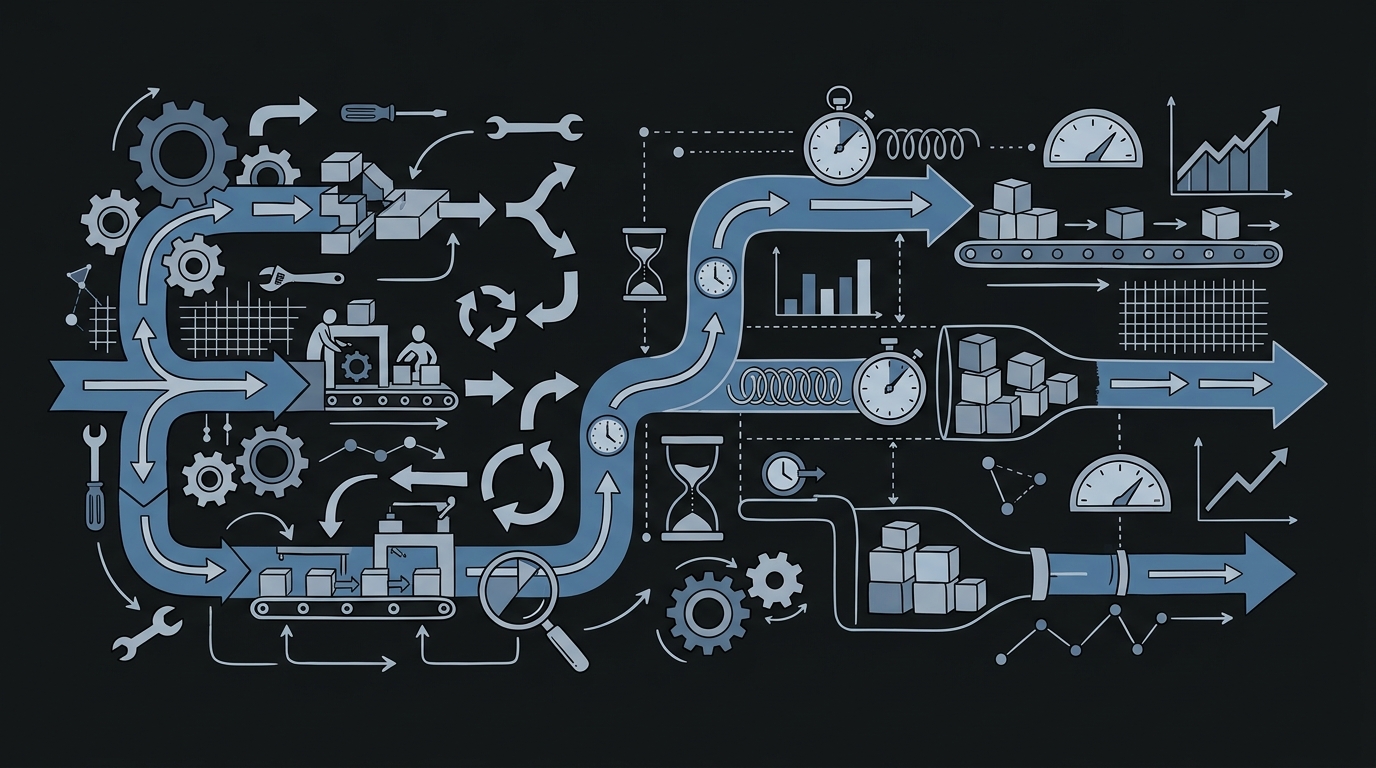
VSM is an architectural analysis that x-rays the entire end-to-end path a raw material takes until it reaches the customer (or an email in an office until it gets invoice approval), mapping both the material and information flow simultaneously.
Why Traditional Process Flowcharts Fail
Ordinary flowcharts only show "what" is being done: process B follows process A. VSM is far more ruthless; it places time and inventory at the center. When you look at a VSM, you don't just see the processes, you see the waiting times between the processes.
In reality, while the actual value-creation time of a product or service is typically measured in seconds or minutes, the total time the product spends in the factory or office (Lead Time) takes weeks. VSM acts as a mirror that exposes the massive abyss between these two metrics.
What Does the Customer Pay For? (Redefining Value)
When creating a VSM, every step is passed through three filters:
- Value-Added Steps: Processes that change the form, function, or feature for the customer, and for which the customer is willing to pay. (e.g., painting the car, coding the software).
- Non-Value-Added, Essential Steps: Steps the customer doesn't care about, but that we must do due to legal, financial, or current technological limitations. (e.g., invoice approvals for the tax office, signing audit documents).
- Non-Value-Added, Non-Essential Steps: Pure waste (Muda). Processes done solely because of our own operational incompetencies. (e.g., holding inventory, repairing defective products, unnecessary email traffic between departments).
The goal is not just to eradicate the third category, but to minimize the second category through technology and automation (e.g., Jidoka) and shift all energy toward the first category (Value).
Information Flow: The True Nervous System of the Factory
The unique feature that separates VSM from all other methodologies is that it maps the Information Flow right above the material flow (boxes, pallets, files). How does the customer order enter the system? Which ERP system transfers it to which other system? How does production planning communicate work orders to the line (Push or Pull/Kanban)?
In most factories, even if the material flow is physically optimized, the system remains sluggish because the information flow is slow, disconnected, or overly centralized. VSM reveals where information accumulates and where it generates false signals, causing the Bullwhip Effect.
The Future State Map
Mapping the current state is merely a diagnosis, not the cure. The true power of VSM lies in the single question asked after pinning the current map to the wall: "If we were to design our system from scratch solely based on customer value, what would this map look like?"
The answer to this question is the Future State Map. At which points should we establish a pull system? What should our Takt time be? Which stations should we combine to create cell production? VSM provides managers with a strategic battle plan to stop putting out daily fires and rewrite the genetic code of their system.