
The Black Holes Draining Corporate Wealth
The greatest revolution Taiichi Ohno made while building the Toyota Production System was giving inefficiency (Muda) a concrete, measurable, and attackable name. Waste is often invisible on balance sheets; it hides among costs, overheads, or the "normal cost of doing business". Companies often try to raise prices to increase profit margins, whereas true profit is secured by stopping the bleeding within the system.
Classical literature codes this as the "7 Mudas" (TIMWOOD). However, we will examine these wastes not just by "what" they are, but "why" they exist and how they drain the organization's energy.
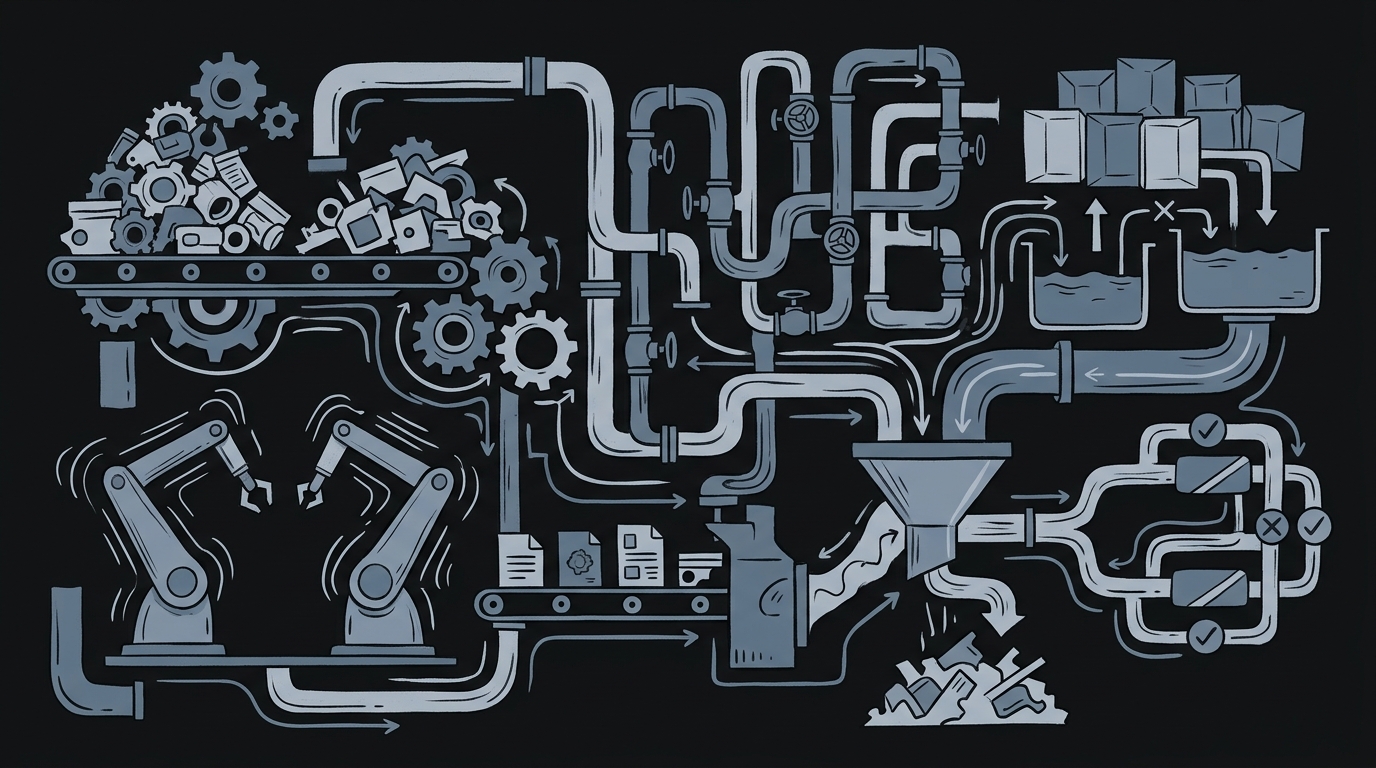
1. Overproduction: The Mother of All Wastes
If you continue to produce without customer demand just to keep a machine or a team busy, you fall into the trap of "Overproduction". TPS considers overproduction as the mother of all other wastes. Why? Because every product produced beyond need creates extra space for storage, extra forklifts for transport, extra personnel for inventory counting, and a massive pile that hides defects. Overproduction is a financial poison that lulls a company into a false sense of security (inventory) that it does not actually possess.
2. Waiting: The Death of Time
If a raw material is waiting to be processed, a document to be approved, a machine to be repaired, or an employee waiting for another to finish their task, there is "Waiting" waste in the system. In the value stream, time equals money. Waiting is almost always a direct result of Mura (unevenness). Unsynchronized lines push managers to create busywork "so workers don't sit idle," which leads us right back to the first waste (overproduction).
3. Transport: Valueless Mobility
Moving products, files, or information from one department to another, or from a warehouse to a factory, adds absolutely no value to the process. Transport is only valuable if it improves the form or quality of a product; in all other cases, it is merely a potential source of accidents, delays, and costs. Poor factory layout or chaotic office architecture is the primary cause of transport waste.
4. Overprocessing: Effort the Customer Doesn't Pay For
Doing work at a quality, precision, or standard that the customer did not request, will not notice, or is unwilling to pay for is "Overprocessing". Adding 5 extra pages of analysis to a report that no one will read, or spending hours polishing a product surface that serves no function for the customer are examples of this waste. Overprocessing begins where perfectionism detaches from customer value. It is the result of engineering arrogance.
5. Inventory: The Lake Hiding the Problems
Inventory is the biggest cushion a company uses to hide its operational flaws. In the Toyota philosophy, inventory is "evil". It covers up machine breakdowns, quality issues, supplier delays, and line imbalances. Just as a high water level in a lake hides the jagged rocks (problems) at the bottom, high inventory prevents companies from seeing their own operational incompetencies.
6. Motion: Ergonomic Loss of the Human
While transport waste is the unnecessary movement of "products" or "materials", "Motion" waste is the unnecessary physical effort of the human. It is a worker constantly bending down and standing up, spending seconds rummaging through a drawer to find a tool, or a software developer clicking through 10 folders to access a file. This is not just a loss of seconds; it is the waste of a human's ergonomic and cognitive energy. A weak 5S culture is the root cause of this waste.
7. Defects: Rebuilding Destruction
This is the time and money spent not doing a job right the first time, producing it with errors, then finding the error, sorting it out, and reworking it. Defects are the combined outcome of the other 6 wastes. If quality is not built into the system (Built-in Quality / Jidoka), quality control departments are established to catch errors. However, the goal is not to catch the error, but to physically make it impossible to commit the error through design and process (Poka-Yoke).