
Lean In The Digital Age
Lean perfects the process by eliminating waste; Agile perfects the product by rapidly adapting to uncertainty. One is not an alternative to the other; they are twin siblings of the digital age, born of the same philosophical root and completing each other.
The Toyota Production System (TPS) may have been born on the oily, noisy floors of factories. However, the codes of lean thinking are universal; they bend software, data streams, and in-office processes just as they bend metals. The roots of the "Agile" philosophy, which has spread from Silicon Valley in recent years, actually trace back to 1950s Japan. When you look at a Scrum board (Jira/Trello), what you are actually seeing is a digitized Kanban board; the cycles called Sprints are the software equivalents of PDCA (Plan-Do-Check-Act) cycles.
However, when translating the physical rules of factories to white-collar offices and digital products, we must understand the very fundamental differences and traps.
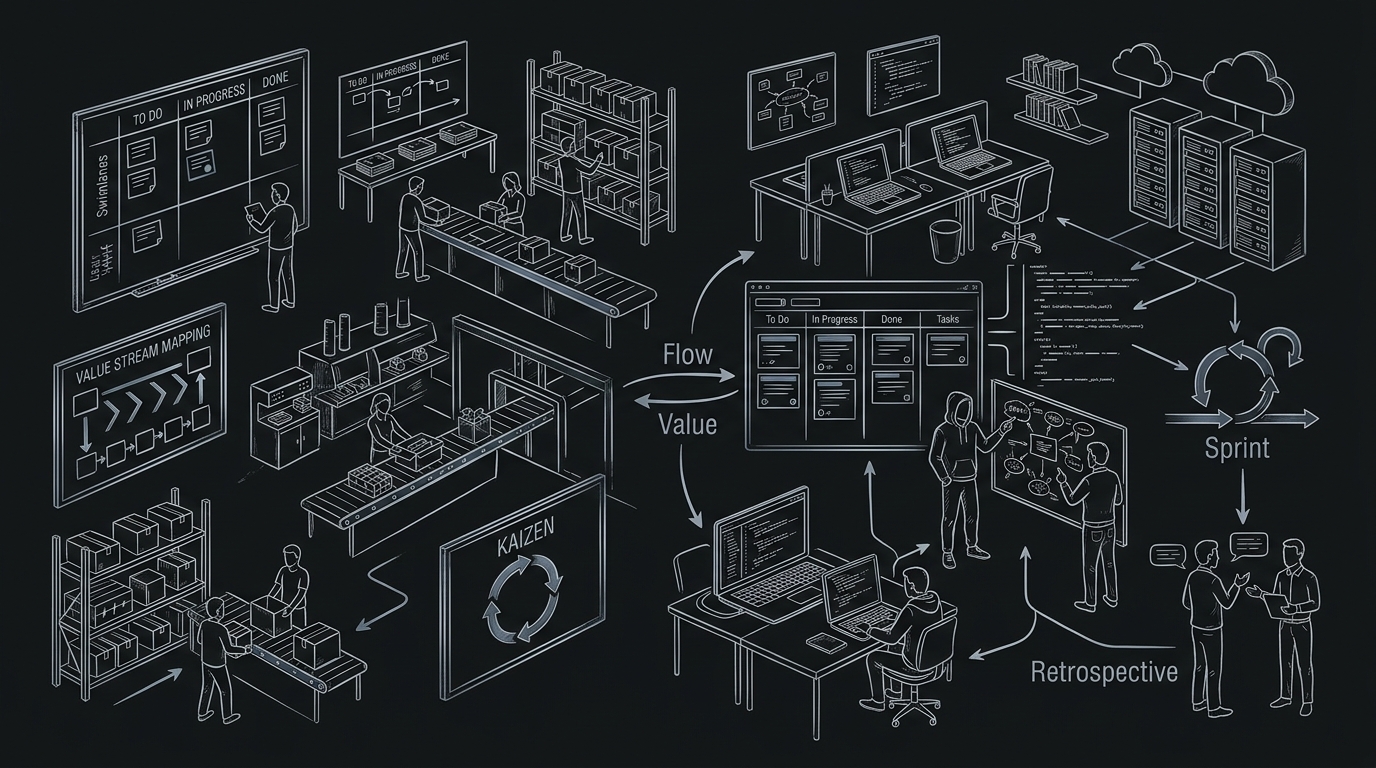
Physical Inventory Vs Digital Inventory
In a factory, it is very easy to see waste (Muda). Thousands of steel rolls waiting in a warehouse is a massive inventory screaming that production has slowed down. It takes up physical space, rusts, and ties up cash.
In offices and digital processes, however, inventory is "invisible." Unfinished lines of code waiting on developers' computers, interface designs waiting on a designer's desk, hundreds of requests waiting for approval in a manager's inbox; these are all "Digital Inventory." They are no different from the accumulated steel rolls in a factory. Most companies, unable to see this waste in digital processes, think they are Agile while actually building a massive digital dump.
Continuous Delivery Vs Continuous Flow
While Lean focuses on pushing out smooth products from the line through "Continuous Flow," Agile has translated this concept to the software world as "Continuous Delivery/Deployment." However, most teams practicing Agile fall into the trap of obsessing over speed (Velocity) and sacrificing quality.
The biggest danger at the heart of Agile is the misinterpretation of the "Fail Fast" mantra as "Write bad code, we'll fix it later." Yet, the founding fathers of TPS (Ohno, Toyoda) would never allow a defective product to come off the line (Jidoka). Quality (Built-in Quality) comes before speed. Making a mistake (producing a Bug) in a digital product might be cheap, but the cost of fixing that mistake after it reaches the end user is no different from recalling a defectively manufactured engine in a factory.
A true digital transformation does not begin with sticking post-its on Jira boards; it begins with the ability to read the invisible inventory, bottlenecks, and waste in the office through the lenses of TPS.
Agile And Lean Matrix
| Dimension | Lean | Agile |
|---|---|---|
| Core Focus | Eliminating waste (Muda) | Maximizing customer value |
| Environment | Predictable, repetitive tasks | Uncertain, innovative projects |
| Process Architecture | Continuous Flow | Iterative Cycles (Sprints) |
| Problem Solving | Root cause analysis, process locking | Rapid prototyping, iteration |