
The Weakest Link in the Chain
Organizations often fall into the misconception that they are merely the sum of isolated departments. The sales team might be breaking records, production lines might be running non-stop, and the logistics department might be reaching incredible speeds. However, if the cash entering the register at the end of the day or the final product reaching the customer is not at the expected level, none of these local optimizations have any meaning.
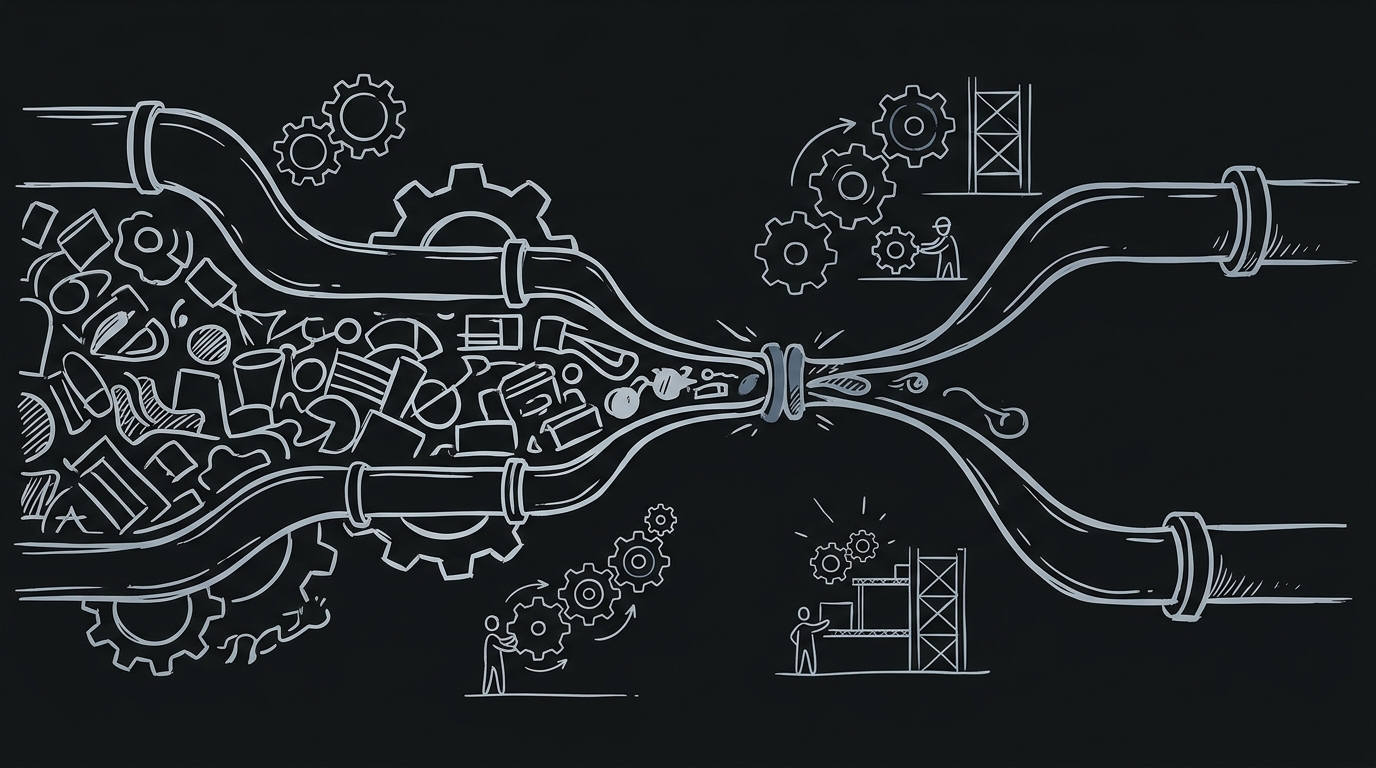
In the physical world, the flow rate of a pipeline is determined not by its widest part, but by its narrowest bottleneck. The exact same thermodynamic rule applies in businesses: The maximum production capacity and speed of a system is only as great as its slowest and most restricted part (The Constraint). The Theory of Constraints (TOC), formulated by Eliyahu M. Goldratt, places this brutal engineering reality at the center of management.
The constraint is not the weak point of your system; it is its most honest mirror. It dictates exactly how fast you can go and precisely where you need to invest. Any step taken without addressing the constraint creates friction and only increases inventory. Focus all your energy on this honest limit.
The Traps of Local Optimization
Any improvement made in an area that is not a constraint is mathematically a "waste" (Muda).
If you have a paint shop (your constraint) that can process 10 products per hour, increasing the capacity of the assembly line preceding it from 50 to 100 products per hour will yield zero financial return. You will only cause a faster and larger pile of inventory (stock) to accumulate in front of the paint shop. Spending your resources, energy, and capital to accelerate a non-constraint area is simply sending faster cars into a highway traffic jam.
The Art of Managing the Constraint
The Theory of Constraints provides leaders with a 5-step analytical focusing protocol to solve the problem:
- Identify the Constraint: Where is the system clogging? Where is material piling up? On whose desk do approval emails wait for days?
- Exploit the Constraint: Never let the constraint sit idle. That machine or that expert must produce value 24/7. Even the constraint going to lunch is a disaster for the system.
- Subordinate Everything to the Constraint: Adjust the speed of all other processes in the system according to the speed of the constraint (Takt Time). Slow down any machine that works faster than the constraint. Otherwise, you only produce inventory and chaos.
- Elevate the Constraint's Capacity: If the first three steps are not enough, invest in that area (buy a new machine, hire new staff).
- Repeat: When you resolve one constraint, by the very nature of systems, a new constraint will inevitably emerge somewhere else. Inertia is the greatest enemy of systems engineering.
The only thing that sets your system's speed limit is that weak link. A leader who cannot find the constraint is managing the company blindfolded.
Comparison Matrix
| Feature | Traditional Management | Theory of Constraints (TOC) |
|---|---|---|
| Focus | Accelerating every department | Accelerating only the constraint |
| Investment Strategy | Distributed across the system | Isolated to the constraint |
| Production Rhythm | Maximum speed of machines | Processing speed of the constraint |
| Result | Excess inventory and high cost | Smooth flow and high profit |