
The Universal Heartbeat of the Factory
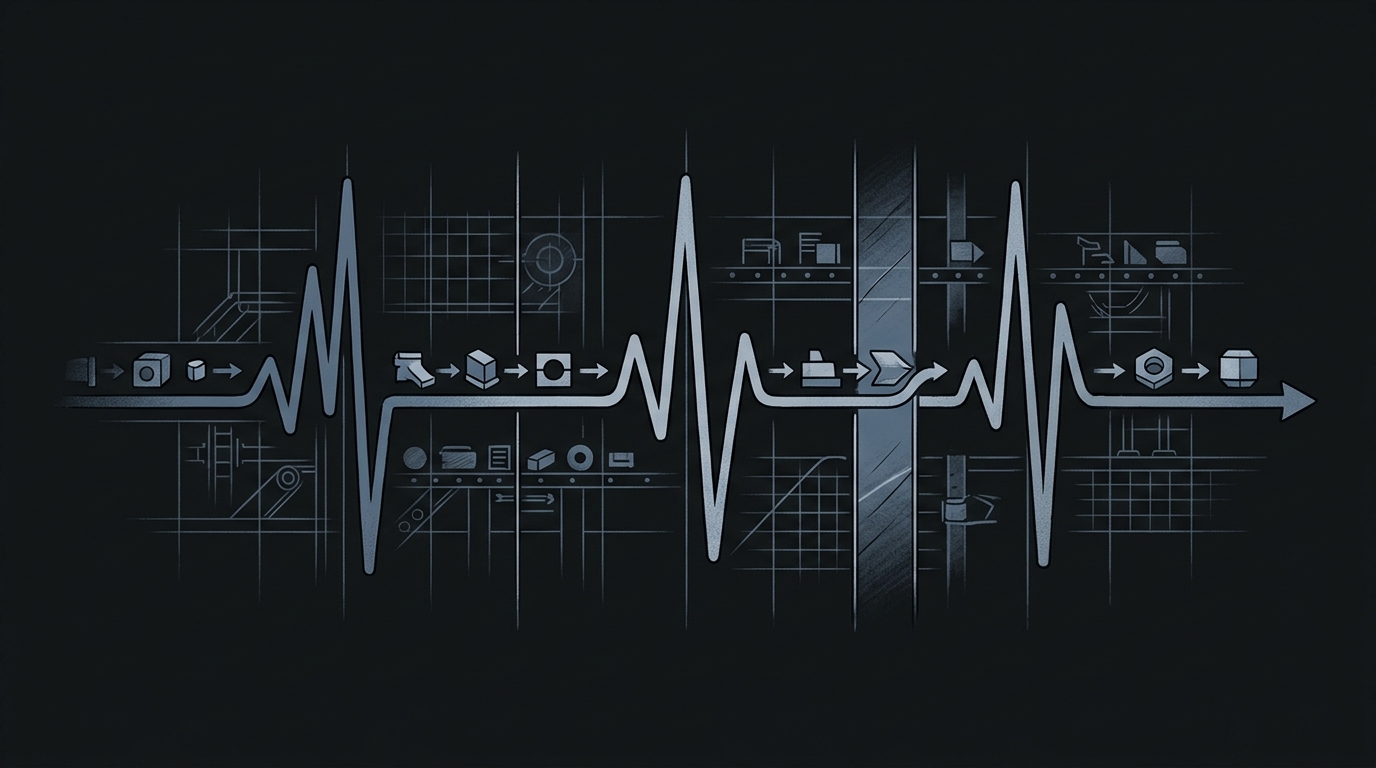
Every organization has an invisible heartbeat. However, in traditional companies, this heartbeat is arrhythmic; it beats slowly in the morning, accelerates in the afternoon, and goes into tachycardia (excessive palpitation) as end-of-month targets approach. The Toyota Production System (TPS) completely rejects this chaos and locks the organization's heartbeat to a single reality: the rate of customer consumption.
The engineering term for this heartbeat is Takt Time.
The Mathematics of Takt Time
Derived from the German word for a conductor's baton or "rhythm," Takt is a simple yet uncompromising formula that perfectly synchronizes your production speed with customer demand:
Takt Time = Net Available Working Time / Customer DemandIf you have 480 minutes of net working time in a shift and the customer demands 240 units from you that day, your Takt Time is 2 minutes. This means a product of perfect quality must roll off the system exactly every 2 minutes (neither 1 minute 59 seconds, nor 2 minutes 1 second).
Takt time is not a goal or a measure of production capacity (Cycle Time). Takt time is a mathematical reality demanded by the customer. The system's duty is to adapt its own capacity to this reality. If a station finishes its work in 1 minute and waits for 1 minute, there is unevenness (Mura) and waste (Muda) in the system. The work must be redistributed, and the line balanced according to Takt time.
Continuous Flow
If Takt time is the conductor of the factory, Continuous Flow is the uninterrupted performance of that music. Traditional manufacturing operates on a "Batch and Queue" logic. Parts are processed in batches of 100, piled up at the next station, and wait for days to be processed. This method creates the illusion that machines are running very efficiently, but it causes money (value) to freeze within the system.
Continuous Flow is based on the One-Piece-Flow philosophy. Products glide between stations not in batches, but one by one, matching the rhythm of Takt time.
Why is One-Piece-Flow critical?
- It Catches Quality Issues Instantly: If a machine is producing a defective part, you realize it instantly at the next station after just 1 part, not after producing a batch of hundreds.
- It Creates Flexibility: When customer demand changes, you can pivot instantly because there is no massive Work-In-Progress (WIP) clogging the system.
- It Liberates Capital: Products create value within minutes rather than spending weeks in the system, massively accelerating the company's cash flow.
Takt time and Continuous Flow transform the production line from a stagnant lake into a rushing, yet controlled, river.