
The Art of Bending Downtime to Zero
One of the greatest contradictions in modern business is that while customers demand more variety every day (different colors, different models, customized services), factories are still designed with a sluggish mass-production mindset. If it takes hours to set up a machine to switch from producing Product A to Product B, the logical response from managers is: "Let's produce 10,000 more of Product A so the cost of the setup time drops per unit."
This exact logic is the birthplace of Overproduction waste. TPS overcame this deadlock with Shigeo Shingo's legendary invention: SMED (Single-Minute Exchange of Die).
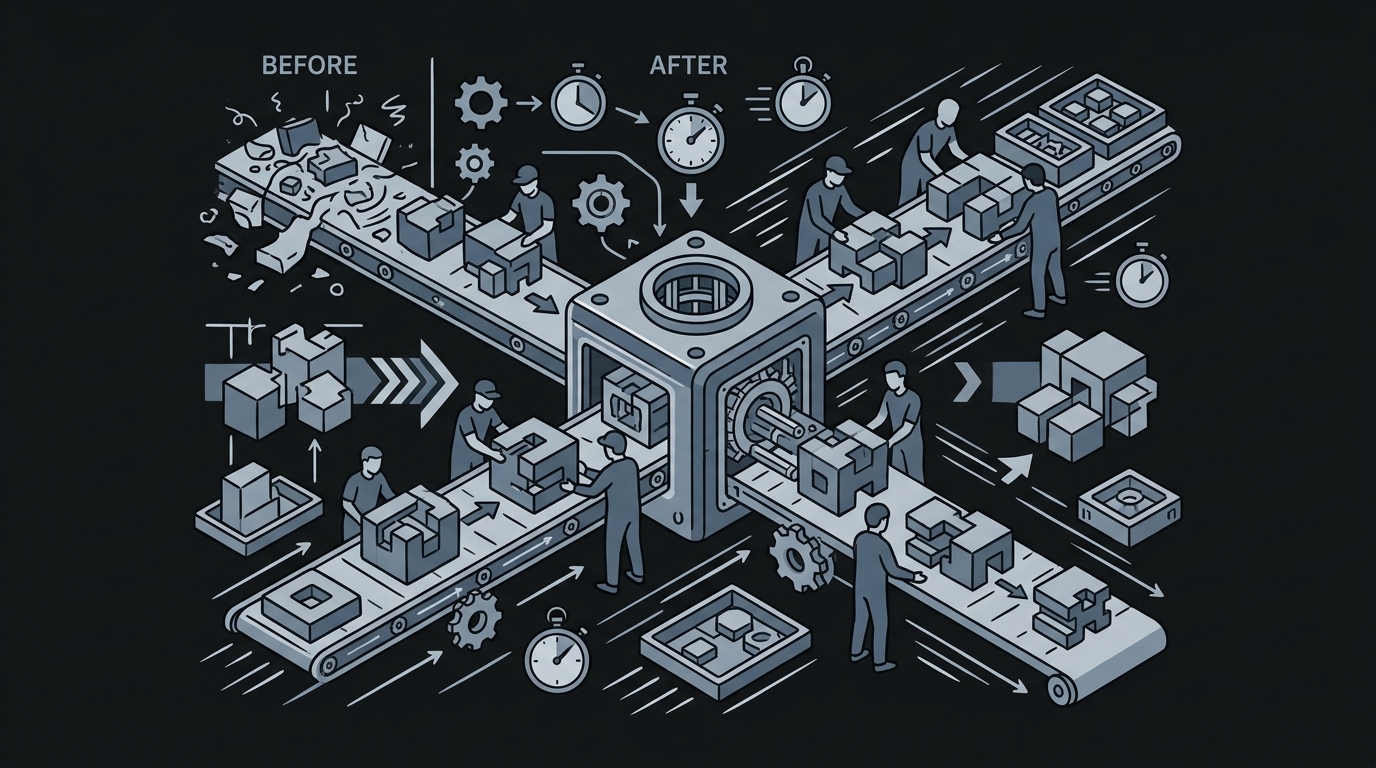
Zeroing the Cost of Variety
The philosophical goal of SMED is not merely to set up a machine quickly; the goal is to shrink batch sizes and drastically increase the company's flexibility. If a die changeover takes 4 hours, you are forced to produce the entire month's demand in a single run. However, if the changeover is reduced to 9 minutes (single-digit minutes), you can produce small batches of 5 different products on the same machine in a single day, thereby responding to instant customer demand (Pull System) without holding inventory.
SMED shatters the "economies of scale" lie of mass production. Producing in massive batches does not lower costs; it merely creates invisible inventory and waiting costs. Flexibility is the only true currency of the modern economy.
Internal vs External Setup
The SMED methodology does not require magic or extreme technology; it requires surgical preparation and process engineering. Shingo divided setup time into a rigid, twofold rule:
- Internal Setup: Operations that absolutely require the machine/process to be completely stopped. (e.g., physically removing a drill bit).
- External Setup: Operations that can be performed while the machine is still running and production is ongoing. (e.g., fetching the new die, preparing tools next to the machine, pre-heating the mold).
In traditional factories, the machine stops, and only then do workers begin searching for the new die or tools. The first and most radical step of SMED is to complete everything possible (External Setup) while the machine is running. The moment the machine stops, acting just like a Formula 1 pit-stop crew, only the bolts are removed, and the new part is inserted.
The Formula 1 Pit-Stop Metaphor
When a Formula 1 car enters the pit, 4 tires are changed in under 2 seconds. Because the pit crew does not go looking for tires after the car has stopped. Pneumatic wheel guns are optimized with millisecond precision. Everyone's duty is mapped out to the millimeter.
SMED turns your factory into a massive pit-stop lane. Clamps and interlocking mechanisms (Poka-Yoke) are used instead of bolts. Adjustments are not made by "trial and error"; they are standardized with alignment pins.
The result is the company acquiring a strategic weapon: While it takes your competitor 3 weeks to respond to a customer demand due to massive changeovers, your Takt-aligned SMED system can produce the same order within 24 hours with zero intermediate inventory.