
Tearing Down the Ivory Tower
Polished dashboards and charts are merely cosmetically enhanced, noise-filled echoes of a dead past. To truly diagnose systemic friction and hidden patterns, a leader must relentlessly abandon the ivory tower and plunge into the bleeding heart of the "real place" (Gemba) where reality is unforgivingly forged.
Modern managers suffer from a deep "dashboard blindness," believing they can read reality from the slick charts and Excel spreadsheets on their screens. The pulse of a factory, a software team, or a hospital never beats in meeting rooms. Those charts are delayed, filtered, and often cosmetically enhanced echoes of events that have long since happened (Lagging Indicators).
If you want to understand the true mechanics of your system, you have to stop looking at the map and step directly onto the terrain. The equivalent of this action in the Toyota Production System is the "Gemba Walk" (Going to the Real Place).
Unfiltered Reality
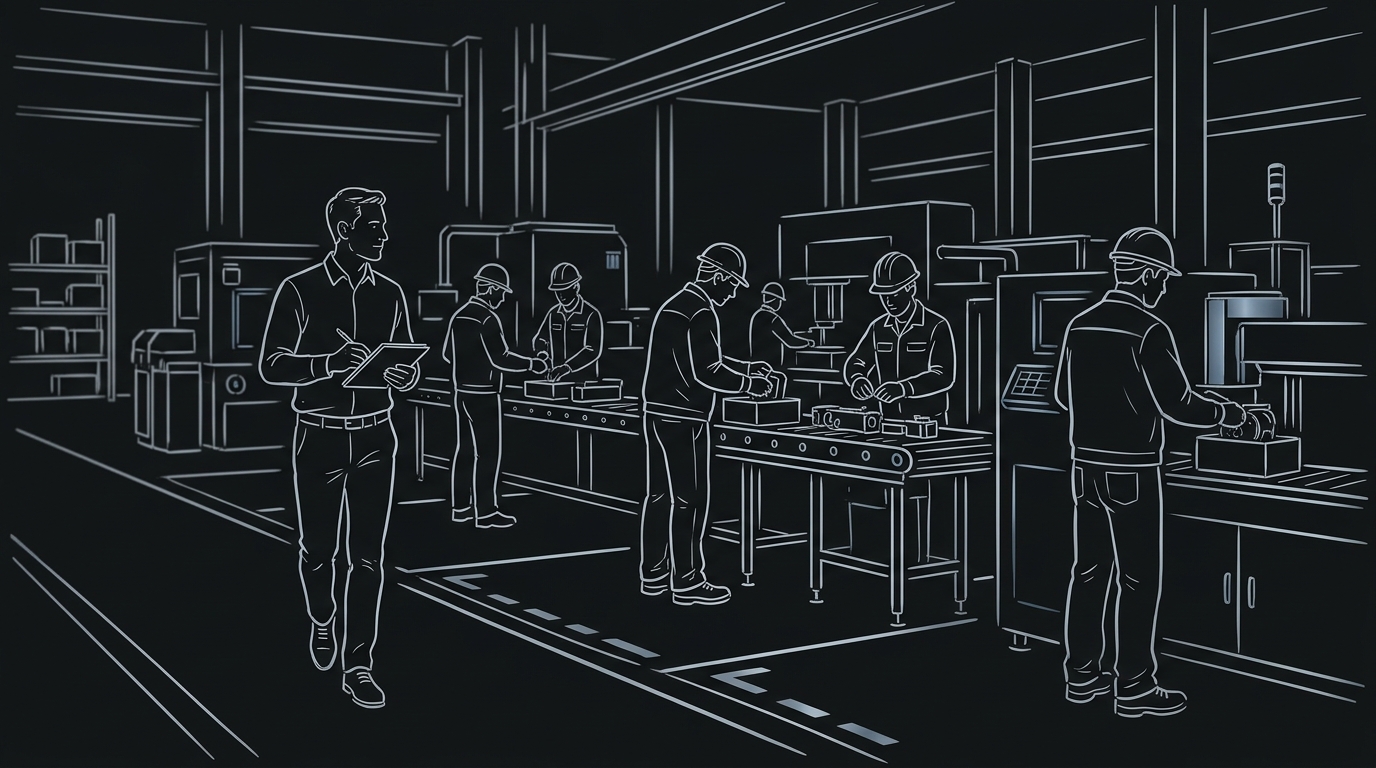
"Gemba" means "the real place" (where the action happens) in Japanese. In police terminology, it's the crime scene; in manufacturing, the factory floor; in software, the screen where the code is written. A Gemba Walk is the act of a leader leaving their desk, descending to the arena where value is actually created (or wasted), and seeing the unfiltered reality with their own eyes.
This is not an inspection or a police raid. A manager looking for mistakes with a penalty ticket in hand is completely contrary to the spirit of Gemba. The purpose of a Gemba Walk is not to judge people, but to understand "the system and the processes." Because employees are usually not at fault; it is poorly designed processes that force them into making errors.
The Power of Silent Observation
Taiichi Ohno's (the architect of TPS) famous "Chalk Circle" technique is the most radical form of Gemba. Ohno would draw a circle on the factory floor with chalk and force the young engineer to stand inside that circle for hours, just observing the system. The goal was to develop the ability (the observation muscle) to see the "friction" beneath the movement, namely the waste (Muda), with the naked eye.
A leader descending to the Gemba listens more than they speak. They hear an abnormal sound coming from the machine, feel the ergonomic strain (Muri) an operator experiences when reaching for a tool, and smell the pile-ups (Mura) in the workflow. Everything that reports hide is stark naked at the Gemba.
Great leaders know that the truth is not written in meeting rooms, but on dusty floors, in the sound of keyboards, and on sweaty brows. Descend from the ivory tower; reality is down there.
| Management Approach | Ivory Tower (Desk Management) | Gemba Walk (Going to the Floor) |
|---|---|---|
| Information Source | Delayed and filtered reports | Unfiltered reality (Seeing with own eyes) |
| Problem Detection | Discussing surface symptoms | Observing friction and waste (Muda) at source |
| Leader's Action | Speaking, dictating, and blaming | Silently listening and understanding the process |
| Employee Interaction | Fear of inspection | A feeling of being valued and understood |