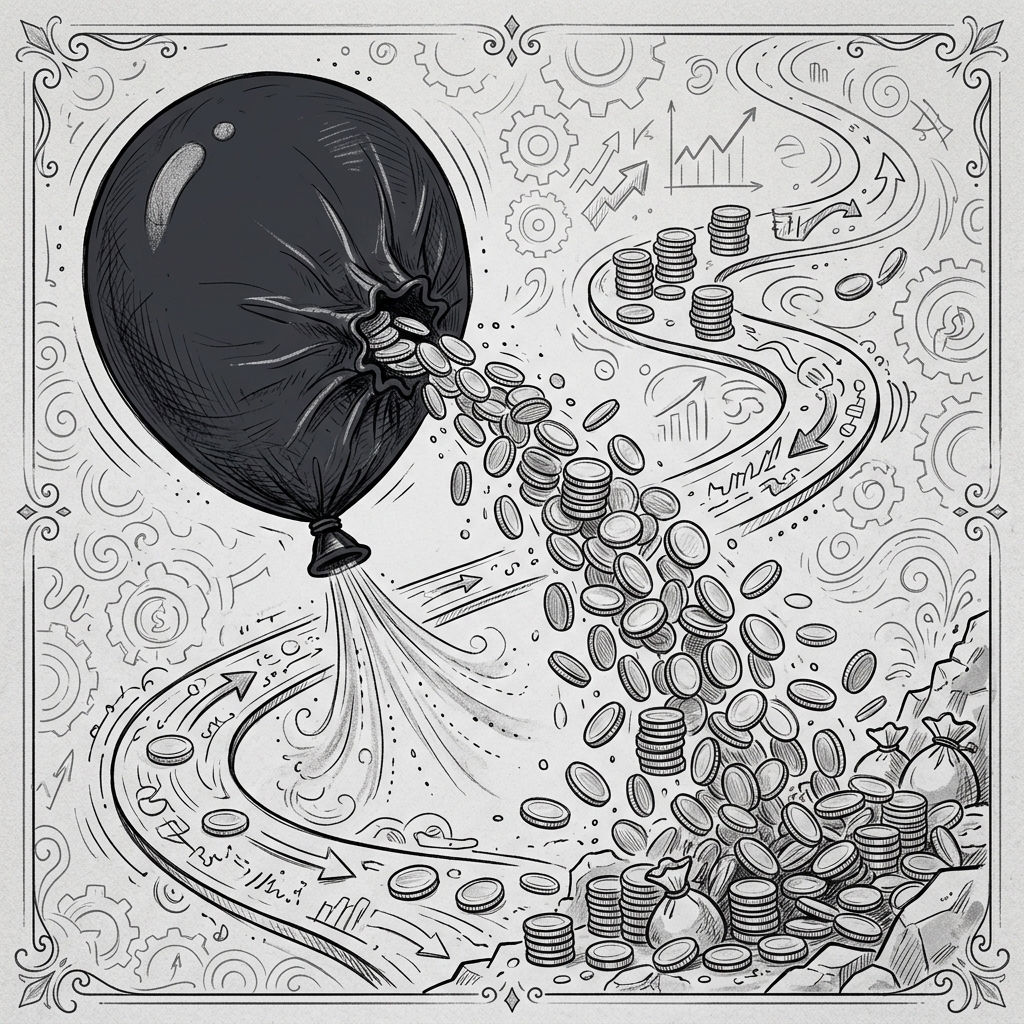
The Invisible Rust and the Ice Age
Time is the most insidious enemy of money; every second it remains stagnant, it slowly melts or becomes entirely useless as the system freezes.
The value of money comes not from the numbers printed on it, but from the amount of goods and services those numbers can buy. A continuous increase in the general level of prices in an economy constitutes inflation, while a continuous decrease constitutes deflation. These two forces are the most powerful macroeconomic winds that directly steer the production decisions of companies and the spending habits of consumers. To survive, companies must leverage their pricing power according to this shift in the purchasing power of money.
Inflation and the Rusting Process
Inflation is the invisible erosion of money's purchasing power over time. If the amount of money circulating in the market increases faster than the amount of goods produced, the value of each unit of currency inevitably drops.
The Invisible Rust and Melting Purchasing Power
Imagine inflation as an invisible rusting process, and the money in your pocket as a solid iron bar. Over time, the rust slowly eats away at the iron, weakening it. Yesterday, you could buy a massive sack of wheat with that same iron bar; today, with your rusted and shrunken iron, you can only buy half a sack. Even though the money sits physically in your wallet or bank account, it is rusting in the background, constantly losing its purchasing power. In economic equations, this means the real value of savings simply vanishes.
The Mathematical Dynamics of Inflation
Inflation is not just a price tag increase; it is also the disruption of the delicate balance between the supply of money and the supply of goods. If central banks inject too much money into the market, more money begins chasing the same amount of goods. This allows sellers to assign higher prices to their products. For corporate balance sheets, this means the numbers on the income statement inflate, but the actual profit earned does not hold the same purchasing power in real terms.
The Litmus Test of Pricing Power
In an inflationary environment, a company's greatest defense weapon is its pricing power. As raw material, energy, and labor costs rise, can the company reflect this cost increase in the price of its own product and demand it from the customer? If a company's costs increase by 10% and it can raise its product price by 10% while customers still buy it, that company has high pricing power. If a company cannot directly pass the increase in raw material costs to the consumer, its profit margins melt rapidly. This situation causes companies unable to raise prices to invisibly lose capital. Strong brands, resilient against inflation, are like strong fortresses that can constantly replace their rusting iron with new ones; weak brands are doomed to perish in this rusting process.
Deflation and the Ice Age
Deflation is the continuous decline in the general level of prices. While it might seem fantastic for consumers at first glance (everything is getting cheaper!), on a macroeconomic scale, it triggers a much more dangerous freezing process.
Winter Slumber and Frozen Demand
Think of deflation as a massive winter slumber where everything slowly turns to ice, and no one can move. People stop all the spending they need to do today, thinking, "It will be cheaper tomorrow, and even cheaper next week." As long as the consumer does not spend (as demand freezes), no money enters the cash registers of companies. Because companies cannot make money, they lay off workers or shut down their factories. Unemployed people become completely unable to spend, and the glaciers swallow the entire economy, leading to total paralysis.
The Deflationary Spiral
Deflation is not just a one-time price drop; it is a dangerous, self-feeding spiral. When consumer demand falls, companies are forced to lower prices further to clear their inventory. These discounts obliterate profit margins. Companies incurring losses start layoffs, which reduces the total household income in the economy. Decreased income lowers demand even further, and prices are pulled down once again. This vicious cycle causes the entire system to freeze over, bringing economic activity to a permanent halt.
The Burden of Debt and Corporate Bankruptcies
Being in debt during a deflationary environment is the worst-case scenario for companies. While earnings and prices fall, the amount of debt owed to the bank remains constant. Even though the company earns less, it has to sell significantly more products than before just to pay the exact same debt. Because the purchasing power of money increases, the real burden of the debt mercilessly increases as well. This is the fundamental mathematical reason why bankruptcies happen one after another during deflationary periods.