The Four Seasons of Economy and Rhythms of Production
Time and production are interconnected gears of a colossal clock; a mechanism that does not slow down in winter will never find the energy to accelerate in summer.
Macroeconomics is not merely a scientific discipline consisting of numbers and complex charts. On the contrary, it is a systematic field of observation that studies the breathing, heartbeats, and life cycle of an entire nation. Companies are like ships floating within this massive system. Without understanding which way the wind will blow and how high the waves will rise, no ship captain (corporate manager) can determine the correct course.
The most fundamental way to understand this big picture is to accurately read a country's total wealth and its fluctuations over time.
The Macroeconomic Landscape and Production Power
The success of a company does not depend solely on the quality of the product it manufactures. If there is a massive storm outside, even the best product may find no buyers. Therefore, the business world must constantly measure the total capacity of the economic ecosystem it inhabits.
What is Gross Domestic Product (GDP)?
Gross Domestic Product (GDP), in its simplest terms, is the total monetary value of all goods and services produced within a country's borders during a specific time period (usually a year). You can think of GDP as a gigantic marketplace. Every apple sold, every haircut given, every car manufactured, and every line of software code written in this marketplace is thrown into this colossal pool.
- Purchasing Power: The total money in the pockets of the people in the marketplace and their appetite for spending.
- Production Capacity: The total size of the stalls in the marketplace and their ability to produce goods.
When GDP grows, the marketplace comes alive; people shop more, and companies hire more staff. Conversely, when GDP shrinks, the marketplace falls silent; stalls close, and spending is curtailed. For companies, GDP is the most fundamental barometer showing how sunny the weather is.
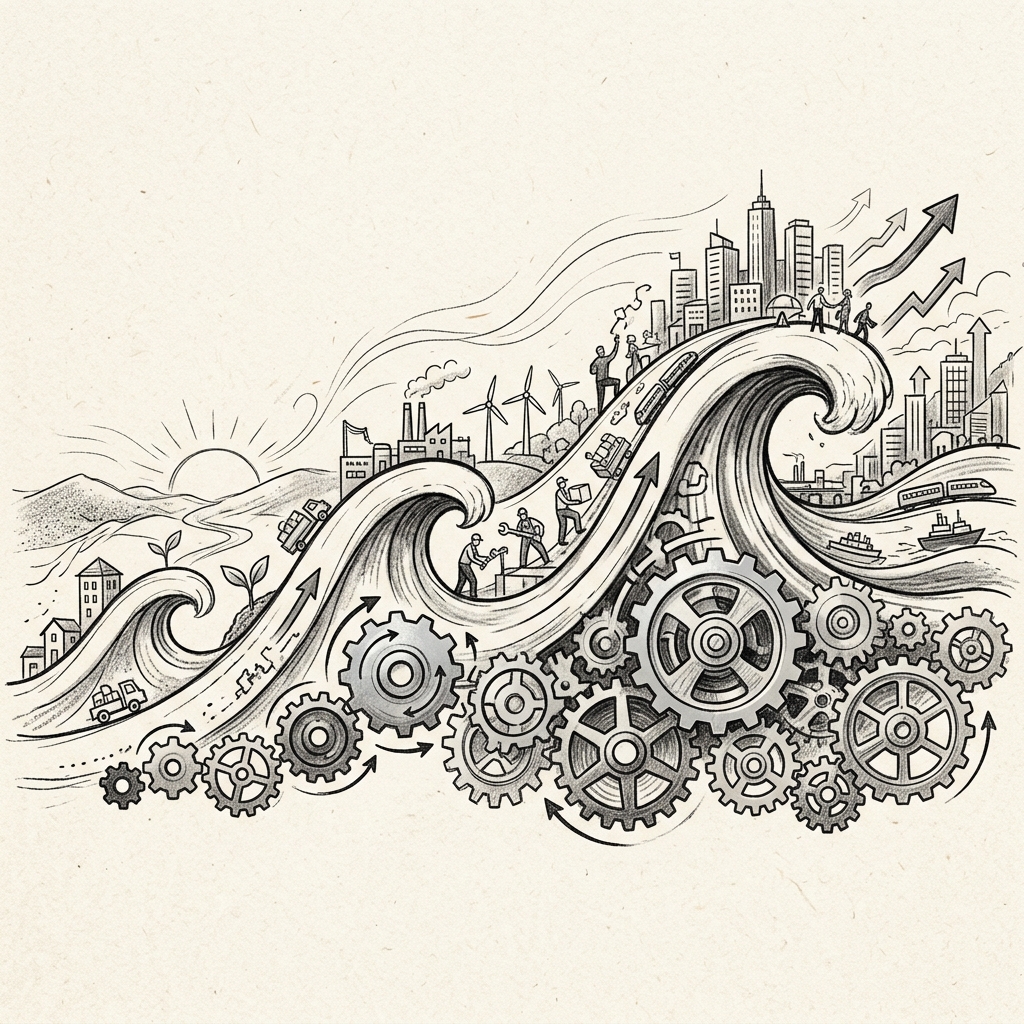
The Four Seasons of the Economic Cycle
An economy never moves continuously up or down in a straight line. Just like the agricultural cycles in nature, it experiences interconnected, predictable, yet irregularly timed seasons. You can imagine companies as farms managing their fields, storing supplies, or planting new seeds according to these natural seasons. This cycle is called the Business Cycle.
Spring: Expansion
Spring is the period when the snow melts, and the soil is revitalized. In the economy, this phase is the time when GDP shows continuous growth, unemployment drops, and people's appetite for spending increases.
- The Farm Analogy: Farmers (companies) see the weather warming up and decide to expand their fields. New tractors are purchased, and more seeds are planted.
- Corporate Action: During this period, securing loans from banks is easy. Companies increase their investments, build new factories, and aggressively hire new personnel. Sales increase day by day.
Summer: Peak
The summer months are when the heat is most scorching, and the harvest is most abundant. However, this abundance contains a hidden danger within itself: Capacity limits have been reached.
- The Farm Analogy: All fields are planted, and tractors are running around the clock. But there is no empty land left to plant. Irrigation costs have risen, and the working laborers have begun to tire.
- Corporate Action: The economy has reached full employment. GDP growth begins to stall. Demand is so high that goods cannot be produced fast enough, and prices rise rapidly (inflation). Companies achieve maximum profits, but their costs have also peaked.
Autumn: Contraction
Autumn is the period when leaves start to fall, and the weather suddenly turns cold. In the economy, this stage is the recession phase, where demand is suddenly cut like a knife, often due to rising interest rates.
- The Farm Analogy: Cold winds begin to blow. The farmer panics and stops expanding. To survive the winter, they store only the most essential products and send excess workers home.
- Corporate Action: Sales drop suddenly. However, companies' warehouses are full of goods (inventory) produced during the summer. Companies completely halt new purchases, begin layoffs to cut costs, and adopt a downsizing strategy.
Winter: Trough
Winter is the silent period when everything freezes, movement stops, and only the most resilient survive.
- The Farm Analogy: The fields are covered in snow. The farmer tries to survive solely on the supplies in the warehouse. Weak and unprepared farms collapse and are forced to sell their lands for next to nothing.
- Corporate Action: This is the most painful point of the economy. Unemployment is at its peak, and GDP has fallen to its lowest level. However, this period is also a cleansing; inefficient companies go bankrupt, market prices stabilize, and the system slowly prepares for spring once again.
Macro Impacts on the Corporate Balance Sheet
Macroeconomic cycles create direct mathematical consequences in the accounting books (balance sheets) of companies. Good management focuses not only on what it produces but also on the season in which it is producing.
Strategic Adaptation of Companies
To survive and maximize profits, companies must dynamically adjust their cash reserves and warehouse inventories according to these seasons:
- During Expansion: Cash in the vault is rapidly converted into raw materials and investments. Inventories are filled to the brim because everything will be more expensive tomorrow.
- During Contraction: Inventories are melted down and urgently converted into cash, even at a loss. In the middle of winter, warm cash saves lives, not products. Cash is king and is held tightly in the vault.
The boards of directors of companies act like the bridge of a massive ship. They instantly track how the weather outside is changing via GDP reports and open or close the ship's sails (investments) according to these winds.