The Harvest Strategy of Capital
A dividend is not a bribe paid to shareholders; it is a mathematical confession that the company has run out of new horizons to conquer, or that the cash will compound better in the hands of the investor.
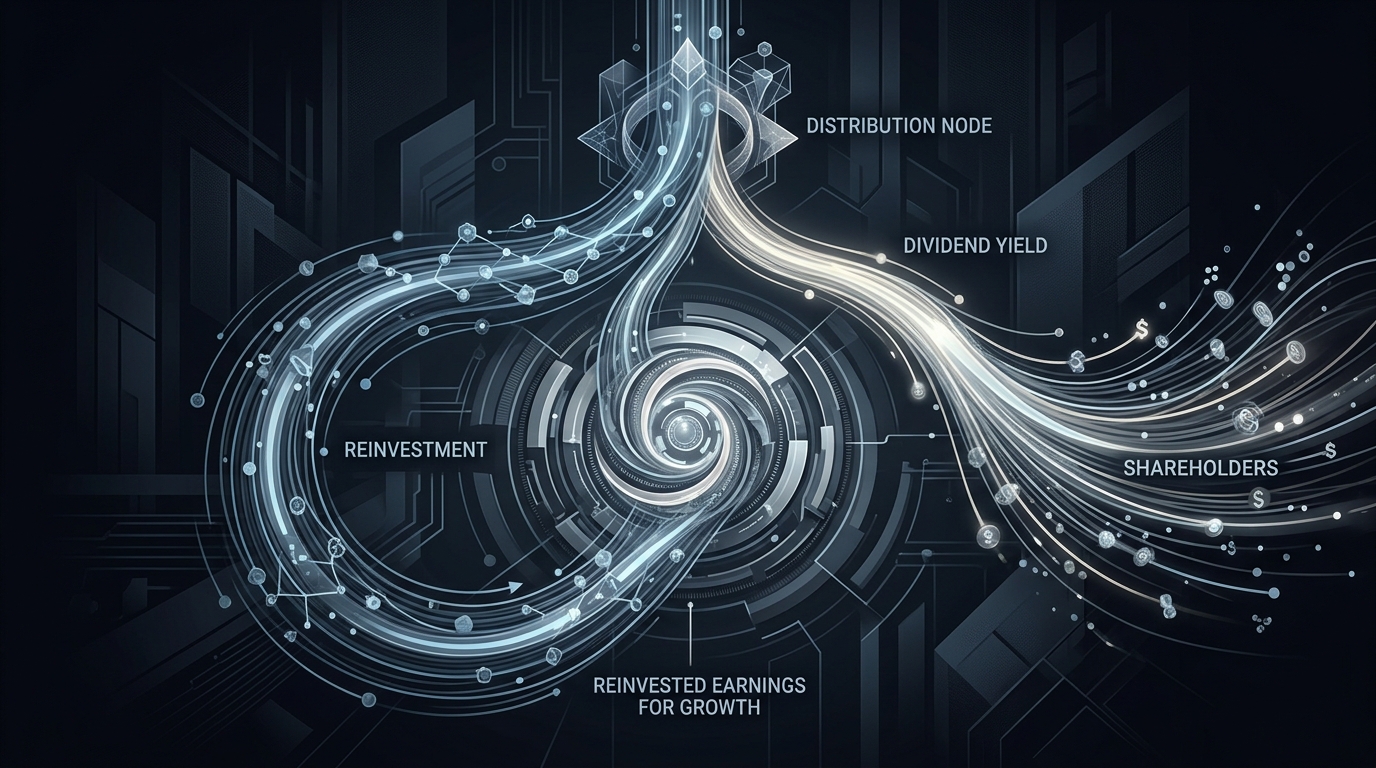
The fundamental purpose of any corporation is to multiply the capital entrusted to it. However, when a company generates a profit at the end of the year, it faces a massive strategic crossroads. Should this generated cash be kept in the corporate vault and reinvested into new factories and research-and-development projects, or should it be distributed directly into the pockets of the investors as hard cash? Dividend Yield and Payout Ratio are the two most critical metrics that solve this capital allocation equation.
The Payout Ratio: The Valves on the Corporate Vault
The Payout Ratio is the fundamental metric indicating what percentage of a company’s net income is distributed to shareholders as dividends. This ratio acts as the clearest signal of how confident management is in the company's future growth potential. If the payout ratio is zero or very low, management is essentially saying that they can generate far greater returns by keeping the cash inside the firm. If the ratio is high, the company admits that its massive growth phases are over and returns the excess cash to investors.
- Low Payout Ratio (0% - 30%): Typically seen in aggressively growing technology, software, or biotechnology firms. Earnings are kept inside (Retained Earnings) to fund new product development and capture market share.
- High Payout Ratio (60% and above): Mostly observed in established telecommunications, energy, infrastructure, and utility companies. Their cash flows are predictable and steady, but they lack massive exponential growth potential.
Consider a farming metaphor. Imagine you own a massive apple orchard and have a fantastic harvest (Net Income) this year. The Payout Ratio determines how much of that harvest you immediately sell at the market to put cash in your pocket, versus how much you set aside as seeds to plant new trees (corporate growth). If you sell all the apples, you are very happy today, but next year your orchard will not have expanded by a single inch.
Dividend Yield: The Rental Income of Investing
While the payout ratio reflects the company's internal decisions, the Dividend Yield directly measures how much cash an investor receives relative to the money they paid for the stock. It is calculated by dividing the annual dividend paid by the stock's current market price. This is mathematically identical to buying a physical house and renting it out; the yield is the ratio of your annual rental income to the total purchase price of the property.
- The Need for Fixed Cash Flow: Companies with high dividend yields are generally favored by pension funds or conservative investors who have transitioned into the wealth-preservation phase and require steady, risk-free cash flows.
- The Inverse Relationship of Price and Yield: If a stock price drops, and the company maintains its dividend payment, the dividend yield mathematically increases. Therefore, excessively high dividend yields can sometimes act as a dangerous value trap. The market may have driven the stock price down because it anticipates the company will not be able to sustain that dividend in the future.
Dividend Sustainability and Free Cash Flow (FCF)
The biggest mistake made in dividend analysis is focusing solely on accounting net income. A company may appear profitable on paper, but that profit might not have entered the vault as actual cash. Because of this, professional investors measure dividend sustainability through Free Cash Flow (FCF). If a company is paying out more in dividends than the net cash it generates from operations, it means the company is funding the dividend by taking on debt or selling off assets. This scenario is absolutely unsustainable in the long run and inevitably leads to a systemic collapse.