Financial Gravity and Synthetic Power
Speed acquired through borrowed capital becomes the greatest source of destruction when the tide turns; leverage is not a skill, it is merely a ruthless time machine that brings future consequences into the present.
One of the most fundamental rules of financial markets is taking risks that are directly proportional to your initial capital. However, institutional markets have developed synthetic mechanisms for those who want to grow faster and profit even from falling markets. These mechanisms allow investors to intervene in the market with power they do not inherently possess. Margin trading and short selling mechanisms grant ordinary market participants enormous leverage, but they also bring mathematical risks capable of collapsing the entire system upon a faulty decision.
The Anatomy of Leveraged Trading
Leveraged transactions are investments made by borrowing capital from a brokerage firm. It is the primary strategy used by companies or individuals with limited capital to open significantly larger trade volumes.
Capital Multiplication Mechanism
Leverage is a mathematical system that artificially increases the purchasing power of your money. For instance, when using a one-to-one leverage ratio, you can buy two hundred units of an asset with only one hundred units of your own capital. This directly doubles the profit you will make when the market moves upward. Just as companies in the business world use bank loans to expand their factories, investors similarly borrow from brokerages to expand their market positions.
- Purchasing Power Multiplier: The ability to manage a massive transaction volume by providing only a small collateral.
- Profitability Optimization: Exponentially increases the return on initial capital in a market moving in the correct direction.
- Opportunity Cost: Provides the flexibility to invest in other areas by freeing up a portion of the capital.
Risk and the Mathematical Cost
The greatest illusion of leverage is the belief that it only magnifies gains. In reality, the system works completely in both directions. A minor adverse movement in the market directly threatens the principal capital in proportion to the size of the debt taken. Because you are managing not only your own money but also the brokerage's money in a leveraged trade, the brokerage imposes ruthless rules to protect its own debt. The moment you start taking losses, your own capital becomes the strict guarantee for paying off your debt.
The Margin Call
The financial term for this ruthless rule is the Margin Call. When a position begins to lose money and this loss reaches the limit of eroding your deposited capital, the brokerage triggers an alarm. To protect the system, you are either required to urgently deposit additional cash into your account, or the brokerage automatically closes all your positions at a loss to recover its funds. This mechanism is the primary catalyst for the largest collapses in financial markets.
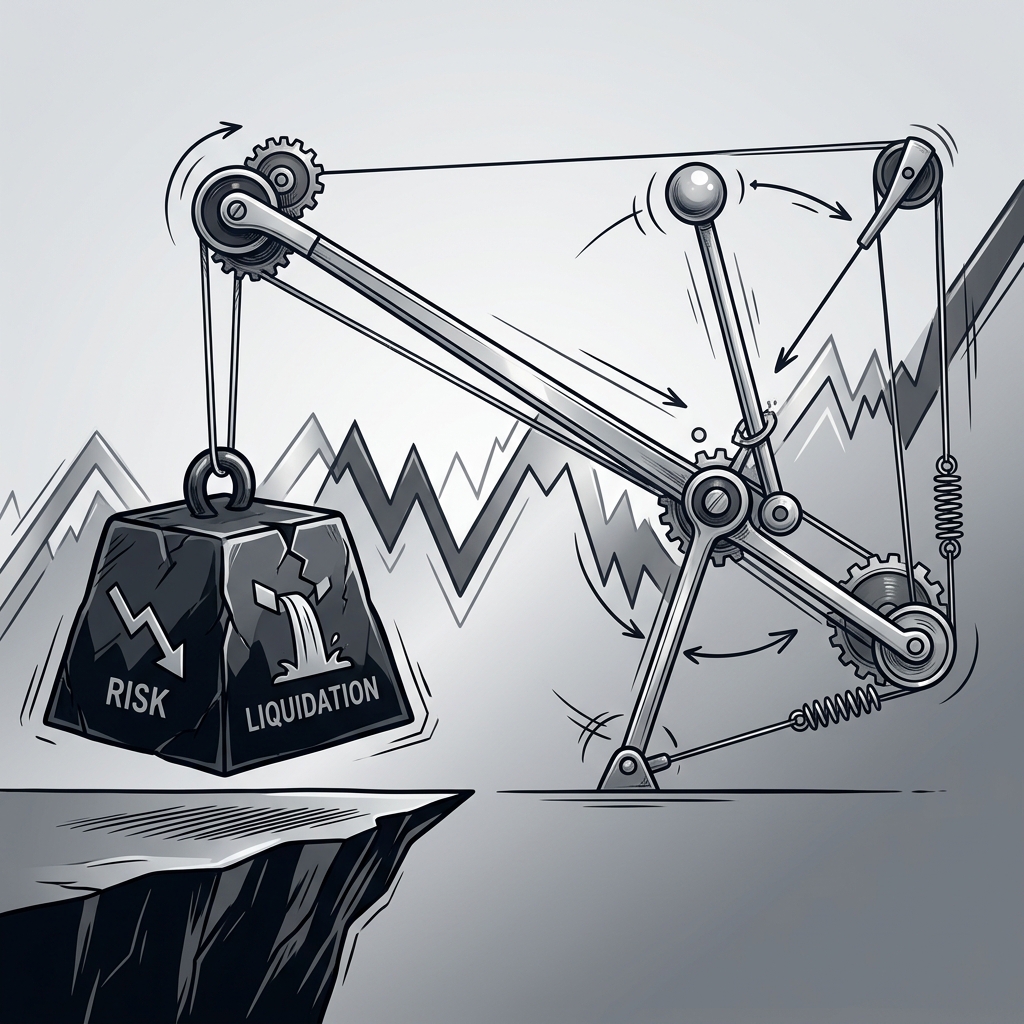
Leveraged trading can be thought of as using a long and sturdy iron crowbar to move a very heavy stone. Your own strength is not enough to lift that stone, but when you place a fulcrum under the crowbar and press down, you easily lift the massive boulder into the air. The iron bar here represents the debt you acquired from the brokerage. If everything goes right, you place the stone exactly where you want it. However, if your foot slips and the end of the crowbar escapes your grip, that massive boulder in the air slams back down, and the iron bar strikes you directly. What crushes you is not the stone itself, but the synthetic power you utilized.
Short Selling and Feeding on the Fall
In financial systems, money is not only made when prices rise. The short selling mechanism is a system that allows investors who believe an asset will lose value to trade on the downside and generate profit from market crashes.
The Borrow-and-Sell Cycle
Short selling is the process of selling an asset you do not own at a high price, then buying it back cheaply when the price drops, and pocketing the difference. When an investor anticipates a market decline, they simply borrow a certain amount of shares from the brokerage firm. They immediately sell those borrowed shares at the current high market price and put the cash in their pocket. At this stage, the investor owes the brokerage firm shares, not money.
- Borrowing Phase: The investor temporarily rents the asset they do not own from the brokerage's inventory while paying a commission fee.
- Selling High: They immediately convert the rented asset into cash by offering it to the market at the current price.
- Price Expectation: The rapid erosion of the asset's value and the market falling into panic is the investor's sole objective.
Short Covering
If the market truly falls as expected, the investor uses only a portion of the cash in their pocket to collect those same shares from the market at a much cheaper price. They close their debt by returning the repurchased shares to the brokerage, and they record the remaining excess cash as net profit. For the transaction to succeed, the asset must absolutely lose value.
The Infinite Loss Theory
The most terrifying feature embedded within short selling is that the risk has no mathematical limit. If you buy a stock, it can at most drop to zero, and you lose the money you invested. However, when you short sell and the stock price suddenly skyrockets instead of falling, you are forced to buy that stock from the market at a significantly higher price just to replace the shares you owe the brokerage. Because the price can theoretically rise to infinity, your loss potential is also infinite. In this scenario, the brokerage steps in again and pulls the plug on the system before dragging you into total bankruptcy.
To understand this system, imagine short selling as a trade you make with your neighbor's car. You borrow your neighbor's car for a few days and immediately sell it to a dealership for a high price. Your goal is that the car's model will lose value a few days later, allowing you to buy the exact same car from another dealership much cheaper and return it to your neighbor. The difference becomes your profit. However, after you sell it, if that car model suddenly becomes a collector's item and its price quintuples, you will be forced to pay that massive price to settle your debt (return the car) to your neighbor.