The Balanced Basket Architecture
True intelligence in investing is not attempting to outsmart market noise, but buying the average of that noise and surrendering to the quiet compounding of time.
The Mathematical Power of Diversification
The Difficulty of Fruit Selection and Singular Risks
An investor buying a single stock is akin to someone trying to pick the absolute best, sweetest single apple from a massive greengrocer. If that specific apple appears flawless on the outside but turns out to be rotten on the inside, your entire investment and expectations are wasted. Companies, as individual entities, can suddenly lose immense value due to management errors, sector-specific crises, legal problems, or rapid technological shifts. This is structurally known as idiosyncratic risk. Relying on a single company is like trusting a ship that only has one engine in the middle of a stormy ocean. When one part breaks down, the entire system collapses.
The Pre-Packaged and Balanced Fruit Basket
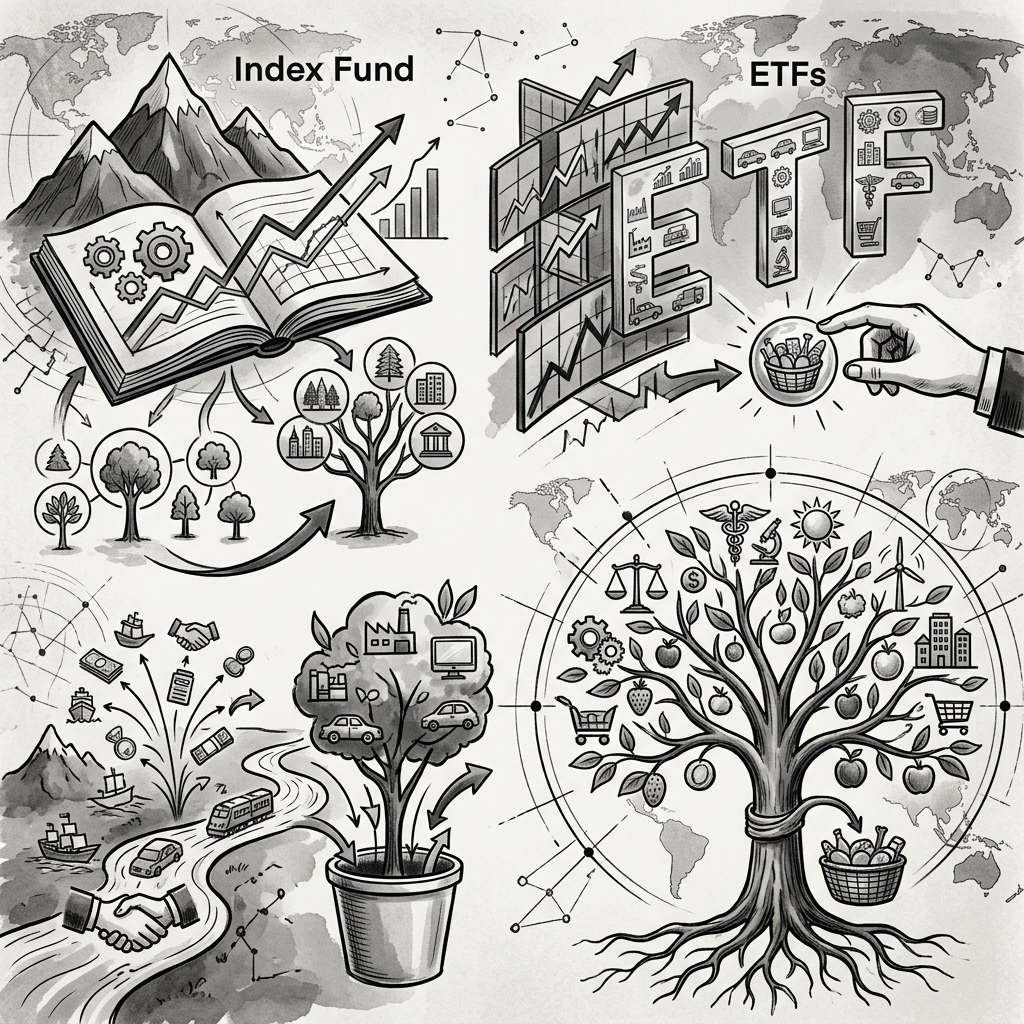
Index Funds and Exchange Traded Funds (ETFs) are structural financial vehicles that, instead of attempting to pick individual stocks, buy tiny pieces of all the largest and strongest companies in the market. These tools are like a pre-packaged, inexpensive, and perfectly balanced fruit basket made by taking a calculated slice of every single fruit in the store. Even if one company (one fruit) performs poorly, the strong performance of the hundreds of others balances out the loss. This basket structure, providing instant diversification within your portfolio, frees you from the fate of a single company and allows you to invest directly in the overall trajectory of the entire market.Optimization of Risk and Return
The fundamental rule of existing in the market is that the risk you take must always be proportional to your expected return. The basket architecture eliminates unnecessary risks from your system, allowing you to focus solely on the natural growth potential of the market. The investor does not try to guess which sector will perform better in a given year; they simply become a partner in the total progress of the broader economy.
Passive Management versus Active Management
The Logic of Copying Market Indices
Index funds mathematically and rigidly copy a massive list, such as the S&P 500, which contains the 500 largest companies in the world. The fund managers do not try to forecast which stock will go up or down tomorrow. They simply stick strictly to the mechanical rules of the list, buying a proportional amount of every company present in the index based on their size. This system completely eliminates human emotions, market fears, and forecasting errors, turning the investment process into an automatic, cold-blooded mirror of reality.
The Advantage of Low Costs and High Efficiency
In active management, highly paid analysts, researchers, and fund managers trade aggressively every day, attempting to beat the market. However, this heavy trading traffic, enormous research expenses, and manager commissions come back to the investor in the form of high expense ratios. In contrast, for ETFs adopting a passive management strategy, there is merely a simple computer algorithm running in the background to replicate the market index. There is no need for costly research or armies of highly paid analysts. Therefore, operating costs are incredibly close to zero. Over the long term, this low cost ensures that a much larger portion of your compound returns stays in your own pocket, exponentially multiplying the efficiency of your money.
Performance Tracking and Predictability
A vast majority of actively managed funds fall behind the performance of simple index funds over long periods. This is because beating the market consistently year after year is statistically almost impossible. Index funds, on the other hand, never carry the claim of beating the market; they simply become the market itself. This humble yet mathematically unshakeable approach offers investors a predictable, transparent, and sustainable growth map.
The Operational Dynamics of Exchange Traded Funds (ETFs)
Trading Convenience and Intraday Liquidity
Traditional mutual funds typically trade only once at the end of the day, based on a single price calculated after the stock exchanges have closed. This situation can create a handicap for investors who want to capitalize on sudden intraday price movements or those who need immediate cash. Exchange Traded Funds (ETFs), however, can be bought and sold instantly on the stock exchange throughout the day, exactly like a regular single stock, even though they contain hundreds of different companies inside them.
Transparency and Architectural Structure
ETFs deliver a massive, diversified internal structure with the simplicity of a single share and top-tier transparency. An investor can see exactly which companies are included in that specific ETF and the precise weight of each company at any given moment. This creates a unique operational advantage for modern investors who want to change their positions instantly while the market is open, shifting their portfolio to different sectors or countries in a matter of seconds. The inside of the basket is completely transparent, and the investor knows exactly what they are buying, down to the second.