The Mathematics of Debt Architecture
Taking on debt is not a weakness, but a mathematical lever used to pull time into the present; bonds are the global engineering of this lever.
Fixed income securities, commonly known as bonds, are the most fundamental financial instruments used by massive corporations and entire sovereign states to borrow capital from global markets. When a company wants to launch a massive infrastructure project, build a new manufacturing facility, or a state needs to construct a new highway network, rather than taking this enormous cash injection from a single bank, they collect it in small fractions from millions of investors. The primary reason they choose the bond market over traditional bank loans is that the investor pool is exponentially wider, allowing borrowing costs to settle at a much more favorable equilibrium. This colossal flow of capital is powered entirely by bond mechanics.
The Building Blocks and Working Principle
At its core, a bond is the official and legal proof of a loan you have provided to the counterparty (a government or a corporation). Unlike equity shares, you do not become a partner in the company's profits or losses; instead, you assume the position of a creditor seeking a fixed, predetermined return. This system does not operate randomly; the agreement between the investor and the borrowing entity is constructed firmly upon three structural pillars.
The Principal Amount
The principal is the foundational sum of money you lend to the government or corporation at the very beginning. When you purchase a bond, you are essentially transferring that amount temporarily into the treasury of that institution. This is the nominal face value printed on the bond and determined at the time of issuance. The enterprise takes this money, deploys it into its projects, and is obligated to return this exact amount to you when the borrowing period concludes. As long as the company avoids bankruptcy, this sum remains steadfast.
The Coupon Rate
The coupon rate is the periodic "thank you" fee the borrower pays you in exchange for the right to utilize your principal amount over a specified duration. At regular intervals, usually annually or semi-annually, you receive a cash payment based on this fixed, predefined percentage. These payments represent the steady income generated without touching the original principal until the bond officially expires. The term "Fixed Income" originates precisely from these unchanging, guaranteed periodic cash flows.
The Maturity Date
The maturity is the legal expiration date of this debt contract. When the maturity date eventually arrives, the borrowing institution makes its final coupon payment to you and closes the contract by returning your initial principal in full. Maturity periods can range widely from a few short months to thirty years. Following fundamental financial rules, the longer the maturity, the greater the uncertainty regarding inflation and default risks; therefore, the system must offer a higher yield (coupon rate) to persuade the investor to lock away their capital.
The Inverse Relationship Between Interest Rates and Price
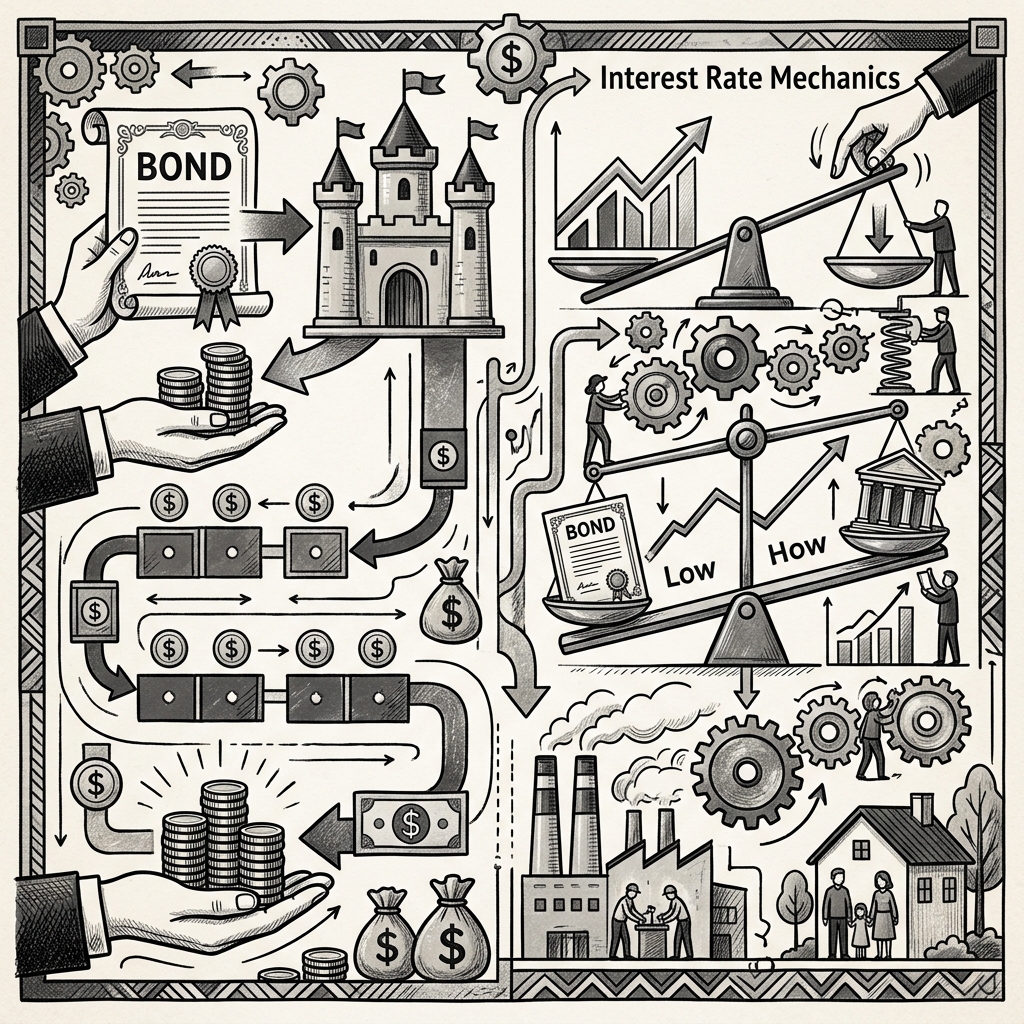
The most critical rule in the bond market—the one that dictates the largest capital movements and is essential to master—is the invisible yet unbreakable mathematical inverse relationship between macroeconomic interest rates and the prices of existing bonds. This correlation acts as the gravitational law of financial markets, and all institutional investment strategies are engineered around this exact equation.
The Competition Between New and Old Debt
Imagine you are holding a ten-year bond that yields a steady five percent annually. Suddenly, the central bank intervenes, raising interest rates and causing newly issued bonds to yield eight percent. Instantly, the allure of your existing bond evaporates. Why would any rational investor purchase your old paper yielding five percent for the same price when a fresh debt instrument yielding eight percent is readily available? Due to this immutable logic, when market interest rates rise, you are forced to discount (lower) the price of your lower-yielding bond just to be able to sell it in the open market. Rates go up, bond prices fall down.
The Bond as an Official Thank You Note (IOU)
To demystify this complex corporate borrowing mechanism and its seesaw effect, you can envision a bond as a formal IOU (I Owe You) given to a massive corporation or a state. On the day you hand over your cash, they hand you a beautifully decorated piece of paper. This paper essentially declares, "In return for this massive financial support, I will pay you a small 'thank you' (coupon) every single year." Once the promised time has completely elapsed, they place the exact original amount (principal) right back into your pocket without a single penny missing.
Price volatility only initiates when you attempt to hand this paper over to another investor before its expiration date. If the government is now distributing new "thank you" payments that are much higher than what your paper offers, the person buying your old paper will rightfully demand to pay a cheaper price for it. This continuous balancing scale between yield and price forms the absolute baseline dynamic of global debt architecture and fixed-income investing.